
0015 Now, let me re-examine Suarez’ three reasons for investigating ‘beings of reason’.
0016 (1) ‘Beings of reason’ are needed to know nonbeing.
If nonbeing is ‘not existent’, then why call it a “being”? Being goes with existence. How can being assist in knowing nonbeing?
0012 (2) The answer to that is by comparison. A nonexistent can be known by comparison to being. What does not existcan be compared to what actually exists.
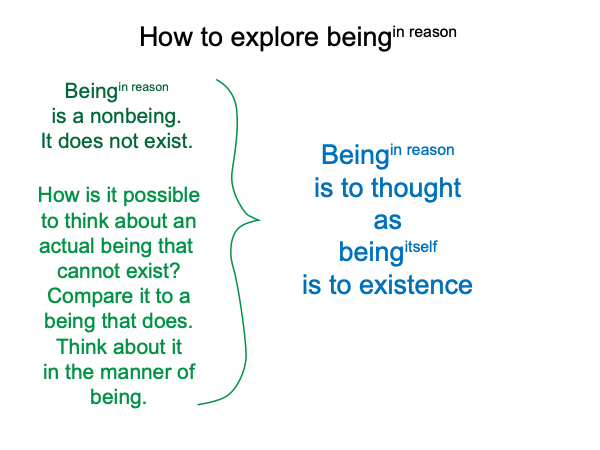
Today, this would be called “a thought experiment”. The thought experiment builds on a comparison. Beingin_reason is to thought (comparatively) as beingitself is to existence.
The question is: How is this comparison accomplished?
The answer is: A nonbeing can be regarded in the manner of being.
0017 (3) The ‘being of reason’ explains why humans can think of self-contradictions.
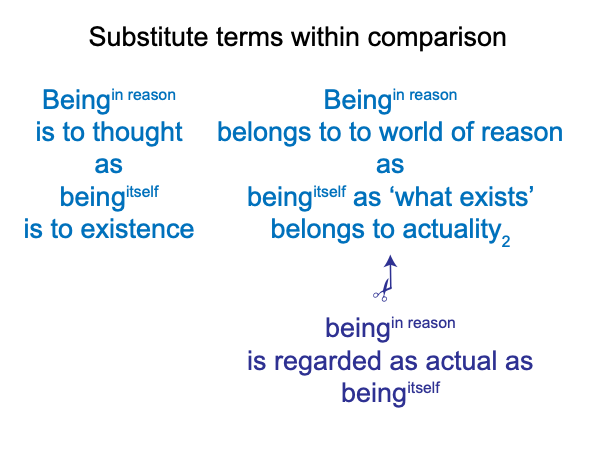
Reason goes with thought. Thought is ‘the world of reason’. Being is ‘what exists’. Existence is ‘the world of actuality’. So let me substitute these terms into the above equation and come up with an alternate way to express it.
‘This nonbeing (called “being of reason”) belongs to the world of reason’ (comparatively) as ‘being (what exists) belongs to the world of actuality’.
0018 To me, this sounds like an example of how humans think in self-contradictions. What I call “being” does not exist. It is a nonbeing. Yet, I can think of it as if it is actual, even though it does not exist.
What does this suggest?
One can explain why humans can think of self-contradictions by explaining the causes, natures and division of ‘beings of reason’.
0019 In discussing these three reasons for studying ‘beings of reason’, I present Suarez’s definition of a beingin_reason. A ‘being of reason’ is a nonbeing thought in the manner of being. It is a thought experiment. It is held, in thought, as a contradiction. This is the case for all thought experiments.