0117 Of course, humans are not like cows. Nor are humans like who we think they are. They are… um… the products of complicated evolutionary feedback loops.
0118 In section six, the author lists more than a dozen publications on the subject, setting the stage to propose his own heuristic framework.
0119 Fortunately, the author has the excuse of not being familiar with Razie Mah’s masterwork, The Human Niche,available at smashwords (and other e-book venues) in 2018.
Unfortunately, he already tried to reverse engineer Bourdieu’s concepts of “habitus” and “structure” into a framework reductive enough to fit the basic requirements of current evolutionary theorists. Current evolutionary theorists? These are the highly-credentialed academics who have yet to figure out that adaptation2H is not the same as phenotype2V even though both labels apply to the same entity2.
0120 I mean, really, current evolutionary theorists make fun of the proponents of intelligent design while sitting on an intersection as mysterious as the improbability of life itself. If a species2b‘ niche1b and its2b genome1b are made possible by an actuality independent of the adapting species2a and DNA2a, respectively, in the normal contexts of natural selection3b and body development3b, respectively, then exactly what rules out a Creator God from operating within the realms2a underlying the situation-level possibilities1b or within the situation-level possibilities1b themselves?
It is something to gag over.
0121 Meanwhile, this examination has already fumbled upon domestication-entanglement co-evolution as a possible manifestation of what the author is talking about.
The author proposes three components, or “nodes”, that influence one another: individual, group and community. With the manifestation at hand, “individual” labels both the ethnographer and the person as matter. The “group” corresponds to the narod. The “community” goes with civilization and the academies within it.
0122 Then, the author proposes that these mutual influences engage in feedback.
Then, the author illustrates the feedback using the example of sexual partnering.
The author chooses the term, “sexual partnering”, because the terms “mating” or “sexual activity related to reproduction”, are too blatant and annoying.
Nevertheless, even with the bland label, the example should pique the curiosity of any undergraduate.
“Sexual partnering”, indeed.
0123 This examiner will stay the course with the current paradigm of domestication and entanglement, modified by ambiguity, because the role of the cow and the role of the human now play out as mirrors of one another.
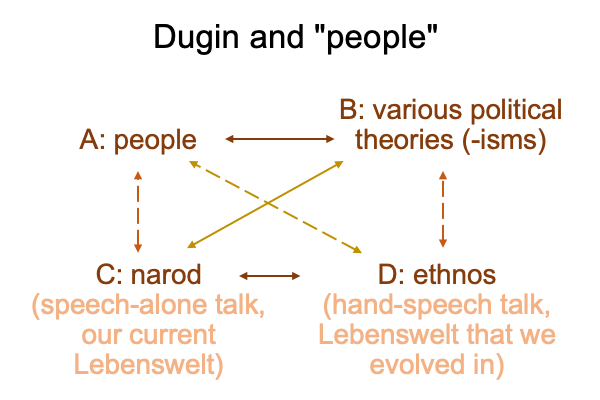
Even though this paradigm is not as… sexy… as the author’s example. It has the benefit of shedding light on the nature of the first singularity, where hand-speech practicing ethnos become speech-alone talking narods, thereby making the passage from the Lebenswelt that we evolved in to our current Lebenswelt.