0124 Section seven is titled, “Sexual Partnering and the Human Niche Framework”.
This section is accompanied by figures.
No, not those types of figures.
Rather, these figures illustrate the mutual influence of the “nodes” of individual, social group and community.
0125 That author starts with the individual.
Figure 1 is roughly re-illustrated here.
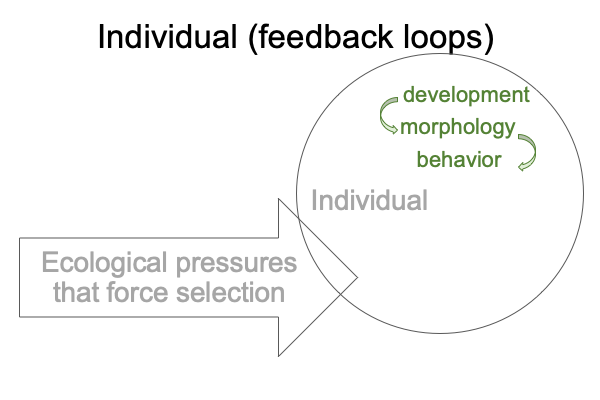
0126 The driver is an ecological or environmental danger or opportunity2a.
I suppose the niche is the circle, representing that the danger or the opportunity2a has the potential to produce adaptations (in development, morphology and behavior)2b.
So, the adaptation2a is portrayed as the threefold element within the circle (niche1b) and corresponds to how individuals adapt over generations.
So, the big arrow must associate to the environment of evolutionary adapatation2a, as well as natural selection3b.
0127 Can I associate this figure to the two-level interscope for Darwinism?
Here are my guesses.
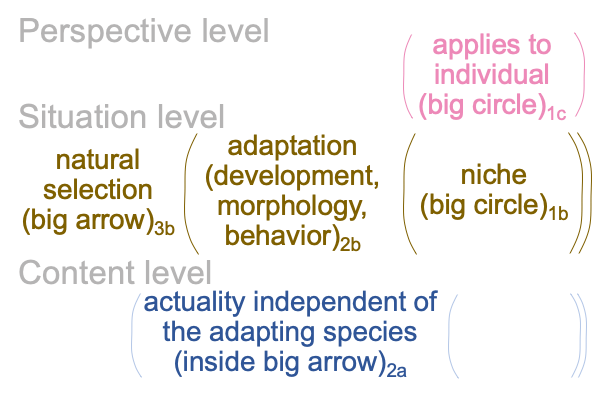
The normal context of natural selection3b brings the actuality of individual adaptations (in development, morphology and behavior)2b into relation with a niche1b, where the niche is defined as the potential of ‘something ecological’1b.
0128 The only caveat falls into the perspective-level potential1c. The adaptation2b potentially applies to the individual2a.
So, there are two double associations.
The big arrow associates to both natural selection3b and the actuality independent of the adapting species2a.
The big circle associates to both the individual (as the focus of inquiry)1c and the niche1b.
0129 Figure 2 (re-illustrated here) adds the social group (the second “node”) to the framework.
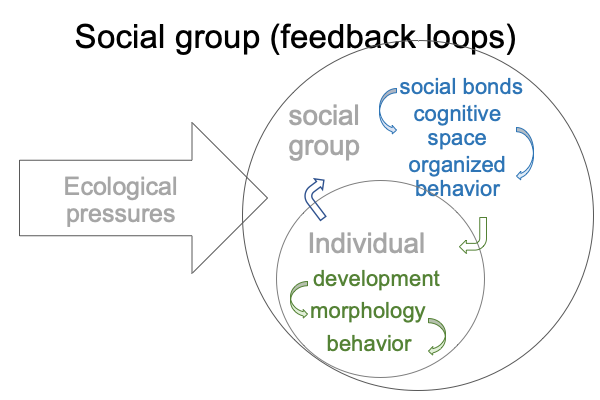
0130 So, let me start with the smallest social circle. While the chimpanzee roves in bands, the social circle under the greatest social pressure is family and friends. Family concerns maternal care, under conditions of individual foraging. Friends engage in grooming, literally picking bugs off one another. Plus, friends are allies in fights.
Three phenotypic features turn out to be adaptive to the social circle of family and friends. Personal bonding assists in questions of pecking order and who to look for at times of confusion. Cognitive space includes the ability to read signs calling for assistance, as well as signs of danger. Finally, both personal bonding and the ability to read the other hominin play roles in the organization of behavior of family and friends.
0131 The theory that male-female pair-bonding co-evolved with bipedalism applies here. Even though all hominin societies have some degree of promiscuity, the coincidence of male provisioning and female fidelity offers an opportunity for reproductive success for both sexes. Male provisioning makes food available for his female and her children. Female fidelity assures that the children are his (therefore contributing to his reproductive success).
These are difficult adaptations, because they engage a style of semiotics that really pays attention to intentional cues, the raw material of language. When a young male consistently offers food to a female, and expects fidelity in return, cultural feedback loops established within the band are crucial. The semiotics of long-term male-female pair bondingare vastly different than the semiotics of maternal care.
0132 Bipedalism is an adaptation to mixed forest and savannah. So, the hominids who can walk turn out to be best adapted to this new ecology, while hominids who retain the current chimpanzee style continue in tropical forests, where individual foraging does not conflict with walking long distances.
0133 This brings me to a crucial idea, implicit in figure 2, but not discussed in this article. The social circle under the most significant selection pressure changes during hominin evolutionary history.
0134 Here is a picture.
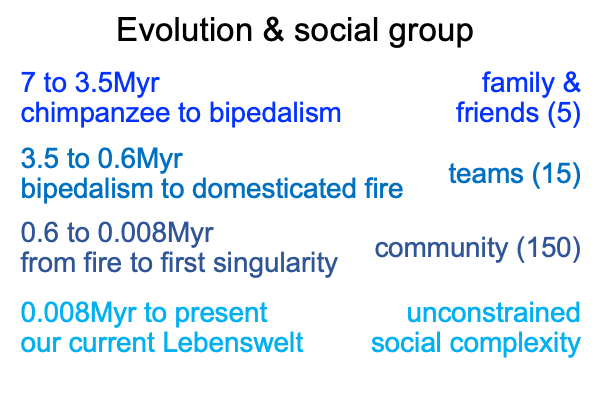
0135 The list on the left contains four evolutionary epochs. The first three define the Lebenswelt that we evolved in. The last labels our current dilemma.
Current dilemma?
You know, ours is a time when one civilization sends ethnographers into diverse narods, because there are no longer any ethnos to send them to.
0135 The reference is Comments on Michael Tomasello’s Arc of Inquiry (1999-2019), by Razie Mah, available at smashwords and other e-book venues. Michael Tomasello’s productive research years significantly overlap with Augustin Fuentes, so it is not surprising that both evolution-minded anthropologists are discussing similar ideas.
Razie Mah’s semiotic-oriented masterworks appear in this timeframe. An Archaeology of the Fall is first uploaded in 2012. How To Define the Word “Religion” is uploaded in 2015. The Human Niche is uploaded in 2018. These three works offer a Peircean vision of human evolution.