0094 Section four is titled, “‘Cultural Complexity’ and the Human Niche Approach”.
To recall, the author begins with three complaints.
One concerns the fact that anthropologists who train ethnographers tend to ignore (or are hostile to) evolutionary theory.
Two concerns the fact that evolutionary theorists have not formulated a schema that an ethnologist would be interested in.
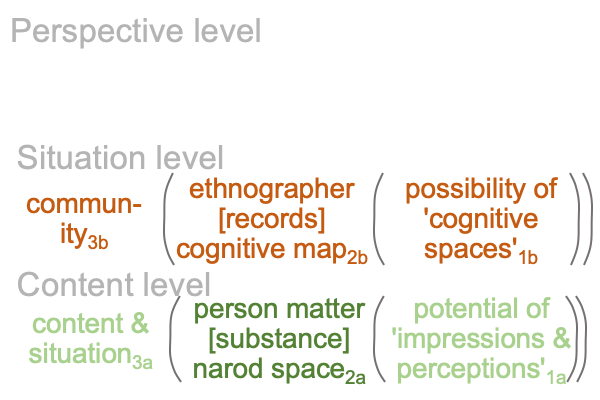
0095 In response to one, this examiner derives a two-level interscope where an ethnographer2b virtually situates persons in community2a.
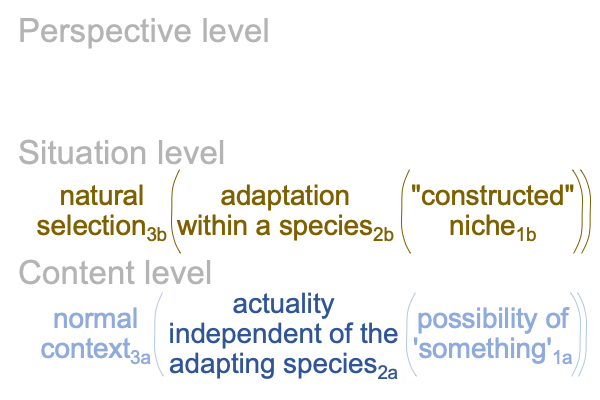
0096 In response to two, this examiner develops a two-level interscope for how niche construction works.
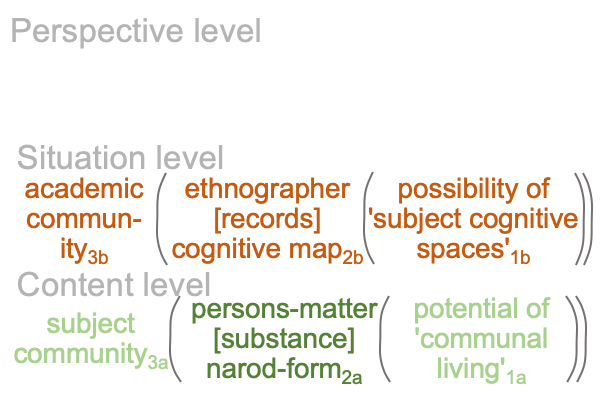
0097 The question arises, “How do these two two-level interscopes relate to one another?”
My initial view is that they are incommensurate. Communty3b compares to natural selection3b? That is nonsense.
But then, I look at the potentials. The possibility of ‘cognitive spaces’1b compares well to “constructed” niche1b.
Also, {the person as matter [substantiating] the narod space as form}2a could be an adequate description for an actuality independent of the adapting species2a (at least, as far as academic anthropologists are concerned).
0098 Perhaps, one or the other two-level interscope may be tweaked, so the narod subject belongs to the content leveland anthropology belongs to the situation level.
0099 Does this resolve anything?
For niche construction, the adaptation within a species2b introduces a normal context3a and potential1a to the actuality independent of the adapting species2a. This may substantially change the actuality2a. For beavers, a fast moving stream2a becomes a glen2a in the normal context of a dam3a operating on the potential of blocking the flow of water1a.
For the recording of communal… er… narodal cognitive spaces2b, the work of the enthnographer2b does not introduce a normal context3a and potential1a to the dyad, {persons as matter [substance] narod as form}2a. Unless of course, something goes horribly wrong.
0100 Instead, the subject community3a and its potential of communal living1a serve as the normal context3a and the potential1a for the narod2a. In other words, at first sight, the narod2a is an actuality independent of the enthnographer2ain the same fashion as the darwinian schema. Also, the narod’s normal context3a and potential1a are taken for granted.
0101 So, is the subject narod2a comparable to cows2a who can be milked for their cognitive spaces1b?
If so then the following implications apply.
In the case of the subject society2a, the narod2a becomes domesticated.
In the case of the ethnographer2a, the discipline of anthropology2a becomes entangled.
0102 The implications for both anthropology and human evolutionary theory are profound. Here is a comparison, pertinent to our current Lebenswelt, that may be in operation in the Lebenswelt that we evolved in.
0103 For our current Lebenswelt, we can look for parallels in history. What historical figures are like ethnographers? The Christian missionary comes to mind. So does Louis Althusser’s concept of “interpellation”. Oh, lest I forget, what about the ten ox-herding pictures in Zen?
For the Lebenswelt that we evolved in, I recall Dugin’s Greimas square, now relabeled for one of the key distinctions between who we are and who we evolved to be.
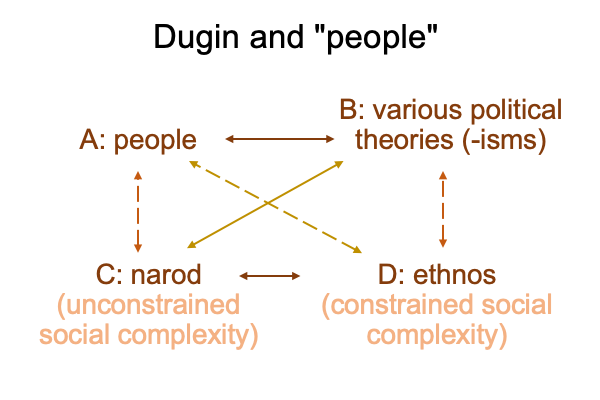
0104 The narod, the traditional society in our current Lebenswelt, is the subject of ethnographic inquiry. That traditional society may arise spontaneously within a people (as expected for civic society) or may come out of the mists of time. Either way, civilized people do not have an incentive to rope them in, so they maintain their traditional pre-political ways. The narod is the raw material that gets fashioned, through institutions and their theological and political theories, into a people.
0105 The ethnographer comes from the people. Each people, including those belonging to the discipline of anthropology, contrasts with the various political theories that interpellate and organize them.
0106 It makes me wonder, “What motivates ethnographic research?”
The narod may have labor and social specializations, but that is nothing compared to a people. Theological and political unity permit incredible specializations. These are the sources of wealth (labor) and power (social), which is the subject of inquiry in Looking at Slavoj Zizek’s Book (2024) “Christian Atheism”, serialized in Razie Mah’s blog for August 2025.
0107 But, what about the Lebenswelt that we evolved in?
Isn’t that where the adaptation that supports domestication and entanglement evolves?
Oh yes, according to Alexander Dugin, the ethnos is what the narod can never return to.