0074 What about genetics?
In section three, genetics enters the author’s picture of the Extended Evolutionary Synthesis.
It enters as a confounder.
0075 A confounder?
Consider the following two-level interscope. It looks almost identical to the two-level interscope for natural history.
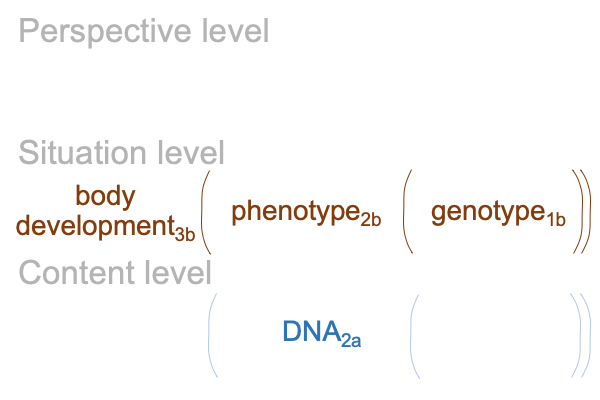
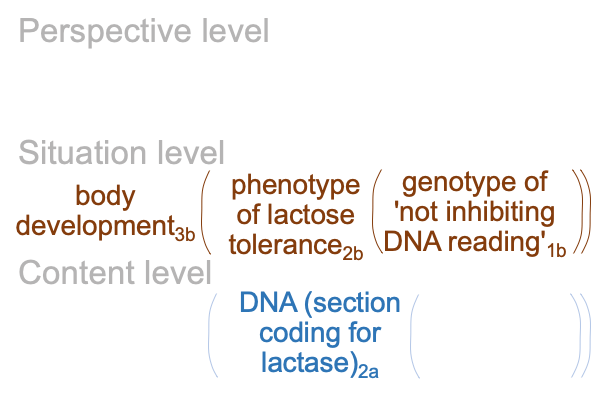
0076 The normal context of body development3b brings the actuality of a phenotype2b into relation with its genotype1b, where the genotype expresses the potential1b of an individual’s DNA2a.
The question is, “Can the actuality independent of the adapting species2a somehow influence the DNA2a or the way that the DNA is read1b?”
The answer is, “Yes, through natural selection3b.”
The influence is not direct. It is intersectional.
0077 For example, let me hypothesize that children are able to drink their mother’s milk because they produce an enzyme, called “lactase”, that is able to digest lactose, one of the sugars in mother’s milk. As the child is weaned, the need to produce this enzyme diminishes and by adulthood, the adult cannot digest lactose, because milk is not part of the diet.
0078 So, with the above figure in mind, the phenotype changes from childhood to adulthood. This makes perfect sense, because adults are quite different than children.
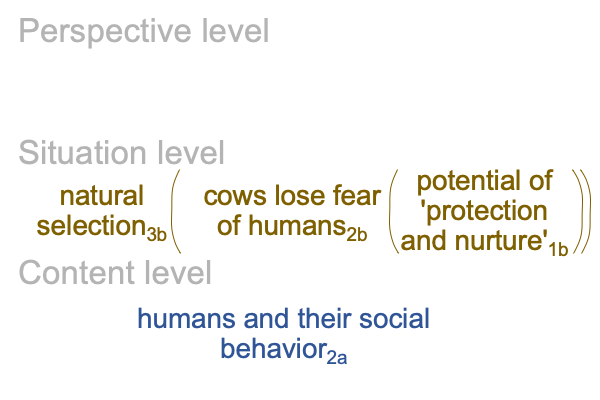
0079 Now, let me go back to the natural history version of the two-level interscopes and consider what happens when cows enter into the human household. At first, humans protect cows and then later, humans feed cows. That sounds like a good deal. In effect, humans are treating cows like other humans.
0080 Cows adapt by losing their fear of humans2b. One would not think that this is an adaptation2b, but it is. Plus, other adaptations take place. Female cows produce more milk2b. They do so with consistency. The bulls, on the other hand, get culled. So, the bull that does not ask to be culled is more likely to survive.
Here is a picture.
0081 From the humans’ point of view, humans adapt by retaining lactase production into adulthood2b.
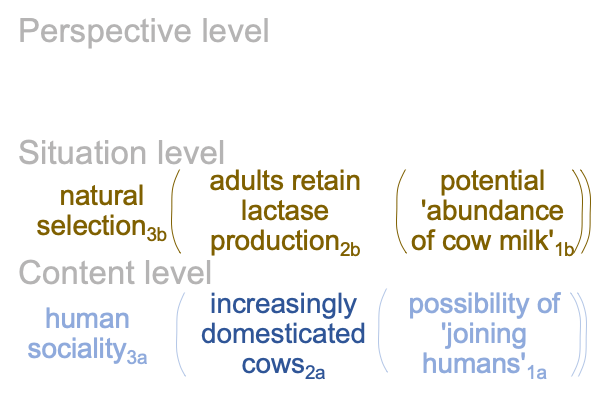
0082 Each adaptations entails an alteration of the phenotype, by way of intersection.
Consequently, genetics is a confounder in many discussions on niche construction.
For humans, the two-level interscope for body development3b changes over generations to produce a phenotype of adult lactose tolerance2b through slight changes in the way DNA2a is read1b.
However, changes in the genotype1b account for the change in phenotype2b, not the adaptation2b.
DNA already codes for the enzyme lactase. However, the expression of the code is regulated by proteins that lock onto the DNA. The particular protein that locks onto the lactase site on the DNA has a range of behaviors, so selection can occur on the basis of the production of lactase into adulthood. The adaptation2b entails a change in phenotype2b. The phenoype2b emerges from and situates the genotype1b, that is the potential1b of DNA2a. In this instance, the DNA2a(which varies among individuals) does not need to significantly change, only the genotype1b does.
0083 Unfortunately, biologists confound adaptation2b and phenotype2b even though each situation-level actuality2b has its own normal context3b and potential1b.
At the same time, confusion is expected, since adaptation2b and phenotype2b constitute a single entity, the species.