0087 This leads to a comparison of the virtual nested forms in the category of thirdness.
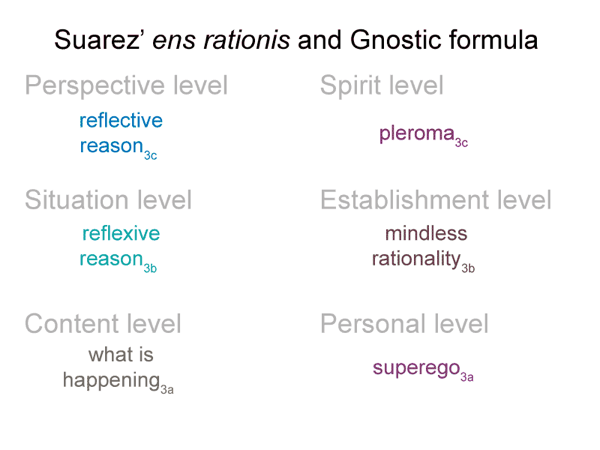
0088 This diagram suggests that any act that defies the superego will be processed as a normal context that defies reflexive reason that (in turn) goes with mindless rationality.
0089 Say what?
0090 The ego must remain responsible for the Self. The ego must be free to act in the Name of the Self.
0091 But, if the ego suppresses, manipulates, ignores and denies the Self, then that is not good either. Once the Self insists on getting attention, the person becomes hysterical.
The word “hysterical” derives from the same root as the scientific technical term “hysteresis”. Hysteresis occurs when a material cannot recover from an imposed stress. The Gnostic worldview plays on that image. Hysteria occurs when something immaterial cannot recover from an imposed material stress.
0092 Gnosis is called “secret knowledge”. The meaning of a Gnostic statement is never about what the Gnostic is talking about. Sophia is Personified Wisdom for exactly this reason. Look at the myth. Sophia birthed the monster who created the current age. At the same time, she aborted the same monster. She hid him in a cloud. Is that taking responsibility? Is that acting in the Name of the Self?
Is that personified wisdom?
0093 Here is the next question: What is the pleroma3c? How does it compare to reflective reason3c?
0094 Recall, in the Gnostic origin myth, the pleroma proceeds in aeons that culminate in Sophia’s Self-ish actions. Obviously, these emanations are not in the clouds that Sophia put Yaltabaoth in. I suppose that the male emanation that Sophia ignored remains outside the cloud. After all, she did not abort His child.
She aborted Her child, after she realized her child as an “alien being”.
Is that the same as an “inconvenience”?
0095 Also, what about the Monad?
In the example, the Monad presents the image of an ideal that will appear in the coming age. The coming age will be one where friends do not lie to one another. That sounds like a future emanation of the pleroma, but it cannot be so, because my life is happening in the cloud, hidden from the pleroma.
0096 What does this imply?
I suppose, the Monad must contain the future end point of each age within the cloud. The first pleroma ended in tragedy. A second pleroma is linked to that cloud where Sophia hides Yaltabaoth. The second pleroma is a mockery of the first. Each age in our current Lebenswelt ends as a farce of a passing aeon. Each age ends as one aborted Yaltabaoth replaces another.
0097 Why?
If the new age where friends do not lie to one another arrives, then it will become a new Establishment. It will manifest itself as a new Yaltabaoth. Plus, it will be as dysfunctional as the present Yaltabaoth, because people abuse and manipulate any set of natural laws and social regulations.
0098 So the next questions unfold. Who is Sophia? How is Sophia present in this world?
Before I address these questions, I return to Burfeind’s work.
Students should read chapters 2, 3 and 4 to complete Part 1.
0099 Consider the 13 traits of Gnosticism listed at the start of chapter 2.
The ego is concerned with material conditions. The ego exhibits responsibility and freedom.
0100 What happens when the material world is declared evil?
The good immaterial Self hears Sophia’s call to return to the Source. The Self must get around Yaltabaoth and the Establishment in order to do so.
0101 As far as the ego is concerned, the ways around Yaltabaoth and the Establishment are both unnatural (against the archons) and abnormal (against social tradition).
0102 Here is one way to get around Yaltabaoth and the Establishment: The ego uses language one way. Sophia uses language another way. Gnosis undermines the traditional vocabulary. Words gain alternate meanings. Ego-supporting institutions, such as marriage and church, are re-purposed.
The word “subversion” fits. The prefix “sub” means ‘below’. The word “version” is “one expression of events”.
Someone may ask me, “What is your version of the story?”
I may reply, “Well, I would like to live in an honest world, where friends do not lie to one another.”
0103 The subversion of the traditional meaning of words suggests that a version is being added below the surface version. Burfeind labels this subversion with the word “phantasm”.
The medieval scholastics used the term in the same fashion. “Phantasm” meant “what is going on in my head when I figure out me in the situation”.
0104 With Gnostic subversion, there are two simultaneous movements. Version corresponds to the ego. Sub- goes with the Self.
The ego version matches the word “reckoning”. The Self’s subversion matches the word “phantasm”.