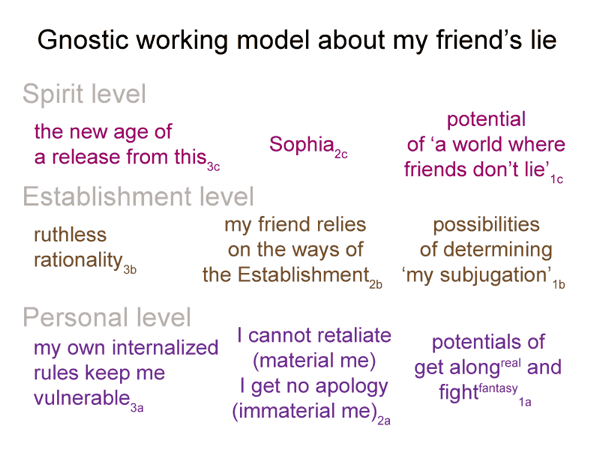
0065 I hear a voice, “This is all the work of Yaltabaoth and the evil Establishment. There is a way to get to a world where friends apologize for lying. I will send secret knowledge for you to fly to the Source.”
0066 Who is Sophia gesturing to?
She addresses my Self, my immaterial me, not in words, but in fantasy.
0067 This is very different than what Christianity offers. But, that is not my path at the moment.
Instead, for now, this claim is left to the student.
0068 I would like to examine the contiguity between the two elements of the content-level dyad in actuality. The technical term for this contiguity is a French word: renvoi.
What is the contiguity between accounting and encountered beings?
What is the contiguity between material (ego) and immaterial (Self) me?
0069 Of course, I cannot fully put these contiguities into words. The Real defies spoken language. Spoken language has to translate the Real into a system of differences. Spoken language cannot grasp the whole.
0070 Nevertheless, let me try.
0071 For Suarez’s model of ens rationis, the accounting being explains the encountered being. I can write the dyad as accounting being [explains] encountered being.
Of course, anyone can ask, “What do I mean by the word ‘explain’?”
I reply, “Look at the example. The accounting being of this is a lie explains the encountered being of my so-called friend’s behavior.”
The accounting being offers a form to what is happening.
0072 For the working model of the meaning underlying the word “Gnosticism”, material me takes responsibility for immaterial me. Obviously, my ego is free to act in the Name of my Self, because he dismisses my fantasy-induced feeling that I should get an apology.
My ego insists, “Oh no, forget that. It is too dangerous.”
I can write that as ego [takes responsibility for and is free to act in Name of] Self.
0073 Yet, no Gnostic will ask, “What do I mean by responsibility and freedom?”
Why?
The Gnostic already knows. Responsibility and freedom are projections of the evil and malignant Yaltabaoth and the Establishment.
The ego is in conflict with the Self. My ego represses, suppresses, manipulates, takes advantage of, denies, repudiates (and the list goes on and on) my Self. My ego is worried about this material world, not immaterial me.
Maybe, I can write this as ego [dominates and represses] Self.
0074 Now, let me compare the two renvoi.
0075 In Suarez’s model, renvoi ultimately makes sense of ‘what is happening’. Renvoi supports the situational-level idea1b that my friend is establishing that he can take advantage of me.
Renvoi is sensical. The idea that situates renvoi is perfectly sensible in a world where there is no human perfection. After all, Suarez wrote in a tradition holding the concept of Original Sin.
0076 In the working model of Gnosticism, renvoi frames concerns of material me over immaterial me. Renvoi supports the situation-level idea1b that my friend ruthlessly participates in the evil inherent in all material concerns.
0077 My Self wails, “All he wants to do is get ahead.”
0078 Renvoi is sensical. In addition, renvoi includes the trampled feelings that constitute my Self. Renvoi includes the practical fears of my ego. The idea that situates renvoi is sensible, not to Suarez’s formal (Christian) intellect2c, but to Sophia’s (Gnostic) call2c.
0079 The next question that goes with the story is: What if I lost it?
What if I yelled at my friend, “Why did you lie to me, you evil monster?”
That would be a mistake, because it would turn the situation against me.
My ego would not allow that possibility.
0080 This answer brings me to a comparison between Suarez’s model and the model of the Gnostic origin myth in the realm of possibility.
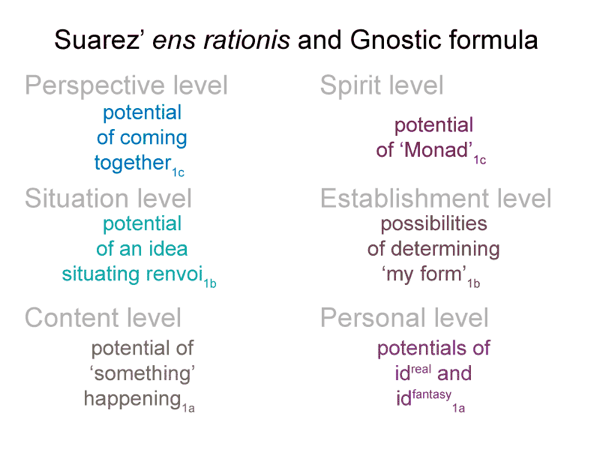
0081 These two virtual nested forms put the previous discussion into a nutshell.
0082 The senses are engaged in order to fulfill the potential of ‘something happening’1a. However, they are also tuned to the possibility of desire in the ‘something’ that happens1a.
0083 A contiguity between accounting and encountered beings (renvoi) informs an idea that underlies the efficient intellect’s projection of an accounting being1b
To complete the loop, the accounting being2a triggers and fills in the content-level nested form3a(2a(1a)).
0084 If the normal context is defined by my superego3a, then the content-level nested form determines my social predicament. My accounting being (my ego) explains my encounters in terms of who the world thinks I am supposed to be1b(3a).
The problem is: My Self2a is not who the world thinks I am supposed to be1b.
0085 For Suarez, the terminus is the potential of coming together1c in the normal context of reflective reason3c.
For Gnosticism, the terminus is the Source1c in the normal context of the inadequacy of this passing age3c.
0086 The potential for coming together1c says, “Pray for your friend’s conversion and forgive him.”
The Source1c says, “Utopia is a world where friends do not lie to one another. Ignore the material concerns of the world. Fly to me.”