0089 Situations may encompass several contents, one for each thing2a. Recall, the normal context3a for each thing is structure3a and the potential1a is ‘disposition’1a. Key to the process2cm is the fact that raw meat2af needs to be cooked.
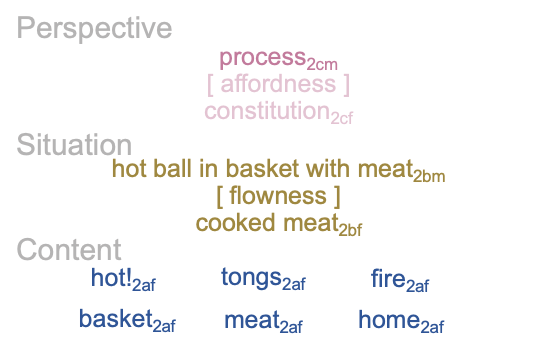
0090 Let me suppose the following.
A team slaughters one sheep and the family of each team member gets a cut. The archaeologist may build a model optimizing the slaughter of a sheep in terms of the number of families that get a cut of meat and organs. Surely, another team will tan the hide. Another team will process the bones for use as tools. Each team member has family and friends. Plus, each team member must make sure that the down-the-line processors get a cut.
This is why the situation-level forms entangles the perspective-level matter of “process2cm“. Humans depend on humans that know how to handle things. Even with an inconspicuous social hierarchy, social networks are active. Teams are crucial. Every child must compete to join one or more teams. The teams are specialized, not the individuals in the team.
0091 If some teams are more successful in obtaining calories than other teams, when why should a team cooperate with sharing their success with other teams?
That question could not be explicitly abstracted when Catal Hoyuk started. It could be explicitly stated before Catal Hoyuk ended.
The answer is that each team member shares success with family and friends.
0093 This question and answer is outside of the scope of Hodder’s conceptual apparatus. A sociological version of “entanglement” is simply not sufficient to ideate the noumenon that is responsible for the phenomena of an archaeological excavation, especially for a site such as Catal Hoyuk, which begins in one Lebenswelt and ends in another.
0094 Hodder reaches for something that he cannot quite grasp. In a subsection of S2C2, titled “reflective and non-reflective relationships with things”, the author discusses the distance between practical, everyday experience (such as cooking with hot little noumena) and abstract reflective thought (such as what occurs after the cook drops a hot clay ball and it rolls towards the pillar supported by the skull of the cook’s father, which reminds her of her brother, who has a sick child and cannot – by taboo – participate in today’s sheep slaughter, even though he is a member of the team).
0095 Forget the qualifier “abstract”. The qualifier should be “socially constructive”. The wayward ball may have been the ancestor’s way of reminding the cook to socially construct her brother’s condition into the process of dividing the cooked meat. There are always more mouths to feed than any slab of meat can accommodate. Happily, today’s hunk of meat is large. She puts an extra ball into the fire.
She knows that she is a little clumsy with the tongs.
0096 She is both cooking and engaging in reflective thought.
Here is a diagram.
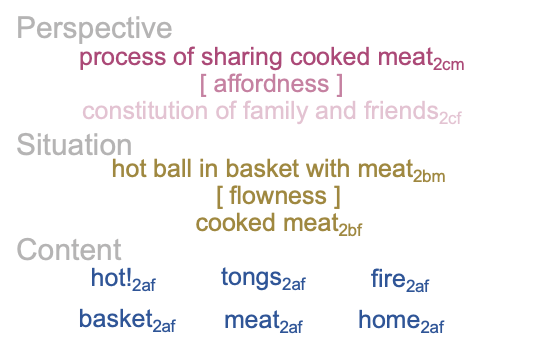
0097 Note how the biological sounding term, “affordance”, is the contiguity between process2cm as matter and consitution2cf as form.
My example has already given away the fact that the perspective-level form2cf will entangle matter2am that brings the story back to the content-level. The cook’s family and friends are already constituted from prior affordances. Yet, the rolling of the dropped hot clay ball serves as a reminder. Think about your father, whose skull holds up this house.