0098 In S3C2, the author admits that the perspective-level thing2c is hard to imagine.
Years of corporate indoctrination… er… “education” have beat the potential to ‘contextualize identity3b and structure3a‘ out of us, only to insert other postulates of inevitability.
The author’s example is a tourist finding a lovely pebble on the beach during a stunningly beautiful sunset. The pebble marks a moment. Heidegger labels the moment “Dasein”.
The English translation is “You had to be there.”
0099 The tourist takes the pebble home, and places it on a tray of travel momentoes in the curio display cabinet.
Perhaps, it is unremarkable among the other travel momentoes. The sunset was so beautiful that it lingers in the tourist’s dreams.
0100 Following the previously developed three-level interscope, here is a diagram of Hodder’s example of “reflective thought”.
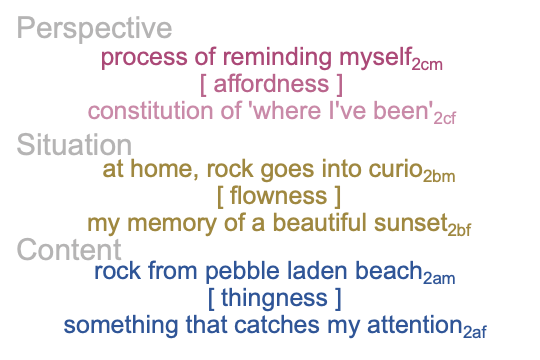
0101 Notice anything interesting?
Where are the tourist’s family and friends?
0102 I guess that you had to be there.
The luminosity of Hodder’s theory of entanglement cannot be dimmed by the author’s sociological breakdown of HT, TH, HH and TT distinctions. But, it can be parodied by examples such as this.
0103 The constitution of ‘where I’ve been’2cf stands for little items that I’ve collected and placed in my curio2am.
Plus, the curio cabinet as a ritual location for my travel memories2af stands for the principle that ‘my travels have made me who I am’2bm.
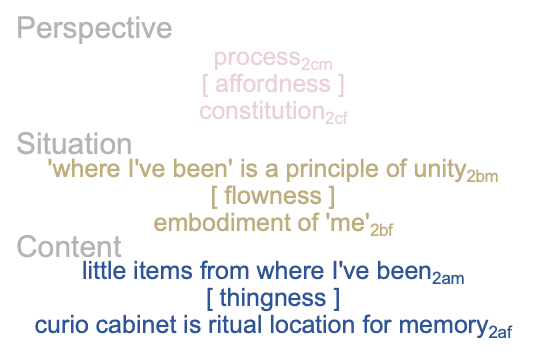
0104 How pathetic is that?
0105 Martin Heidegger (1889-1976) lives through the Second Battle among the Enlightenment Gods, the Hot War among Fraternal Ideologies (1939-1945) as the pre-eminent philosopher in Germany. He gets tagged with working for the losing side. Now, Hodder testifies that Heidegger was wrestling with issues relevant to eighty years in the future.
0106 How does one describe the substance of thingness?
Does the German label, “Dasein”, suffice?
Does the label, “ready to hand”, portray the way that flowness situates thingness.
Does the label, “present to hand”, portray the way that affordance contextualizes flowness?
Peirce’s categories provide a new “language” for speaking the terminology of Martin Heidegger… and… Ian Hodder, for that matter.
0107 Heidegger pays no attention to the writings of the obscure American, Charles Peirce (1839-1914). He has an excuse. He lives in Germany during a civilizational crisis.
Alfred North Whitehead (1861-1947), trains in and teaches mathematics in London before he accepts a professorship at Harvard in 1924 (at the tender age of 63). Harvard University gave him an office near where Charles Peirce’s handwritten papers… er… “unpublished manuscripts” were kept. In 1927, Whitehead publishes Symbolism: Its Meaning and Effects and delivers the Gifford Lectures that are later edited into the volume, Process and Reality. These are the topics of interest to Hodder.
0108 Some of Peirce’s papers were purchased in 1914 by Josiah Royce (1855-1916). When Royce suddenly died… well… that put an end to his efforts. Peirce’s copious notes remained in an office at Harvard.
Replace the terms “little items” and “curio cabinet” in the above figure with “Peirce’s unpublished manuscripts in various empty offices” and “trunks stored in the library at Harvard University”, then adjust the narrative accordingly.
What if… like in a science fiction story… you had access to a curio cabinet where the tokens of memory told their stories to whoever picked them up?
Could anyone become family or friend?
0109 Section three of chapter two (S3C2) considers previous accounts of human dependence on things. The author breaks his discussion into three topics. The list of authors is not exhaustive.
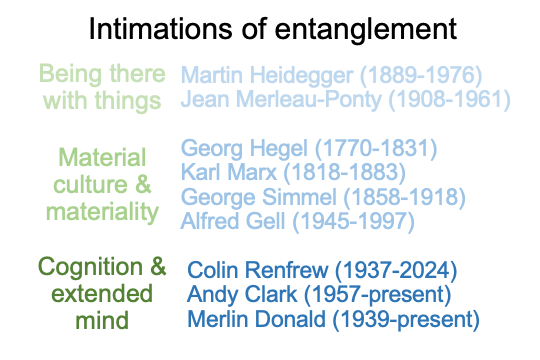
0110 Being there with things concerns phenomenology. “Phenomenology” transliterates into “the logos of phenomena”. This seems strange, because this “logos” (the “word”, so to speak) is the noumenon. To me, Hodder’s treatment of entanglement, including the HT, TH, TT and HH dependencies, does not pose a mechanical or mathematical model. It offers a guess as to what the noumenon must be. Once the noumenon is clarified, then its phenomena can be observed and measured, resulting in positivist models.
0111 Material culture and materiality includes both Hegel’s thing and Marx’s thing, as well as later proposals by Simmel (on social interaction) and Gell (on agency). In the following, I will only discuss Hegel and Marx.
Why?
They are entangled.
0112 Cognition and extended mind proposals are formulated while regarding recent advances in the neurosciences. Neuroscience research is laboratory-oriented and may regard the human brain as matter and cognition as form.
0113 To me, the brain-cognition thing associates to – what Hegel called – spiritual arrangements. It is just like the hot clay ball rolling towards the one pillar of the house that is “supported” by the skull of the cook’s father, recovered after decomposition, then covered with plaster.
One cannot deny the material arrangements of cooking a slab of meat. At the same time, the rolling ball signifies another situation, where her brother’s son is like the rolling clay ball and her brother must now deal with it. The agency of the ball speaks in tongs.