0157 Chapter three (C3) concludes with a set-aside description of the archaeological site (anglicized to) Catal Hoyuk, located in central Anatolia (Turkey). The site flourished between 7400 and 6000 BC. An adjacent site (Catal Hoyuk West) started around 6000 BC and ended around 5500 BC. At its peak, the settlement is very large, but it has no streets. People traveled to their homes by walking on roof tops.
0158 Dr. Hodder was in charge of the excavation for many years. His publications on this topic span from 1996 to 2022.
0159 Catal Hoyuk consists of houses with refuse or midden sandwiched between them. There are no public administrative centers. There are no ceremonial platforms. There is plenty of evidence for a spiritual dimension in the people, because they buried their ancestors beneath their floors and adorned their walls with bones of bulls.
0160 In terms of the archaeological periods for the Levant, Catal Hoyuk corresponds to the pre-pottery B and C periods as well as the Pottery Neolithic. Radiocarbon-14 dating has been used to establish a time frame for twelve levels and four “pre-levels”.
0161 A distinct change occurs with respect to pottery. Levels XII through X (say, 7100-6700 BC) contain little pottery, even though clay balls are used for cooking. Levels IX and VIII are difficult to assess. Cooking pottery is apparent in level VII (around 6610-6520 BC). At the same time, there is a shift in building material (to sandier bricks).
The site seems to prosper in levels VII and VI, reaching its greatest density and house packing. Then, there is a break, followed by the building of more elaborate houses, with areas devoted to storage and production. Stamp seals are found. The range of pottery types expands. After level V (say, 6300 BC) there is evidence for the domestication of cattle (definitely for Catal Hoyuk West) along with more intensive use of the secondary products (milk and wool) of sheep and goats.
0162 The placement of the special section on Catal Hoyuk is interesting.
It comes after chapter two (C2, “Humans Depend on Things”) and at the end of chapter three (C3, “Things Depend of Other Things”).
It comes before chapter four (C4, “Things Depend of Humans”) and chapter five (C5, “Human-Human Entanglement”).
0163 Does the author unwittingly signal a transition in the human Lebenswelt, from a Lebenswelt that is evolutionarily ancient (marked by implicit abstraction) to a Lebenswelt that is technically novel (marked by explicit abstraction)?
0164 I think so.
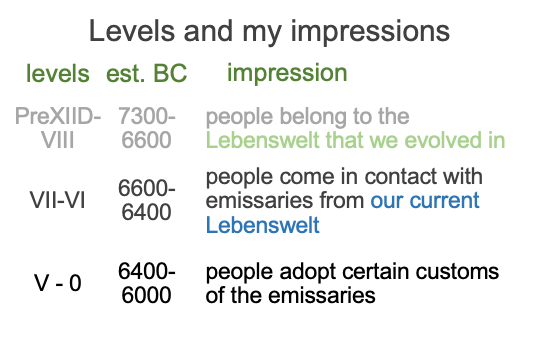
Here is my breakdown of the levels at Catal Hoyuk, estimating the (radiocarbon) dates from the figures in C3.
0165 Why do I suggest this possibility?
Where do these emissaries from our current Lebenswelt come from?
0166 The scientific proposal is found in Razie Mah’s e-work, The First Singularity and Its Fairy Tale Trace. A dramatic exposition is found in An Archaeology of the Fall.
0167 Nonetheless, I offer a brief synopsis.
The hypothesis of the first singularity has two parts (P and Q).
0168 First (P), fully linguistic hand talk evolves after the domestication of fire, around 600kyr (thousands of years ago). It is an adaptation to the social circle of the community, the team of teams. See Razie Mah’s e-works The Human Niche (plus attendant reviews) as well as the two-part Comments on Michael Tomasello’s Arc of Inquiry (1999-2019). These were placed on sale in 2018 and 2024, respectively.
0169 Speech is added to hand talk with the evolution of our species, Homo sapiens, around 300kyr. The voice is initially added to hand-talk as an adornment. Then, speech begins to take on a life of its own, because the semiotic qualities of speech are significantly different than hand-talk. By the time when animal and plant domestication begins (maybe 15kyr), speech talk and hand talk are two complementary modes for talking. I call this “hand-speech talk”. The use of voice or manual-brachial gesture depends on tradition.
For a reference, consider Razie Mah’s e-work Synaesthesia and the Bicameral Mind in Human Evolution, editing Mah’s blogs from October and November, 2025.
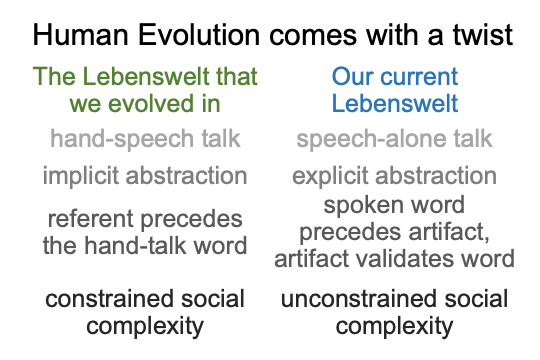
0170 By 10kyr, all human cultures practice hand-speech talk and have been doing so for as hundreds of thousands of years. These cultures belong to the Lebenswelt that we evolved in. Hand-speech talk exhibits the semiotic qualities of icons and indexes and facilitates implicit, rather than explicit, abstraction.
0171 Crucially, hand-talk words are not labels. They are images and indications. Therefore, the referent precedes the hand-talk word in such a fashion that its attributes enter into word meaning. For example, the hand-talk word, [image RAVEN], may indicate a type of bird or the color black, depending on the context. The linguistic dynamics of hand-speech talk have not been investigated because… well… all civilizations practice speech-alone talk. Only a few monographs have been published on the (last remaining and maybe already dead) hand-speech languages of the North American Plains Indians and the Australian Aborigines.
0172 I am still on the first point (P).
In contrast, speech-alone talk is fully symbolic. It cannot picture or point to its referents. So, humans in our current Lebenswelt have followed a script, based on their phenotypic expectations about the nature of reference in hand talk. If a spoken word exists, then there must be a referent. This is precisely the expectation that phenomenology relies on, when someone (such as Ian Hodder) proposes a word, such as “entanglement”, as a label for the form of four dependencies: HT, TT, TH and HH.
0173 Here is a picture of the difference between the Lebenswelt that we evolved in and our current Lebenswelt.
0174 Second (Q), the cultural transition from hand-speech talk to speech-alone talk must have an “initial moment”, so to speak. No one thinks, “Why do we keep practicing the hand-component of our hand-speech talk?”, because every important word in that question is an explicit abstraction.
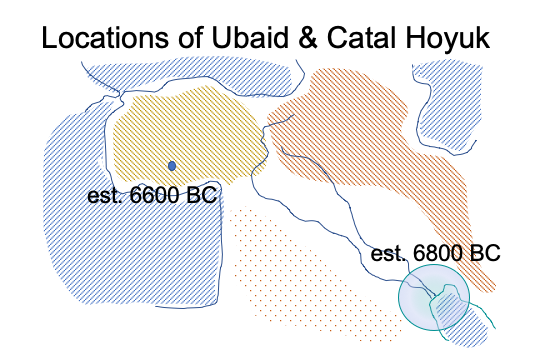
0175 Razie Mah identifies the Ubaid of southern Mesopotamia on the basis of a sequence of speculations. One culture forms from two hand-speech talking cultures originally living in the dry land of what is now called the… um… “Arabian”… or is it “Persian”?… Gulf. That dry land is flooded with the rise of the seas, with a nominal date around 6800 B.C. The two cultures, forced into the same territory, on the edges of the rapidly expanding Gulf, fuse, creating a pidgin, then a creole, the Sumerian language. This creole is the first language based on speech-alone talk.
The Sumerian language is called an “isolate”, because it is unrelated to any family of languages. This is what one expects for a creole.
0176 Now, I can jump to Dr. Hodder’s research, because the crucial transition starting in level VII occurs only 200 years after the fastest rise of the sea levels that, for Mah’s hypothesis, marks the constellation of the speech-alone talking Ubaid culture.
0177 Level VII may indicate first contact with speech-alone talking emissaries from a culture that is already more wealthy (from labor specialization) and more powerful (from social specialization) than the hand-speech talking culture of Catal Hoyuk. Plus, they bring pottery. They want to spread the word, along with a few recipes.