0189 To me, the author – not even consciously – transits from a world where families build their own homes in a marvelously productive location (C2 and C3) to a world where social and labor specializations create things that depend on their… um… continued interventions to prevent the created things from falling apart (C4 and C5).
What was once an intrinsic manifestation of the three-level interscope of thingness, flowness and affordness shifts to extrinsically arranged specialties organized to maintain cultural traditions.
The intuitively obvious transitions into entrapment.
0191 The disciplines that deal with these topics include behavioral archaeology (S3C4) and material science (S2 and S3, C4).
0192 For example, these sciences try to figure out how the people of Catal Hoyuk dealt with refuse. These experts see attempts at refuse organization throughout the Levant in the PPNB. House floors are swept clean. Middens outside the settlement are established. This occurs without signs of social or labor specialization, long before the Ubaid of southern Mesopotamia appears on the scene.
0193 Behavioral ecology (S4C4) studies the domestication of plants and animals. Plant domestication is well underway before the sea-level rise. Cereals, lentils, fruit trees, and tubers respond to selective use and care by humans, consistent with Darwinian analysis. Humans offer a novel niche to plants and animals, because a relation with humans is an actuality that is independent of each adapting species. Plants and animals, in turn, offer niches for cultural adaptations.
One hand washes another, even in the biological realm.
0194 Mutuality is not exclusive to humans and plants and animals. For example, certain predatory fish will allow small grazing fish (otherwise an easy meal) to nibble parasites off their exteriors. It is a win-win situation. The predator gets rid of parasites. The grazing fish gets a meal and does not serve as a meal.
Of course, humans take “mutuality” to a whole new scale.
0195 Humans give food to the animals. Every type of animal is different. The humans read the signs that the animals offer.
A vast literature in behavioral and evolutionary ecology can be used to understand the phenomena of domestication. To me, these phenomena are observable and measurable facets of human adaptations to specifying and exemplar signs, which dwell within the three-level interscope that associates to Mariusz Tabaczek’s inquiry into classical and contemporary hylomorphism (points 0004 to 0012).
0196 In the following diagram, the specifying sign is rendered in light red and the exemplar sign is rendered in light green.
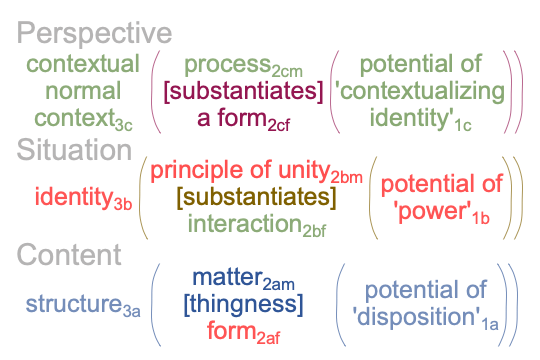
0197 In the specifying sign, a content-level form2af (SVs) stands for situation-level principle of unity2bm (SOs) in regards to identity3b operating on the potential of ‘power’1b (SIs).
In the exemplar sign, a situation-level embodiment2bf (SVe) stands for a perspective-level process2cm (SOe) in regards to a perspective-level normal context3c operating on the potential of ‘contextualizing identity’1b (SIe).
0198 For example, sheep perform a submission gesture, making it easy for humans to figure out how to become a leader of sheep. The sheep recognize their shepherd. Sheep are disposed to submit. The human whose identity3b is the shepherd2bm has the power1b to lead the flock2b on the basis of the way that he is able to read submission gestures2af.
0199 Animal domestication involves s human becoming pack leader and taking responsibility1c for feeding and protecting his flock2bf.
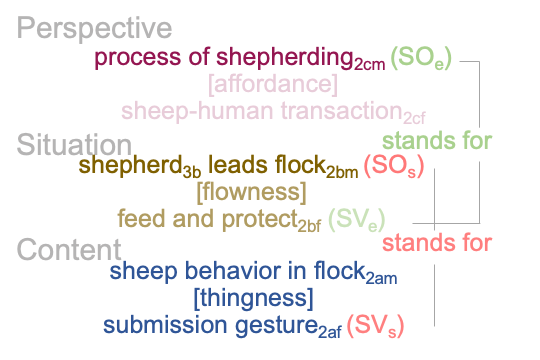
0200 In the specifying sign, the sheep’s submission2af (SVs) stands for the flock2bm (SOs) in regards to the shepherd3b operating on the potential of ‘human power’1b (SIs).
In the exemplar sign, the form of the feeding and protecting of the flock2bf (SVe) stands for a specialized way of living2cf (SOe) in regards to the normal context of animal domestication3c operating on the potential of ‘human responsibility’1c (SIe).
0201 On top of that, the process of serving as a shepherd2cm [substantiates by way of affordance] a human-sheep transaction2cf enacts the suggestion, “Give fodder to the animals.” (Genesis 1:30).
0202 The biblical reference is not an accident.
Domestication of animals implies that our kind adapts to the potential of ‘responsibility’1c.
0203 Does that connection appear in the vast scientific literature of human behavioral ecology?
Maybe, the connection may be winnowed from references to immediate and delayed return systems (S6C4).
Or, the connection pertains to the conclusion (S7C4) that things can be unruly, even when they depend on humans.