0054 Next, allow me to compare the virtual nested forms in the realm of actuality. Suarez’s model of mind-dependent being is on the left. The Gnostic origin myth is on the right.
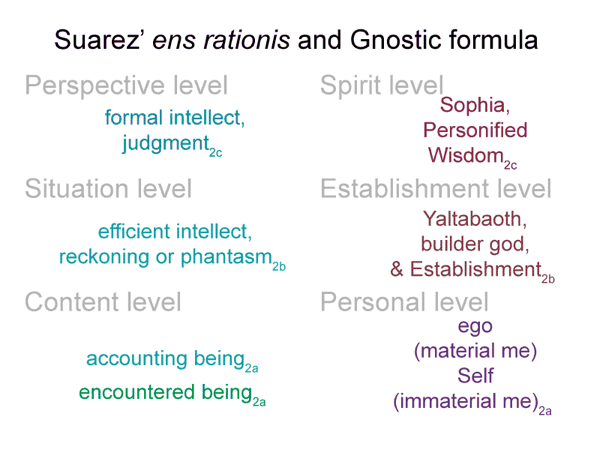
0055 Even though these two virtual nested forms look very similar, there is one key difference.
0056 In Suarez’s discussion of mind-dependent being, the end point is alignment among all the elements in actuality. The formal intellect reflectively judges the reckoning of the efficient intellect. The accounting being projected by the efficient intellect ought to explain the encountered being. Plus, the explanation should conform to a reality principle.
0056 The Gnostic formula is different. The virtual nested form in the realm of actuality never aligns.
0057 Why?
Yaltabaoth and the Establishment are monsters. The ego is only concerned about the person’s material conditions. The ego is slave to natural laws and social norms. The ego is at the service of a corrupt material body that encases the pure immaterial spark of the Self. There is no possibility of alignment.
0058 What is the Self to do?
The Self can admit defeat and just get used to it. The Stoic says, “Live a life of quiet desperation.”
The Self can rebel and become the target of the wrath of Yaltabaoth and the Establishment. That is the way of Icarus, who rebelled against his father Daedalus’ instructions.
The Self can submit to the ego’s demands and bow before the laws over and over again, finding joy in its own humiliation.
Or, the Self can escape and return to the Source. Through secret knowledge, practices, rituals and incantations, the Self can experience Sophia. It can find a way past ego and Establishment. It can slip by Yaltabaoth. It can get around the efficient intellect with its accounting being. It can return to the Source.
0059 Here is a story.
A friend of mine lied to me in order to gain advantage. Because I need to get along in my social circle, I cannot retaliate.
On a later occasion, my so-called friend shows me a photograph from before the lie.
“Who is that?” he asks.
“That is me.” I reply, trying to hide my disgust. I would like to be the carefree and trusting person that I once was. I am no longer that person.
My so-called friend smiles. He confirms that I am the same person, as far as he is concerned. He did not apologize. He re-iterated the lie. He re-enacted his advantage over me.
I think to myself, “So, this is what I get instead of an apology.”
0060 What happened in this story?
0061 In Suarez’s model, my efficient intellect projects an accounting being (my ego-response) into the second slot of the content-level actuality. My ego-response accounts for the real encountered being (of my so-called friend’s actions).
My ego-response also reflects the situation, which emerges from ‘what is happening’.
I am too vulnerable to fight what he did. I am too slow to respond. Plus, he would gain even further by turning the group against me.
My ego-accounting being takes care of material me.
0062 If there was a possibility of us coming together, of honestly becoming friends again, he would have apologized. Hey, I just thought of it. I should demand an apology.
It’s too late.
His act with the photograph shows that ‘he wants his cake and to eat it too’. He wants me to be a friend as before as well as a chump that he lies to. There is nothing I can do to stop that from happening.
0063 Here is Suarez’s model of the story.
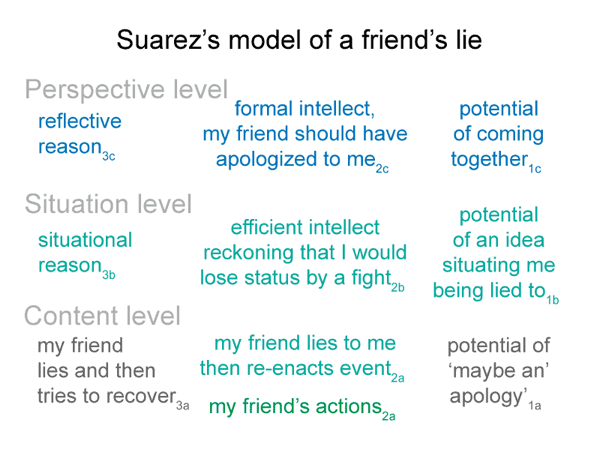
0063 A momentary flash of reflective reason2c opens a possibility1a.
I could demand an apology. But, that would start a fight. What would I say?
0064 Maybe, I would say, “What type of friend are you, lying to me for advantage?”
But, then, he would say, “Well, what type of friend are you, for even mentioning this.”
Ah, the cruelty. He obeys the rules, even as he defies their spirit. I cannot. He can bend the rules. I cannot. He can break the rules. I cannot. What am I to do?