0036 But, wait a minute. What about that spark?
Christians formulate the polarity within the unity of my person as active soul (animates) body. The modern formula is a little more Gnostic. The polarity within the unity of my person is ego [taking responsibility for and acting in the Name of the]) Self. In the virtual field produced by the actuality of Sophia, the Gnostic formulation takes one more step. My ego concerns the material aspect of my person. My Self constitutes the immaterial aspect of my person.
0037 Thus, the personal level sets the stage for the ascent of the Self to the Monad. Through Gnostic myth and rituals, Sophia provides the secret knowledge, the symbols and the experiences that awaken the Self and call it to journey to the Source.
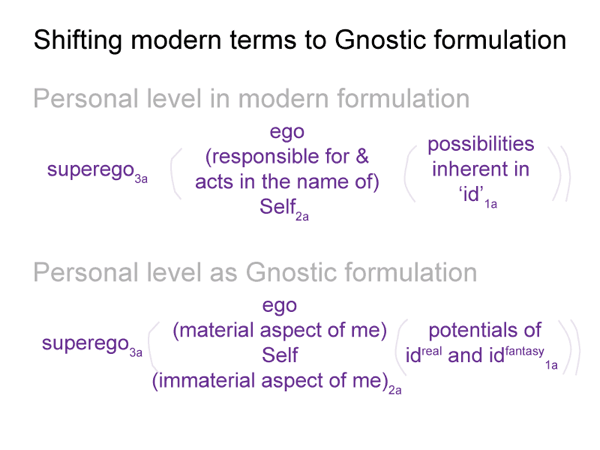
0038 Thus, my working model of the Gnostic origin myth described in chapter 1 of Burfeind’s book looks like this:
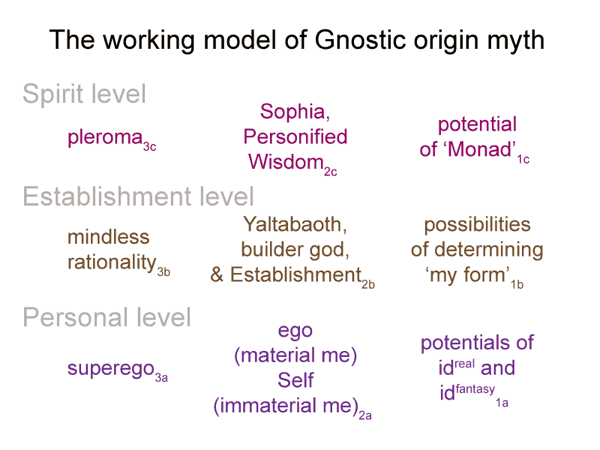
0039 Sophia delivers her message to the Self, not the ego. The ego accounts for the Self. So, in the interest of survival, the ego suppresses the experience of the call.
Now, I will compare my working model to Suarez’s model of mind-dependent being.
0040 During the 1600s, the Baroque scholastics, such as Francisco Suarez, tried to figure out mind-dependent beings. Actually, they were features of mind-independent beings that could be taken by the mind to be mind-independent. Privations, negations, self-contradictions and relations were classic examples.
0041 For example, there is a hole in a wall. The hole actually is a place where the mind-independent wall does not exist, but everyone treats the hole as if it exists. I encounter a wall. The wall has a spot were it does not exist. I immediately conclude this hole is real. I am upset about it.
0042 What is going on?
Actuality belongs to secondness. Secondness is dyadic. There should be two elements in the slot for actuality, even though only one element is typically listed.
On the content level, the encountered being2a is one element. It emerges from the potential of ‘something’ happening1ain the normal context of ‘what is happening’3a.
In the example, the wall2a satisfies ‘something’ happening1a. But then, so does that hole2a. The missing section of the wall is where something is not happening.
The efficient intellect2b projects a being that accounts for the encounter2a. This being is completely mind dependent, even though I regard it as mind-independent. The accounting being2a accounts for the encountered being2a. The accounting being says, “There is a hole in the wall.”
0043 Suarez’s discussion on ens rationis can be modeled as an interscope, just like the Gnostic origin myth. The similarity is striking.
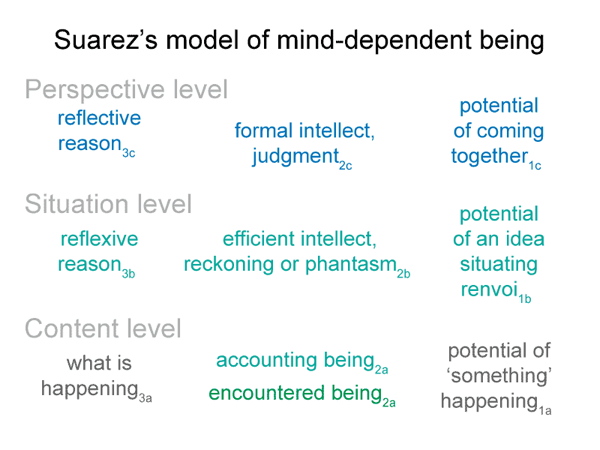
0044 The term “renvoi” is new. Renvoi is the contiguity between accounting and encountered beings. Look at that wall. I could call the hole a “privation”. But, that would not be enough. It’s not a privation of wall. It is a hole in the wall.
0045 So, let me dwell on the comparison between the interscopes of the Gnostic origin myth and Suarez’ model of mind-dependent being.
0046 The Self is like the hole in the wall. The wall is the seamless operation of the ego, within the framework of the superego, fulfilling the reality-principle desires of idreal.
My Self says, “None of this is ego-activity is about me. Or is it?”
All sorts of feelings come bubbling up from idfantasy. Many of them are weird. I label the actuality that encounters these feelings “my Self”.
0047 For the content-level, the comparison looks like this:
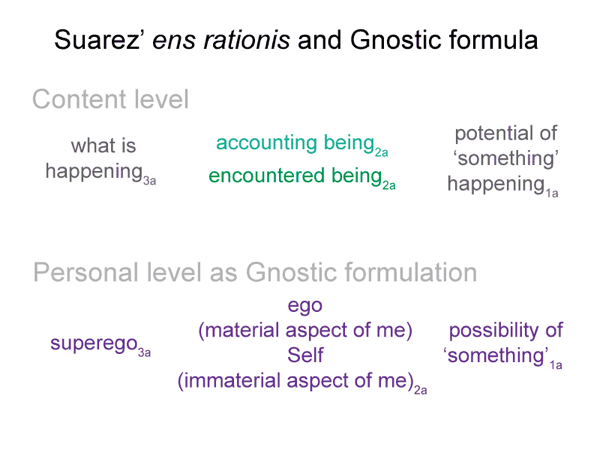
0048 What does this imply?
My ego is comparable to my efficient intellect projecting a being that accounts for my Self within the normal context of ‘what is happening’.
0049 This is exactly the opposite of what I would expect for the actuality emerging from idreal.
I expect that my ego would encounter the world. Instead, my Self encounters the world. My ego is responsible for and freely acts upon that encounter. My efficient intellect projects my ego in order to account for my Self.
0050 Even more striking is that the ego brings to bear all the materiality of natural laws and social norms in its account of the Self’s encounter. It’s like the ego starts by yelling, “Get that idfantasy out of here. Idreal will tell me what to do.”
Recall, the ego acts in the Name of the Self, but the ego does not necessarily take the Self into consideration.
0051 Hmmm. Would that explain repetition disorders?
If my ego does not take responsibility for my Self, then he can ignore my idfantasy. So my Self, in response, will simply serve up the same encounter over and over again.
She says, “Deal with this, reality principle. Take responsibility for what I like and what I don’t like. Acknowledge my feelings.”
0052 Imagine a world where I only encounter real beings. Or maybe, imagine a world without accounting beings. I cannot notice a hole in the wall, because I cannot account for the wall itself.
I suppose my day would go like this: Hunger. I look for an encounter with real edible being. I strive to avoid being eaten. Oh, what’s that? Ah. Got it. Yum. Sleepy.
In a world filled with social norms, none of this flies. I must cook food and share that food with others. Sometimes I don’t enjoy what they like. But, I have to eat. Then, when I want to sleep, no one will permit it. I have tasks to do.
The Self learns to enjoy these troubles. Idfantasy can adapt to almost anything. I may not like my routine, but I can learn the art of enduring it. It can learn to pray. I can find joy in my routine.
0053 So, my Self compares to the encountered being. Perhaps, my Self is better expressed as me encountering ‘my encounter with a real being’.
The Self is all about experience. It is not about responsibility and freedom. That goes with the ego.