0018 So far, this origin story portrays the production of the cosmos and the descent of the soul. Cosmic creation and personal destiny are thus linked through a spirit (formerly, the perspective) level virtually contextualizing an establishment (formerly, situation) level. Obviously, we humans go into the content… er, personal level.
0019 The mindless rationality of Yaltabaoth determines both the universe and my person. It stands in the way of my spark’s return to the Source. My material body is a hindrance. My body and its concerns are subject to being situated by the builder god’s natural laws as well as the establishment’s laws and decrees.
0020 Is this starting to sound vaguely modern?
Burfeind traces a path from ancient to modern times. So, it will probably come as no surprise that the best terminology for the ascent of the soul comes from the past two centuries.
Burfeind lists Sigmund Freud and Carl Jung as Gnostic thinkers. They founded modern Western psychoanalysis. They were trained in science and medicine, yet they produced terminology that associates to the personal level. They formulated their ideas at a time when Gnosticism was constellating in the West in the form of social movements.
0021 What term captures concerns with the body in the situation of the natural laws and social norms?
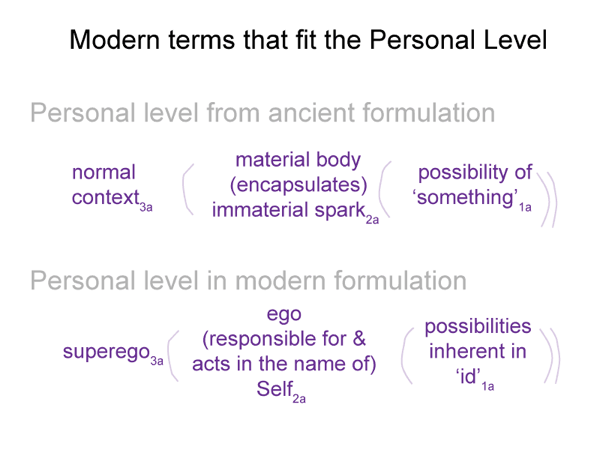
Freud’s ego does. The ego operates according to the reality principle. It defines my actuality. So, it goes into slot 2a.
The ego situates personal desires to accommodate to natural and social conditions. These desires belong to the realm of possibility. Freud called them “it”. English translators turned “it” into the technical term “id”.
0022 The reality principle may be labeled idreal. I can hear the reality principle in the phrases, “face it”, ‘that it’s”, “it’s too much”, “what about it” and so on. Substitute the word “id” for “it”. The reality principle is one current within the id. The id allows many currents. The logic of firstness is inclusive. It allows contradictions. So the id ought to go into slot 1a.
0023 The superego is the normal context in which the ego operates. The superego internalizes the natural laws and social norms. It goes into slot 3a.
0024 So far, the ego2a constitutes one element of the personal level actuality. It works to satisfy the superego3a. It fulfills the reality principle1a. If that was all, then I would expect the person to be an easily trained animal. That is hardly the case.
Ah, this is where the spark must come into play.
0025 Freud’s Gnostic venture did not go far enough. Freudian psychoanalysis aimed to strengthen the ego2a. To him, the ego was assaulted by other currents in the id besides idreal. The goal of the analytic dyad was to show that these other currents were mere fantasies, generated in response to some clinical cause.
The clinical cause was typically a trauma experienced during childhood. The symptom was an aberrant and insistent idfantasy, making it difficult for the patient to maintain healthy ego function. The client exhibited a fixation.
The technical term is “repetition disorder”.
Okay, what about that spark?
0026 At first, Carl Jung was a promising student of Freud. Well, not quite. Actually, he was already an established practitioner in the fledgling field of the psychological sciences. He started following Freud’s ideas. Freud thought that he had found the person to inherit his intellectual legacy.
But then, Jung rebelled.
0027 The problem?
Freud insisted that idfantasy was like a locomotive driven by the coal-burning engine of steamy sexuality. Yes, Freud was fixated, at least for a while. Other students proposed alternate engines, such as yearning for the mother’s breastand social status. Yes, idfantasy is a broad current within the id. It is like the Euphrates compared to the Tigris of idreal.
0028 Carl Jung completed Freud’s Gnostic formulation by proposing why humans are not easily trained animals. Jung said (more or less), “Yes, the ego works within the normal context of the superego. Yes, the ego operates according to the desires of the reality principle, idreal. But that is not all. The ego is also responsible for the other element of the dyad in actuality. The ego acts in the name of the other element in the dyad.”
What do I mean by “dyad in actuality”?
Actuality belongs to the category of secondness. Secondness always contains at least two elements. One affiliates to effect (in the broadest sense of the word). The other affiliates to cause. Ah, cause and effect? That sure sounds like actuality.
The ego is like a cause (in the broadest sense of the word).
What is the other element in the personal-level dyad of actuality?
0029 The Self is another element.
The ego is responsible for the Self. The ego acts in the Name of the Self.
However, the Self is watered by a different river within the id. That river is idfantasy.
0030 What is the Self?
It is the actuality emerging from the possibilities inherent in idfantasy. I know my Self through experiences that stimulate idfantasy. Most of these experiences are personal feelings that occur in the moment, as the ego acts within particular circumstances and for particular reasons consistent with idreal.
0031 The Socratic formula, “know your Self”, may be framed as, “Pay attention to what you feel as you go about your duties in this world of natural laws and social norms.” In this way, you can train your fantasies to imagine virtuous situations, such as the situations depicted by Plato.
0032 Here is a diagram of how modern terms fit into the personal level.
0033 Jung discovered the element missing in Freud’s analysis. At the same time, he generated a host of troubling questions. For example, the Self is obviously outside of spoken language, since it does not operate according to the simple rule that ‘words refer to things and states of things’. It bootstraps itself from feelings encountered during the operations of the ego. It starts as a simple “I like this” and “I don’t like that”.
Then, the Self becomes sophisticated enough to know that this is a sign of that. Spoken utterances are not taken at face value. The ego does that. Instead, spoken utterances are incorporated as gestures that image or indicate something that I like or something that I don’t like. Or, even more evocatively, the gestures picture and point to something that may be fantasized about and something that may not be fantasized about. The Self is full of acquired tastes.
0034 The person flourishes when the ego takes responsibility for the Self and acts in the Name of the Self. The idfantasythat Freud attributed to some originating trauma is really a current of desire that the Self experiences over and over again. Idfantasy may express itself as desire or revulsion. Sometimes, desire is revulsion and revulsion, desire.
0035 If the ego treats the Self properly, then the Self may well be happy.