0071 So far, this examination presents a philosophical definition of entanglement that complements Hodder’s use of the term. On top of that, there appears to be two confoundings that resolve in a very specific fashion. The entangled matter actually (in secondness) belongs to the adjacent-higher level than the originating matter.
Here is a picture.
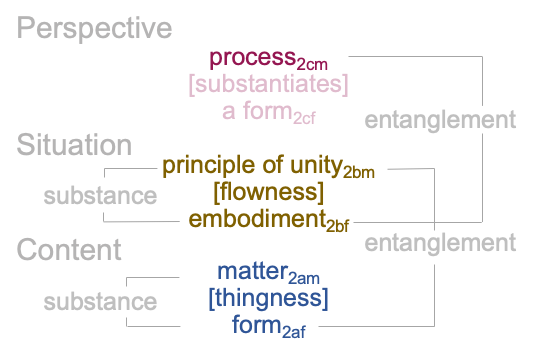
0072 Now, I would like to focus on the second confounding.
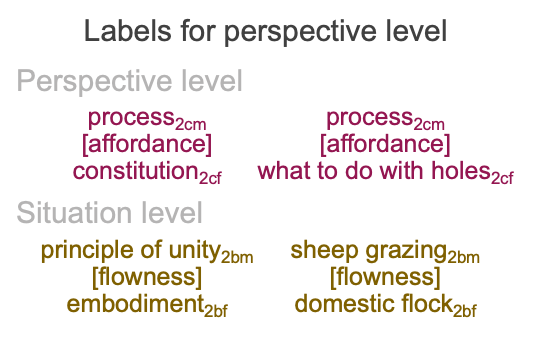
I would like to figure out a satisfying label for the perspective-level form2cf.
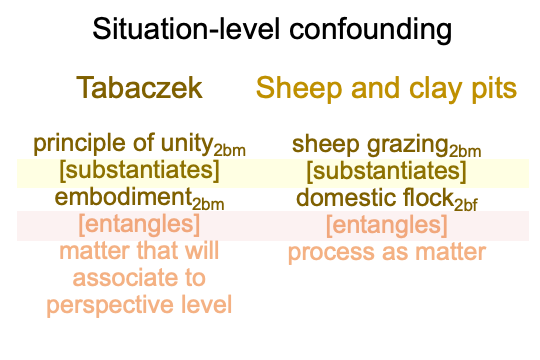
0073 The general structure, as an extension of Tabaczek’s exploration into classical and contemporary hylomorphism, occupies the left side of the following diagram.
The example of sheep and pits dug in the pursuit of good clay occupies the right side.
0074 The author is not clear about this situation with respect to sheep that are grazed in the area that has pits dug out in pursuit of clay. Really, can I expect an answer? Catal Hoyuk goes out of business around 7500 years ago (radiocarbon dating).
There are clues.
Apparently reeds grasses (technically called “phragmites”) proliferate in wet areas, which could correspond to holes dug for clay. In Figure 4.2 (S1C4), the author diagrams a process where reeds are used for roofing. So, maybe the holes were not a problem, after all. Maybe the scenario is even more complicated. Do sheep eat phragmites? I suspect that they do.
So, maybe sheep are not as stupid as I originally imagined.
The ones that go into the pits to eat the reeds, however, might not have a plan for getting out.
0075 So, humans have to constitute a plan, not an explicit plan, but a habit of action that constitutes a judgment. A process2cm as matter [substantiates] a habit for checking whether sheep cannot get out of holes2cf as form. At the same time, the person checking the sheep can gather a bunch of reeds to keep the rooftop flush.
0076 Here my picture of the resolution of the situation-level confounding.
A single process2cm deals with both getting clay for pots2am and the stupidity of sheep2am.
0077 Note that the perspective-level contiguity is not [substantiates]. It is [affordance] or [affordness]. Affordness associates with the niche, which is the potential of ‘an actuality independent of the adapting species’1. Every thing in the digging holes for clay and grazing sheep in the same area saga offers a danger and an opportunity. That danger or opportunity is called an “affordance”. So, the awkward sounding, “affordness”, is not too far removed.
I will try not to fall into the pit of terminology.