0953 The article before me is published by Sign System Studies (volume 45(3/4), 2017, pages 317-334) by Peeter Torop in the Department of Semiotics at Tartu University, Estonia. This particular volume is dedicated to semiotics and history.
0002 Amazingly, this article has no subtitle.
Perhaps, I may add one: An Inquiry into the Chronotope.
0954 At first, I thought that the word, “chronotope”, coined by Mikhail Bakhtin (1895-1975 AD), was “chronotrope”, where “trope” is a label for a rhetorical trick that belies the complexity of things. Tropes change over time.
0955 For example, the Latin trope, “ens reale“, has been translated as “being that is real”, as well as “mind-independent being”. Add time, and the parole of the chronotrope stays the same, but the matter, the langue, shifts. “Ens reale” migrates from what the scholastics pursue in their philosophical discourses to what?… a being that is mind-independent? Does mind independence (as matter) somehow substantiate a form (that is the elusive goal of philosophical inquiry)?
0956 If I use Aristotle’s hylomorphe as an exemplar of Peirce’s secondness, I can diagram the following “chronotrope”.
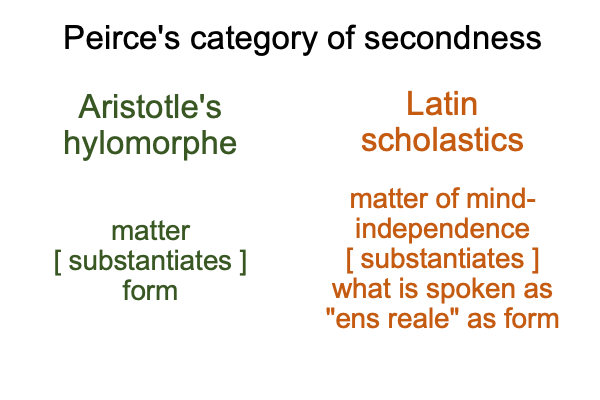
0957 Peirce’s category of secondness consists of two contiguous real elements. For Aristotle’s hylomorphe, the real elements are matter and form. The contiguity, placed in brackets for proper notation, is [substance] or [substantiates]. Either noun or verb is appropriate, because the contiguity can be construed as either.
0958 Does Aristotle’s hylomorphe transmogrify, over time, into mind-independence as a real element and the term, “ens reale” as another real element?
Perhaps, mind-independence could work as matter that substantiates ens reale as form.
Or, maybe, mind-independence could associate to langue and ens reale could go with parole.
0959 I suppose that tropes can shift (in time) in awkward ways.
0960 That leaves me with Bakhtin’s term, “chronotope”.
In chemistry, the nucleus of an element contains protons and neutrons. The word, “element”, precisely labels a fixed number of protons in its nucleus. The number of neutrons may vary, resulting in different atomic masses for two different isotopes of the same element. The word, “isotope” labels a fixed number of protons (characterizing the element) and neutrons (contributing to the isotopic mass). Some isotopes have too few or too many neutrons, making the nucleus unstable and subject to radioactive decay.
0961 Here is a picture.
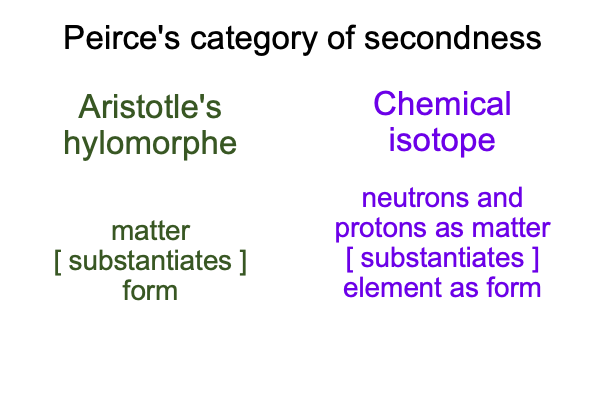
0962 By analogy, a “chronotope” is the same element, but its placement in time may vary.
Is that correct?
0963 Is time neutronic?
Maybe the analogy of radioactive decay can introduce time into the elemental thing by producing a confounding, in the following manner.
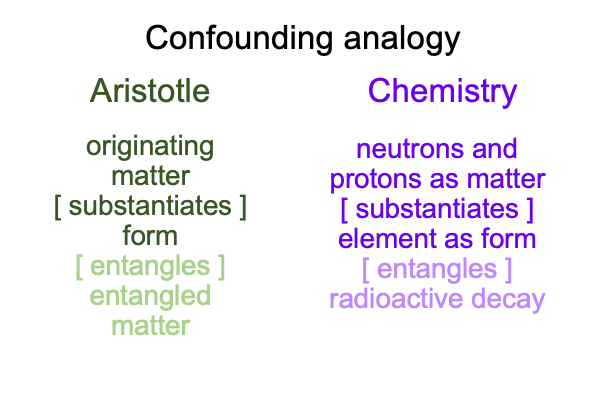
Yes, a confounding labels one form associated with two matters, one originating and one entangled.
0964 The problem is that radioactive decay as matter cannot resolve into a substantiation of the element as form, since it changes the elemental form by altering the miox of neutrons and protons in the atom.
Well, certainly the elemental thing, {protons and neutrons as matter [substantiate] a radioactive isotope}, is subject to decay. But, does decay itself constitute an entangled matter, especially when the occasion of radioactive decay changes the original element into another element plus a radioactive emission?
0965 In other words, if radioactive decay occupies the slot for entangled matter, then the original elemental thingchanges form upon resolution of the confounding.
0966 What a weird analogy.
Nevertheless, allow me to continue.