02/19/26

Looking at Peeter Torop’s Article (2017) “Semiotics of Cultural History”  (Part 1 of 11)

0953 The article before me is published by Sign System Studies (volume 45(3/4), 2017, pages 317-334) by Peeter Torop in the Department of Semiotics at Tartu University, Estonia. This particular volume is dedicated to semiotics and history.

0002 Amazingly, this article has no subtitle.

Perhaps, I may add one: An Inquiry into the Chronotope.

0954 At first, I thought that the word, “chronotope”, coined by Mikhail Bakhtin (1895-1975 AD), was “chronotrope”, where “trope” is a label for a rhetorical trick that belies the complexity of things.  Tropes change over time.

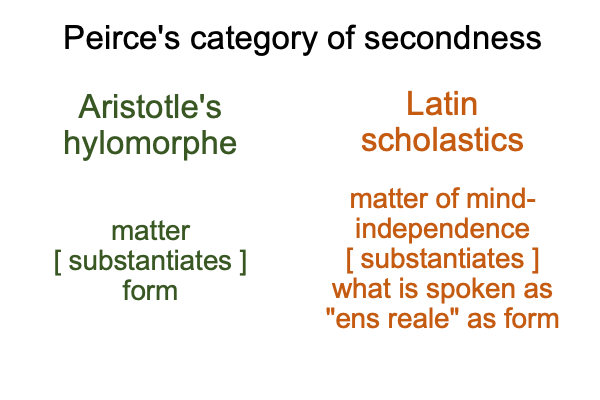
0955 For example, the Latin trope, “ens reale“, has been translated as “being that is real”, as well as “mind-independent being”.  Add time, and the parole of the chronotrope stays the same, but the matter, the langue, shifts.  “Ens reale” migrates from what the scholastics pursue in their philosophical discourses to what?… a being that is mind-independent?  Does mind independence (as matter) somehow substantiate a form (that is the elusive goal of philosophical inquiry)?

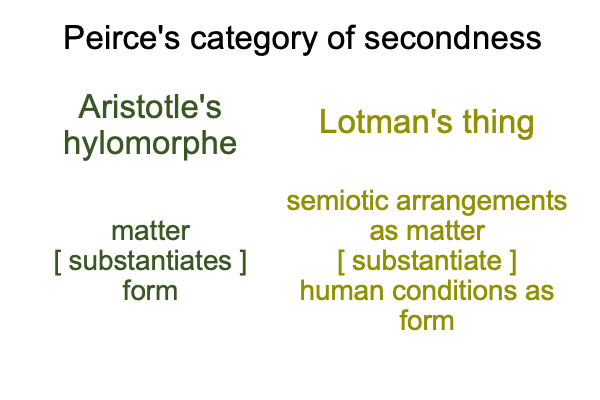
0956 If I use Aristotle’s hylomorphe as an exemplar of Peirce’s secondness, I can diagram the following “chronotrope”.

0957 Peirce’s category of secondness consists of two contiguous real elements.  For Aristotle’s hylomorphe, the real elements are matter and form.  The contiguity, placed in brackets for proper notation, is [substance] or [substantiates].  Either noun or verb is appropriate, because the contiguity can be construed as either.

0958 Does Aristotle’s hylomorphe transmogrify, over time, into mind-independence as a real element and the term, “ens reale” as another real element?

Perhaps, mind-independence could work as matter that substantiates ens reale as form.

Or, maybe, mind-independence could associate to langue and ens reale could go with parole.

0959 I suppose that tropes can shift (in time) in awkward ways.

0960 That leaves me with Bakhtin’s term, “chronotope”.

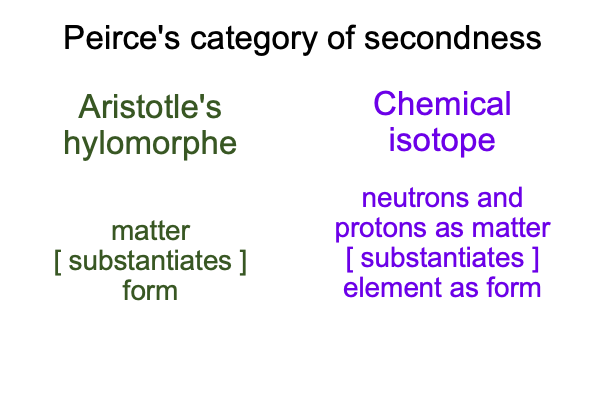
In chemistry, the nucleus of an element contains protons and neutrons.  The word, “element”, precisely labels a fixed number of protons in its nucleus.  The number of neutrons may vary, resulting in different atomic masses for two different isotopes of the same element.  The word, “isotope” labels a fixed number of protons (characterizing the element) and neutrons (contributing to the isotopic mass).  Some isotopes have too few or too many neutrons, making the nucleus unstable and subject to radioactive decay.

0961 Here is a picture.

0962 By analogy, a “chronotope” is the same element, but its placement in time may vary.

Is that correct?

0963 Is time neutronic?

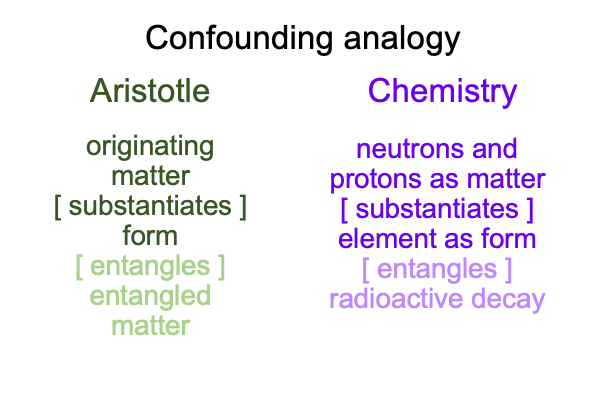
Maybe the analogy of radioactive decay can introduce time into the elemental thing by producing a confounding, in the following manner.

Yes, a confounding labels one form associated with two matters, one originating and one entangled.

0964 The problem is that radioactive decay as matter cannot resolve into a substantiation of the element as form, since it changes the elemental form by altering the miox of neutrons and protons in the atom.

Well, certainly the elemental thing, {protons and neutrons as matter [substantiate] a radioactive isotope}, is subject to decay.  But, does decay itself constitute an entangled matter, especially when the occasion of radioactive decay changes the original element into another element plus a radioactive emission?

0965 In other words, if radioactive decay occupies the slot for entangled matter, then the original elemental thingchanges form upon resolution of the confounding.

0966 What a weird analogy.

Nevertheless, allow me to continue.

02/7/26

Looking at Peeter Torop’s Article (2017) “Semiotics of Cultural History”  (Part 11 of 11)

1088 The final section, on cultural semiotics as semiotics of cultural history offers the trope… er… slogan… saying, “Culture is memory.”

On the fundament, the literary text2bf offers something to remember, if for no other reason than it is encoded as a text. Texts may survive to be available to the future.  Parole2af is often not so lucky.

Time is cruel

So many texts have been lost.  Precious few oral traditions remain intact.

The issue is twofold.  The text or the oral tradition needs to survive.  Also, a code for translation must be retained… or… recoverable.

This is one of the problems with the writing of ancient Mesopotamia, where there are few texts that have more than one script in a single document.

1089 Lotman spends many hours reflecting on text and code.

Some of his reflections end up in his book, Universe of the Mind.

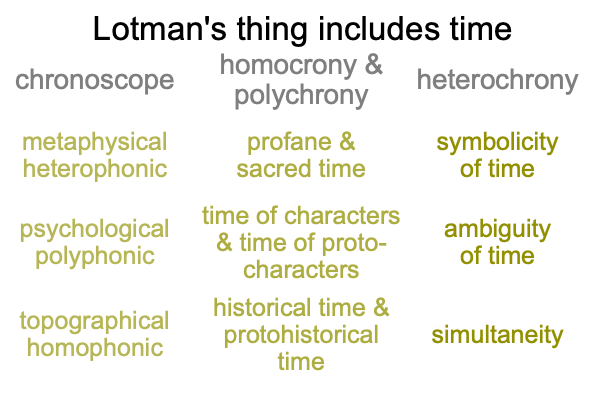
1090 The author presents a table on Lotman and Uspenskij’s views of the temporal aspect of chronotopical analysis.

1091 Of course, the above table does not correspond to Torop’s original table2bf (fundament and derivative, Figure 1).

Perhaps, this table further develops and refines Bakhtin’s semiological structuralist model2c (Figure 2).  

However, it is hard not to imagine that the above figure translates into an interscope.

1092 Say what?

1093 The Tartu-Moscow School expresses two interscopes, the fundament culminates in the semiological structuralist model2c and the derivative rises to a yet-to-be-determined perspective-level actuality2c.

1094 Bakhtin’s notes and scribbles express two interscopes as well.  These two interscopes constitute two adjacent tiers within a model more expansive than the semiological2a structuralist2b model2c.  The construction of Torop’s article intimates that this expanse is well worth investigating.

1095 The way that Lotman’s thing includes time shows how Torop’s tables2af entangle a language2am of presence1b (as well as meaning1a).  Lotman recognizes2bm time2af as a formal requirement of the chronotope2am and forces Torop to construct his own table (Figure 4 on page 330) as a way to situate2bf that entanglement2a.

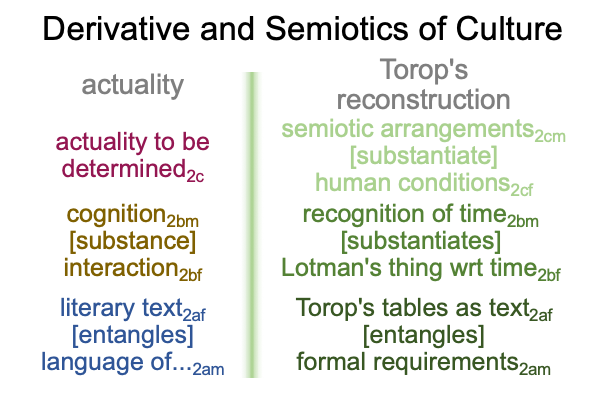
1096 Here is a juxtaposition of the virtual nested form in the category of secondness for the derivative interscope and Torop’s reconstruction of Lotman’s approach.

1097 A virtual nested form proceeds down a column in a three-level interscope.

Here are the columns in the realm of actuality2.

1098 In the general form of the derivative interscope, a perspective-level actuality2c (to be determined) brings the situation-level actuality of {cognition2bm [substantiates] social interaction2bf} into relation with the possibility of {a literary text2af [entangling] a language2am of meaning1a, presence1b and message1c}.

1099 For Torop’s table addressing Lotman (Figure 4), the perspective-level actuality2c of {semiotic arrangements2cm[substantiate] human conditions2cf} virtually brings the situation-level actuality of {Lotman’s recognition of time2bm[substantiates] Lotman’s thing with respect to time (as a three-level table)2bf} into relation with the content-level possibility that {Torop’s tables as text2af [entangle] the chronotope’s formal requirements2am of the normal context of the Tartu-Moscow School3a}.

1100 Oh yeah, that makes sense.

Cultural history manifests in the framework of the semiotics of the text, where the text is a representation of culture.

Bakhtin’s culture, that is.

Lotman’s culture, too.

1101 If Bakhtin’s insights are formalized as text by Torop’s tables, then Torop’s tables constitute a semiological structuralist model2c of Bakhtin’s insights2af and support the entanglement of a language2am that sounds very much like any language of interpretation.

What is the meaning1a, presence1b and message1c of the chronotope?

Lotman’s thing focuses on time and produces a variation of the fundament interscope.

Torop’s table of Lotman’s consideration of time produces a categorical stairway to a perspective-level actuality2c in the derivative interscope.

1102 Once again, what is Lotman’s thing?

Oh, yes, it is the archaeological recovery of an insight that is present… at least in potential… since the very origins of Slavic civilization.

In the beginning is the Word, and the Word as matter substantiates the human condition as form.

1103 Here is a picture.

Such is the resolution, of the confounding where history substantiates culture and culture entangles semiotics.

1104 My thanks to Peeter Torop, for putting pen to paper and for building the tables that demonstrate the fecundity and the surprising beauty of the first iteration of the Tartu-Moscow School of Semiotics.  May a second iteration follow.

01/9/26

Looking at Boris Uspenskij’s Article (2017) “Semiotics and Culture”  (Part 1 of 8)

0642 The article before me is published by Sign System Studies (volume 45(3/4), 2017, pages 230-248) by Boris Uspenskij (1937-present), one of the members of the first ascent of the Tartu-Moscow School of Semiotics, in the 1960s through the 1980s.  The full title is “Semiotics and culture: The perception of time as a semiotic problem”.  The paper was originally presented as a lecture held in Madrid in 2010.  Plus, the paper is based on a two-part article published under the title “History and Semiotics (the perception of time as a semiotic problem)” in 1988 and 1989.

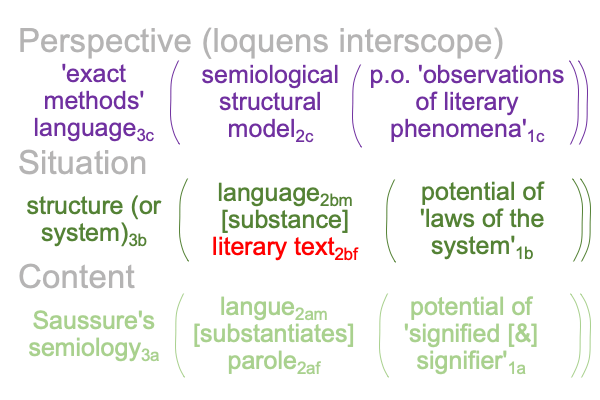
0643 The first ascent of the Tartu-Moscow School of Semiotics builds a fundament of semiology3a, structuralism3b and disciplinary languages3c that retain formal and final causations along with material and efficient causalities (called “exact methods3c“).  The result is an actuality2ca semiological structural model2c (SVi), that stands for a dyadic actuality2a where {the literary text2af (SOi) [entangles] a language2am of meaning, presence and message1a}.

0644 Here is a diagram of the fundament interscope.

0645 Exact methods3c?

Think of it3c as flying a probe2bm into a cloud of phenomena1c that cannot fully objectify the noumenon of a literary text2bf.  This scholarly data-collector2bm extracts observations and measurements1c that will be evaluated (using exact methods) on the basis of signification3a(1a) and structure3b(1b).

0646 Semiological structural model2c?

According to the empirio-schematic judgment, a disciplinary language (relation, thirdness) brings a mechanical or mathematical model (what ought to be, secondness) into relation with observations and measurements of phenomena (what is, firstness).  

A parallel construction follows.

A disciplinary language of exact methods3c (relation, thirdness) brings a semiological structuralist model2c (what ought to be, secondness) into relation with observations and measurements of phenomena1c within a literary text2bf (what is,firstness).

0647 Phenomena1c?

Phenomena are observable and measurable facets of a noumenon, a thing itself.

According to Kant’s slogan, a phrase that Kant may have never uttered but which is attributed to him in the same way that the entire Pentateuch is attributed to Moses, a noumenon cannot be fully objectified as its phenomena.  A thing itself cannot be reduced to its observable and measurable facets.

0648 Language2bm?

Language2bm is the situation-level matter (as opposed to form) constituted by Saussure’s definition of language2aentering into a structure (or system)3b, such as a mother tongue3b, a genre3b, a style3b, an artistic community3b, a tradition3b, and other civilizational beings3b.

0649 Clearly, the semiological3a structuralist3b model2c aims to capture an Aristotelian expression of how language as matter2bm substantiates a literary text as form2bf.

Without the literary text2bf, a semiological structural model2c cannot coalesce because there is nothing to delimit free-floating, unanchored language from the phenomena that an inquirer is interested in.  It is like matter without a form to substantiate.  It’s useless.

0650 So, in the fundament interscope, language as matter2bm gives substance to the literary text as form2bf.

At the same time, the literary text as form2bf allows the entire situation-level hylomorphe2b to take a shape where language2bm may be regarded as phenomena.

0651 Say what?

Language2bm substantiates the literary form2bf and, at the same time, may be regarded as phenomena of the literary form2bf.

It2bm is substantiating matter2bm (esse_ce) because it virtually situates the content-level actuality2a, {langue2am[substantiates] parole2af}.

It2bm is regarded as literary phenomena by the perspective-level potential1c.

0652 The substantiated form2bf (essence) is like a noumenon and its2bf substantiating matter2bm (esse_ce) serves as its2bf observable and measurable facets (that is, its phenomena).