0806 If I return to a color-coded Greimas square for Russian identity3a (or reasoning3a(1a)) during the Cold War Among Materialist Ideologies (1945-1989), then it becomes clear that the joke reveals that my official consciousness (B) and my private consciousness (D) are not contrasts, but are (weirdly) intrinsic to my Russian identity3a (A) and my Russian will1a (C), respectively. They are intensions, according to the Soviet regime and the Marxist denkstyle, of what I am supposed to say2a and what I am supposed to think2a.
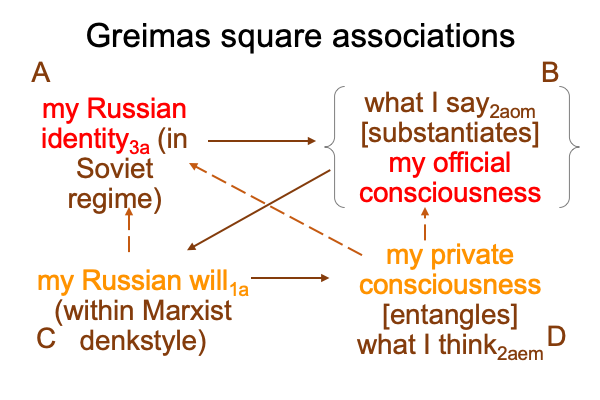
0807 Indeed, the dyad of {my voice2aom [substantiating] my official consciousness2af} (B) depicts the “mental geography of the Soviet regime”, that substantiates Soviet… er… Russian identity3a (A) and Russian will1a (C). In effect, B is official Marxist imagery2aom.
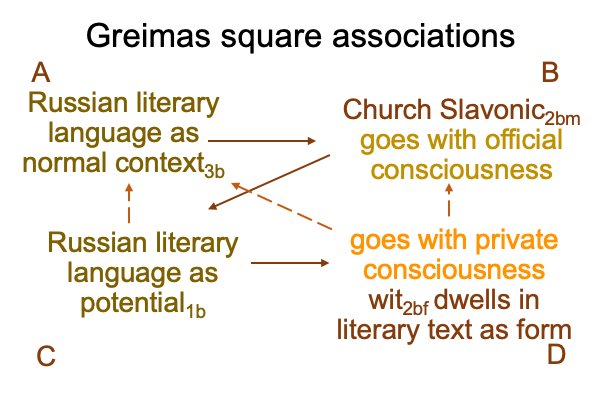
The following figure depicts the elements of the above Greimas square as a confounding.
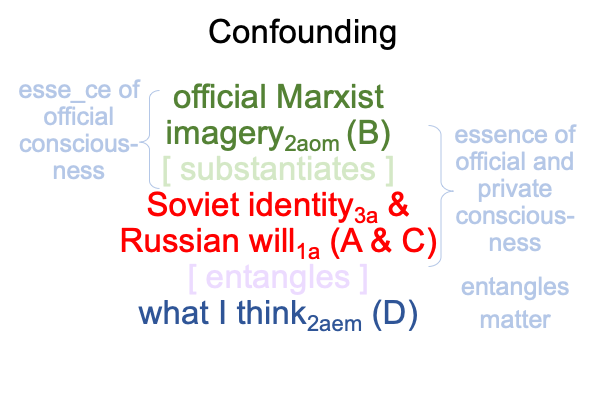
It makes me wonder about the nature of the Greimas square.
0808 The essence should be substantiated official consciousness2af. But, since the Russian has both an identity3a (A) and will1a (C), and since identity3a (A) associates to official consciousness2af (B) and will1a (C) associates to private consciousness2af (D), then a freakish doubling of consciousness occurs when I think2aem (D).
0809 Now, this type of dualism, as funny as it appears, my also have been at play… quite literally… in medieval diglossia.
Boris Uspenskij describes this phenomenon, where Church Slavonic language2a (which would go with B) substantiates Russian literary languagebm (which would go with both A (Orthodox identity3a) and C (Russian will1a)) and entangles Russian wit2aem (which goes with D). If the literary text2bf is synonymous with wit2a (what I think2aom D), then Russian civilization is much more… um… hilarious than western Europeans are willing to admit.
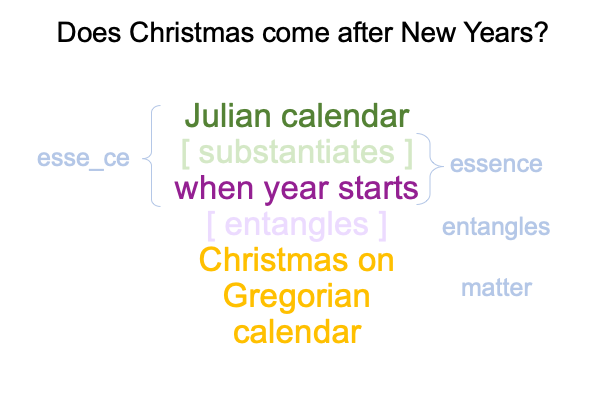
0810 The author provides several examples, one of which is the practical business-oriented Julian calendar (which appeals to official consciousness) and the somewhat off-kilter theology-oriented Gregorian calendar (which appeals to private consciousness), leading to questions about whether one can celebrate New Years if it comes before Christmas.