0827 The next section of the essay is titled, “Russian space”.
Consider the contrasts (B) to Russian identity3a (A) that have appeared in this examination.
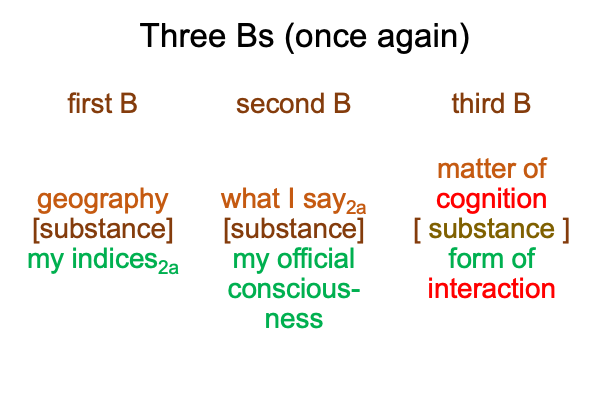
Each of these dyads embody an Aristotelian thing. We encounter things. Things are composed of matter and form. Things can serve as matter for other things. Things can serve as form for other things.
0828 Perhaps, it is no surprise that geography is a thing that serves as matter, allowing me to form the way that I orient myself in Russian space. At the same time, geography is implicated in what I say, especially when I say, “Moscow is first of all, a tsardom, not a city, and that tsardom is oriented to Constantinople, that is Byzantium.” Geography, as a matter of cognition, substantiates “Russian space”, in the form of historic belongings.
No wonder the author describes Russian geography as a mystical historiosophy.
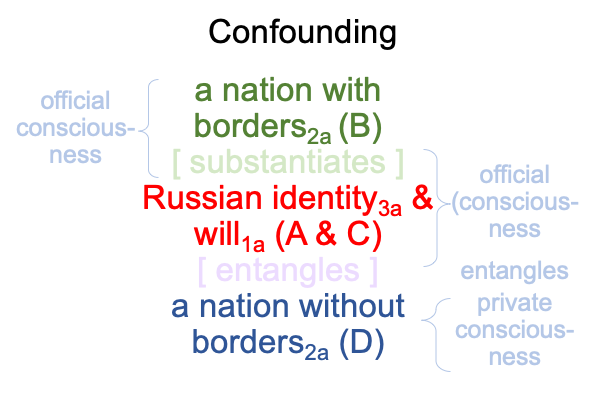
0829 Nothing is quite fixed, because directions are confounded with historical processes and so are… um… borders. Russia, is a form, with an expanse without borders as originating matter. Yet, Russia, as a form, is regarded as a nation.
Here is the geography of Russia, writ-large.
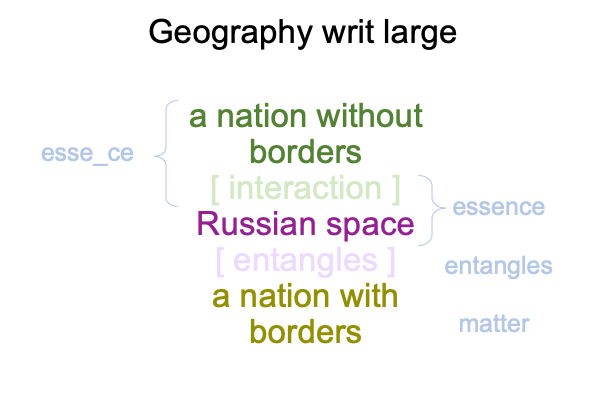
0830 The original thing is Russian space. An expanse without borders [substantiates] Russian space.
From page 274 to 279, the author dwells on the way that Russia, as a civilization, wrestles with Russia, as a nation.
The reason is clear. The Russian space, as form, entangles (through alliances and conflicts) the matter of borders.
Confoundings are dangerous.
0831 In the author’s historical telling, in its infancy, Russian civilization does not so much worry or fixate on borders. East and West offer principles that can be adopted or rejected. The West is logical, blabbering and deceitful. The East is none of these, because the East does not speak, and that can be sort of scary.
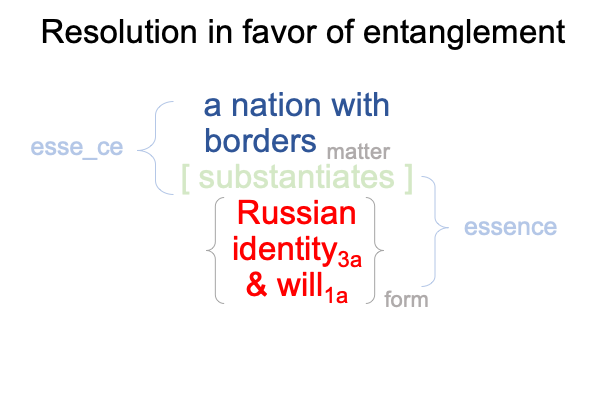
0832 The author does not detect a resolution of the entanglement in favor of the Western formulation of nations with borders. And yet, a particular closure is anticipated.
0833 Here is a picture.
0834 What is the promise?
Russia will join the West.
0835 What is the problem?
A nation-child is born at the same time as the mechanical philosophers of the 1600s. This child of the British Empirereaches adolescence. This adolescent breaks free. One orbit of Pluto later, the adult-nation is now a cacophonous grasping, manipulative and technologically savvy minion of oligarchs. The financial manipulators demand total submission as the price of being rewarded as promised. The USCB is now the Union of Socialist-Capitalist Bigilibs.
Please, conform to our empirio-normative domination.
AI guides iron hands within velvet gloves.
0836 So, now Russia, acting as a nation with borders is entangled in another matter, the need to become a nation without borders2a, through alliances, rather than through lines on a map.
0837 Yes, something is different.
The Russians are now a people.
And, the people advocate for Eurasian convergence (D).
See Comments on Alexander Dugin’s Book (2012) The Fourth Political Theory, by Razie Mah, available at smashwords and other e-book venues.
0838 Accordingly, Lotman’s typology of relations of cultural betweenness, depicted in the purely relational structure of the Greimas square, conjures an opportunity.
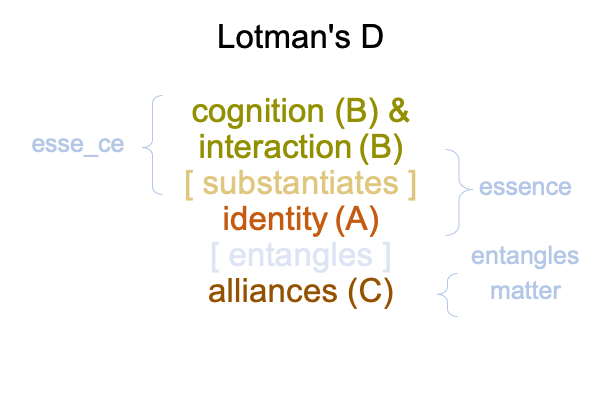
0839 Take a look at D in the last two figures and wonder, “What type of matter is thus entangled?”
0840 My thanks to the author, Mihhail Lotman, for publishing this article, whose full title is “History as geography: In search of Russian identity”.