0980 The semiotics of culture has the potential of offering explanations that are not available to historiography.
At the same time, historiography records (literally, “graphs”) those explanations.
0981 For a relatively recent example, at the start of the Third Battle among the Enlightenment Gods (1945-1989 AD), the contesting ideologies of capitalism and communism directly appeal to mass audiences. Their representatives aim to capture hearts and minds. By the end of the Cold War Among Materialist Ideologies (1945-1989), both capitalists and communists cloak their discourses in scientific professionalism. Experts rely on (apparently) precise technical vocabularies. Experts offer normative valuations that demand sovereign implementation.
0982 In terms of semiotics, the sign-system changes from presenting arguments that appeal to the hearts and minds of the masses to providing normative valuations to an administrative state. Rhetoric transmogrifies into scientific demeanor. Experts know best.
0983 In terms of historiography, events speak for themselves. The so-called “Iron-Curtain” rises as soon as the so-called Second World War (1937-1945) ends in the defeat of “fascist powers”. Soon, walls are built between “capitalist societies” and “communist societies”. The walls are supplemented by nuclear weapons. Consequently, warfare between the contending ideologically driven polities is narrowed to proxy-warfare. In America, these proxy wars occur in Berlin, Korea, Vietnam, and so on. Spy-craft conducts subterfuge. Self-identifying “Americans” tell a frightened public that “We are fighting communism.”
0984 In 1963, an American president dies from subterfuge from his own “side”.
In 1968, Soviet tanks crush a rebellious “Prague spring”.
Clearly, both incidents are signs that historiography cannot “graph” without changing the cultural coordinates.
Both incidents indicate that the capitalist and the communist ideologies no longer appeal to the masses.
The ideologues will now turn to expertise, in the style of science.
0985 The end of The Third Battle Among Enlightenment Gods (1945-1989) marks the opening of the fourth: Empirio-normative Domination of Subject Populations (1989-present), as elaborated in Razie Mah’s three-part e-book, Original Sin and the Post-Truth Condition (available at smashwords and other e-book venues).
0986 Well, perhaps I have provided more than an example.
0987 Shall I skip to the beginning, and provide a complement to Torop’s narrative?
The First Battle of the Enlightenment Gods, the Tragic War Among Naive Mercantilists (1914-1918), ends with the Russian Revolution, and Russian’s sovereign power falls into the hands of communist ideologues. Who paid for those ideologues?
Perhaps, the mercantilists were not naive. At the same time, they might not have heard about Husserl’s phenomenology, Freud’s psychoanalysis, the semiology of Ferdinand de Saussure and the semiotics of Charles Peirce, bubbling up in intellectual circles. All these new schools move the Zeitgeist closer to science, or to something that appears in the guise of science. After all, when discourse sounds scientific, then it must be scientific. Isn’t that so?
0988 Karl Marx, riffing from Hegel’s spiritual phenomenology to materialist economics, formulates one of the most resilient models to appear in the guise of science. The model is really a thing, because it2a mimics the first step in natural philosophy: the recognition of matter and form as two contiguous real elements. A thing is {matter [contiguity] form}.
Not unsurprisingly, this turns out to be how Charles Peirce characterizes the category of secondness. Secondness consists of two contiguous real elements. Secondness is the realm of actuality.
0989 Here is a picture of Marx’s thing.
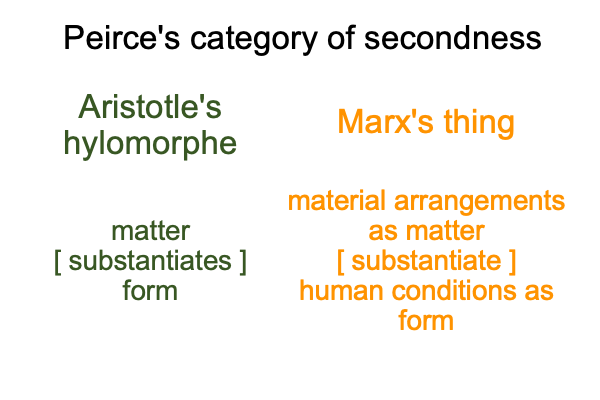
0990 Well, the Soviet shakers-and-movers, celebrating their acquisition of sovereign power, intend to implement a turn towards science for all institutions within the regime. Why? Because Marx’s thing dictates that… if one changes material arrangements, then one changes human conditions.
What better way to alter material arrangements than through scientific formulations?
0991 So, what is a professor in Slavic languages and literature to do?
Well, at first, German formalism offers an opportunity to reduce literary texts to their underlying rhetorical tropes. But, once such a reduction is performed, the professor can only offer a list of tropes. Tropes are not very convincing material arrangements. But, over time, they may ripen into chronotropes, which I have mistakenly mixed up with Bakhtin’s “chronotope”.
0992 Somewhat embarrassed at this, I ask myself, “What would be Bakhtin’s chronotope for this narrative?”
I suppose that it retains its “tope” over time, but changes is “chrono” with time.
Perhaps, the term is similar to the German word, “Zeitgeist”. The spirit remains the same, but its manifestation depends on the times.
0993 Here, the “tope” or the “geist” is the 20th century’s mounting confidence that all reality will come under the domain of science. Using Peirce’s… or is it Marx’s terminology, thirdness and firstness will fail based on their own internal contradictions. Does that mean that the “chrono” and the “Zeit” will change with material arrangements and human conditions? If so, then only secondness, the realm of actuality, the Marxist thing, is credible.
I conclude that the relevant “chronotope” may be the purely dyadic structure of Marx’s thing.
0994 However, for professors in Slavic languages and literature, Saussure’s discovery that spoken language consists of two arbitrarily related systems of differences offers a parallel to Marx’s thing that is more suitable for their subject matter. So, these thought leaders argue that Saussure’s thing is… well… a good substitute for Marx’s.
0995 Here is a picture.
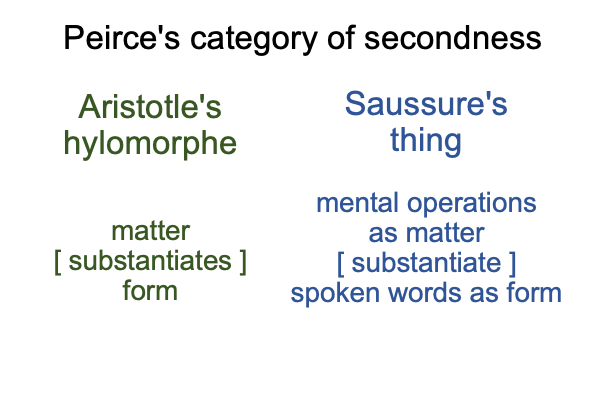
Mental operations as matter correspond to langue.
Spoken words as form correspond to parole.