1044 The derivative interscope compares to the table on extratextual relations in Figure 1 on page 321. The title of Figure 1 is “The construction of text”.
1045 Here is a table comparing the virtual nested form in actuality for the derivative interscope with Torop’s extratextual relations.
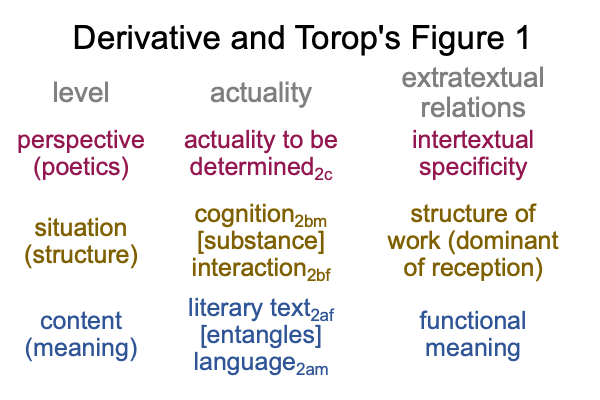
While the fundament interscope addresses the text itself. The derivative interscope assesses the text in relation to other texts. Such an assessment characterizes extratextual relations for the work.
1046 Are the correspondences sufficient to conclude that this examination’s fundament and derivative interscopes and Torop’s intratextual and extratextual relations are similar… if not identical?
If the answer is “yes”, then this examiner has a clue to the nature of the missing perspective-level actuality2c. The perspective-level actuality2c assesses how a particular text relates to other texts, and in doing so, weighs the intelligibility of the reception of the work2b against the universality of its functional meaning2a.
1047 An affirmative answer also brings this examiner to the topic of Bakhtin’s chronotopes.
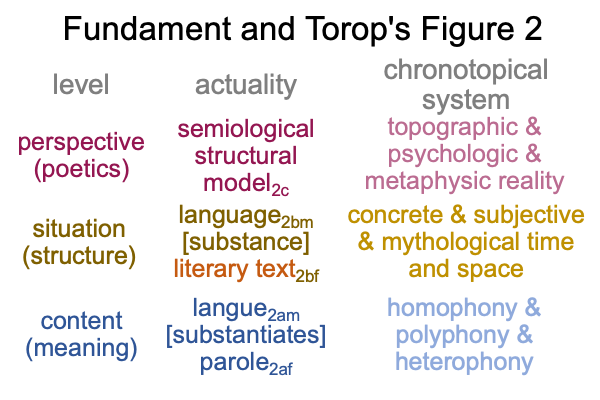
Figure 2 on page 322 of Torop’s essay presents what may be Bakhtin’s chronotopical system.
In fact, the table in Figure 2 is assembled from a short piece, “Forms of time and of the chronotope in the novel”, written around 1937-1938, along with “concluding remarks” added in 1973. Plus, there are entries in various notebooks, scribbles on papers that were preserved, and so on, adding clarity… and weirdness… to a distinction between architectonic time (corresponding to the chronotope) and the time when the story or artwork is composed (and, presumably, the author and the author’s cultural scope are alive).
1048 For example, consider a sci-fi author completing a story about “life in the future”, the day before the world ends. The chronotope must be life in the future. The time when the story is composed corresponds to the day before an asteroid hits the Earth.
Oh, this is the twist.
The author belongs to a rare breed of dinosaur living 65 million years ago.
The translation occurs when an AI program trained to scan fossilized dinosaur nests suddenly recognizes patterns within the nesting material that correspond… through comparison with patterns in other… what?.. ancient Mesopotamian glyphs, allowing for some sort of translation.
1049 So, what is the title of this unbelievable literary text?
“Actuality to be determined2c“.
1050 Am I saying that Bakhtin’s chronoscope is the actuality to be determined2c?
Am I saying that the actuality to be determined2c is more than intertextual specificity?
It2c is the time envisioned in a story written the moment before the author, and the author’s cultural scope, vanish into the past.
1051 So, what is this moment in the present, where the past recedes and the future awaits the text itself?
It must be the moment when langue2am [substantiates] parole2af.
1052 Just as there is a time-piece within a radioactive atom that determines when the unstable isotope decays into another element, there is a time piece within every author and cultural scope. That time-piece determines when the time of composition and the chronotope separate into the author and the text.
1053 An academic can study the author and the text in order to produce, using the fundament interscope, a semiologiccal2a structural2b model2c. This model2c, when regarded as the noumenon of the text2af, may entangle key elements within the chronotopical system, as shown in the following figure.
1054 But, there is a problem.
The closer that the semiotician swerves into Bakhtin’s chronotopical system, the more and more the semiological structuralist model2c looks… well… irrelevant.
Look at the poetics level.
Surely, a semiological structural model2c is bland and uninteresting compared to topographic, psychological and metaphysical realities.
No?
1055 Okay, there is another problem.
It is not at all obvious that my one-to-one association with each of Bakhtin’s triads corresponds to content-, situation- and perspective-level actualities.
The chronotope does not seem to match the fundament and derivative interscopes, at least not directly.
Plus, Torop loves Bakhtin as much as he does Lotman and Uspenskij.
The essay makes that obvious.
1056 On top of that, the article itself swerves from the TMS school (olive color) to Bakhtin (orange color) and back (to olive color).
Here is a picture with color-coded section headings.
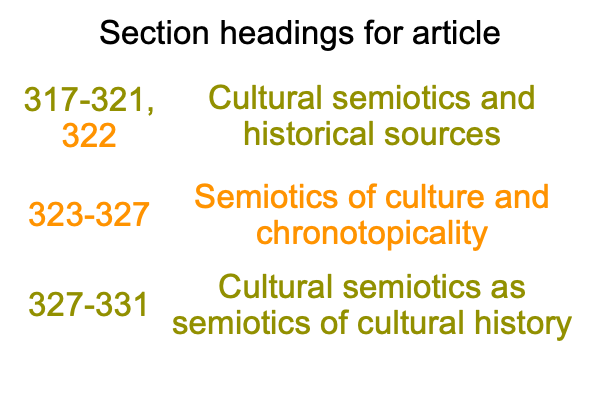
1057 So, the author goes from the TMS school to Bakhtin and back again.
What does this imply?
The swerve into Bakhtin must be crucial.