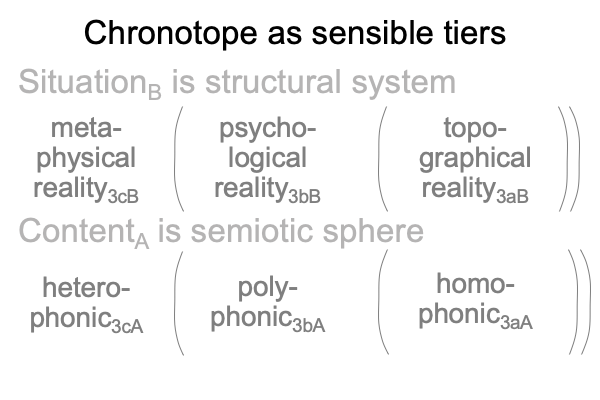
1070 Torop continues to recount the lessons that come from Bakhtin’s notes.
The next section is titled, “Semiotics of culture and chronotopicality”.
Not only does a chronotopical analysis distinguish three levels in every text, but, for literature, the three levels display narratives and performances.
Is this where semiotics enters into the picture?
1071 The author offers another table correlating levels of the text and the sphere of semiotization.
Here is a picture.
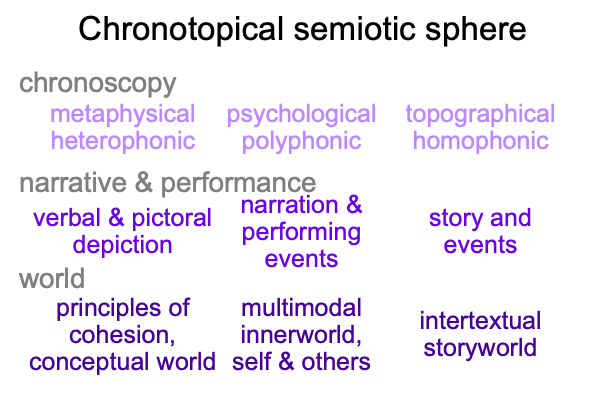
1072 The same principles apply as before.
Chronoscopy goes with Peirce’s category of thirdness.
Narrative and performance associates to secondness.
The world belongs to firstness.
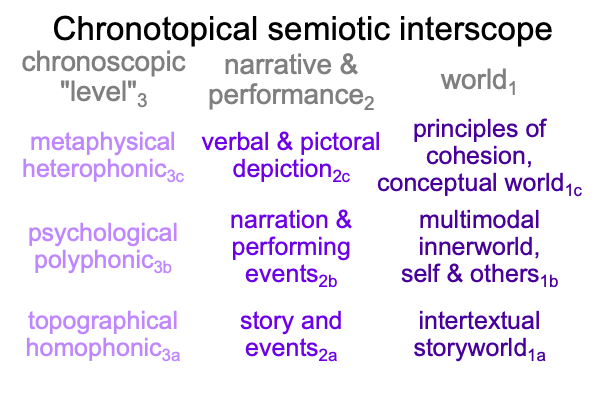
1073 Similar to before, the above figure looks like a semiological3a model2c.
On the content level, a topographical homophonic normal context3a brings the actuality of story and events2a into relation with the potential of ‘an intertextual storyworld’1a.
On the situation level, a psychological polyphonic normal context3b brings the actualities of narration and performance2b into relation with the potential of ‘a multimodal, innerworld with self and others’1b.
On the perspective level, a metaphysical heterophonic normal context3c brings the actualities of verbal and pictorial descriptions2c into relation with the potential of ‘cohesive principles establishing a conceptual world’1c.
1074 Now I ask, “Do these arguments add up to a semiological3a structuralist3b model2c?”
1075 By the time that the author finishes this section, he has intimated that Bakhtin’s article and scribbles on the chronotope offers a semiological structuralist model composed of interscopes, rather than category-based nested forms.
Here are the virtual nested forms in the category of thirdness for each interscope.