1076 The author moves on to the topic of “cultural semiotics as semiotics of cultural history”.
I love topics like this.
They almost make my wordplay appear reasonable.
1077 According to Lotman, each generation has a language to describe yesterday.
1078 What does this imply?
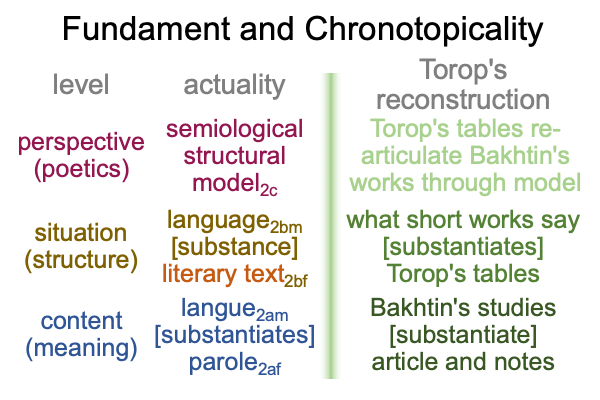
Torop has a positivist language2af, historically developed within the Tartu-Moscow School of Semiotics (on its preparation for a second iteration, this examiner hopes), for translating the somewhat disordered clues left by Bakhtin into a text, consisting of tables. Each of these tables correspond to an interscope (Peircean constructions, which the author does not have at the time, but are implicit to the tables, themselves).
There are two tables.
The one dealing with narrative and performance associates to the semiological level of the fundament interscope.
The one dealing with space and time associates to the structural level of the fundament interscope.
These tables correspond to the literary text2bf as form for the fundament interscope.
1079 In Torop’s language, langue as matter2am consists in what Bakhtin is thinking, and wondering about, in regards to the way that literature works. This matter2am sort of emerges from a signfied1a in the normal context of Saussure’s semiology3a. Parole as form2af consists in the article that Bakhtin writes and the pages of notes that survive concerning the nature of the “chronotope”. Indeed, the spoken word, “chronotope2af” situates the signifier1a that Bakhtin imagines and Torop uses to tag the article and the pages of notes.
Bakhtin’s works correspond to langue2am and parole2af in the fundament interscope.
1080 These associations allow me to apply the fundament interscope, as a semiological structuralist model2c, to Torop’s tables2bf.
1081 To me, this application is appealing.
1082 I now move on to the rest of Lotman’s observation.
Each generation, in principle, does not have a language to describe tomorrow.
1083 How does this apply?
In 2017, Torop does not have Peirce’s construction of the interscope.
The basics are presented by Razie Mah’s e-books, A Primer on the Category-Based Nested Form and A Primer on Sensible and Social Construction (available at smashwords and other e-book venues).
1084 Despite this lack, Torop successfully communicates that Bakhtin’s parole2af of the “chronotope” serves as the language2bm that substantiates two tables2bf. The universality of the “chronotope”2af and the intelligibility of Torop’s two tables2bf are weighed when one regards them as contributing to a semiological3a structuralist3b model2c.
1085 Here is corresponding interscope.
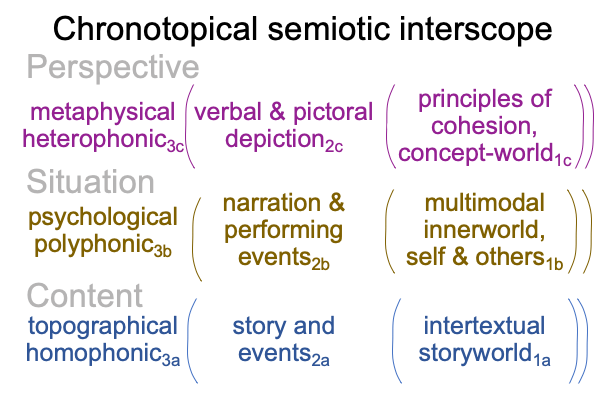
1086 The above interscope may be compared to the interscopes postulated by this examiner as characteristic of the Tartu-Moscow School of Semiotics.
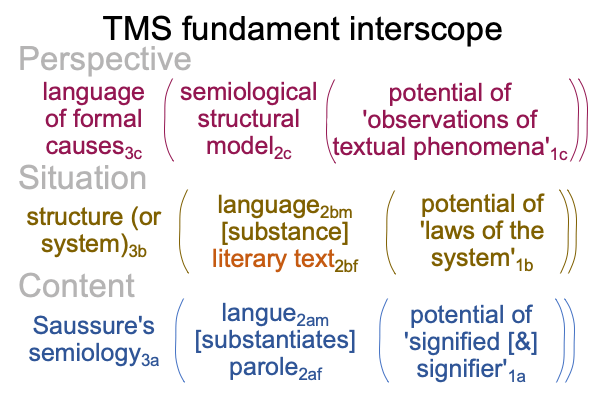
1087 But there is more.