0642 The article before me is published by Sign System Studies (volume 45(3/4), 2017, pages 230-248) by Boris Uspenskij (1937-present), one of the members of the first ascent of the Tartu-Moscow School of Semiotics, in the 1960s through the 1980s. The full title is “Semiotics and culture: The perception of time as a semiotic problem”. The paper was originally presented as a lecture held in Madrid in 2010. Plus, the paper is based on a two-part article published under the title “History and Semiotics (the perception of time as a semiotic problem)” in 1988 and 1989.
0643 The first ascent of the Tartu-Moscow School of Semiotics builds a fundament of semiology3a, structuralism3b and disciplinary languages3c that retain formal and final causations along with material and efficient causalities (called “exact methods3c“). The result is an actuality2c, a semiological structural model2c (SVi), that stands for a dyadic actuality2a where {the literary text2af (SOi) [entangles] a language2am of meaning, presence and message1a}.
0644 Here is a diagram of the fundament interscope.
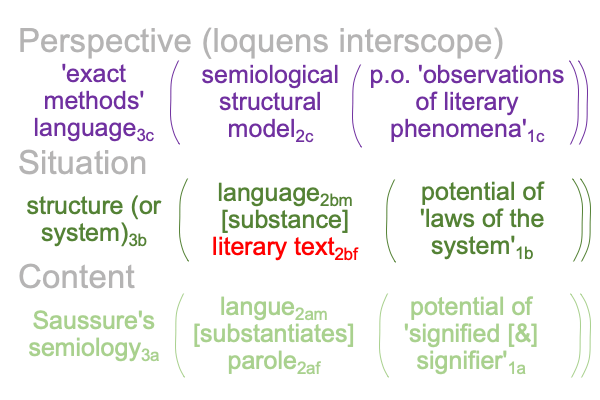
0645 Exact methods3c?
Think of it3c as flying a probe2bm into a cloud of phenomena1c that cannot fully objectify the noumenon of a literary text2bf. This scholarly data-collector2bm extracts observations and measurements1c that will be evaluated (using exact methods) on the basis of signification3a(1a) and structure3b(1b).
0646 Semiological structural model2c?
According to the empirio-schematic judgment, a disciplinary language (relation, thirdness) brings a mechanical or mathematical model (what ought to be, secondness) into relation with observations and measurements of phenomena (what is, firstness).
A parallel construction follows.
A disciplinary language of exact methods3c (relation, thirdness) brings a semiological structuralist model2c (what ought to be, secondness) into relation with observations and measurements of phenomena1c within a literary text2bf (what is,firstness).
0647 Phenomena1c?
Phenomena are observable and measurable facets of a noumenon, a thing itself.
According to Kant’s slogan, a phrase that Kant may have never uttered but which is attributed to him in the same way that the entire Pentateuch is attributed to Moses, a noumenon cannot be fully objectified as its phenomena. A thing itself cannot be reduced to its observable and measurable facets.
0648 Language2bm?
Language2bm is the situation-level matter (as opposed to form) constituted by Saussure’s definition of language2aentering into a structure (or system)3b, such as a mother tongue3b, a genre3b, a style3b, an artistic community3b, a tradition3b, and other civilizational beings3b.
0649 Clearly, the semiological3a structuralist3b model2c aims to capture an Aristotelian expression of how language as matter2bm substantiates a literary text as form2bf.
Without the literary text2bf, a semiological structural model2c cannot coalesce because there is nothing to delimit free-floating, unanchored language from the phenomena that an inquirer is interested in. It is like matter without a form to substantiate. It’s useless.
0650 So, in the fundament interscope, language as matter2bm gives substance to the literary text as form2bf.
At the same time, the literary text as form2bf allows the entire situation-level hylomorphe2b to take a shape where language2bm may be regarded as phenomena.
0651 Say what?
Language2bm substantiates the literary form2bf and, at the same time, may be regarded as phenomena of the literary form2bf.
It2bm is substantiating matter2bm (esse_ce) because it virtually situates the content-level actuality2a, {langue2am[substantiates] parole2af}.
It2bm is regarded as literary phenomena by the perspective-level potential1c.
0652 The substantiated form2bf (essence) is like a noumenon and its2bf substantiating matter2bm (esse_ce) serves as its2bf observable and measurable facets (that is, its phenomena).