0627 Today, we no longer are who we evolved to be.
What does this imply?
We can no longer be who we evolved to be.
Our current Lebenswelt is not the Lebenswelt that we evolved in.
0628 Today, the general ego interscope presents a purely relational structure (a suite of triadic relations) that may be processed implicitly. This is the configuration of langue, as opposed to parole.
Here is a picture.
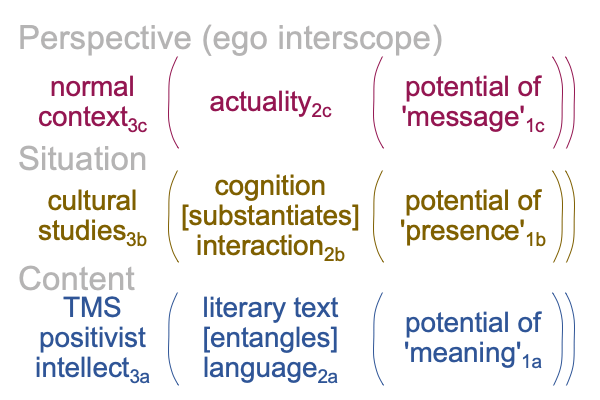
0629 Almost all of the elements of the interscope are filled with explicit abstractions.
A trace of Aristotle’s philosophy resides in the Tartu-Moscow School of Semiotics. Upwellings from deep within Slavic civilization breathe into explicit abstractions.
An archaeology can be seen in the structure of the content- and situation-level actualities. According to Aristotle’s hylomorphe, matter [substantiates] form. But, this Christianized pagan civilization realizes the inverse is also a thing. Form [entangles] matter.
0630 In the example, the form of a small bird entangles the matter of a young initiate.
The claim coheres with the crucial claim of Razie Mah’s book on hominin evolution, The Human Niche. Our niche is the potential of triadic relations.
The lesson appears like a banner on the perspective level.
0631 This brings me to the joke about Juri Lotman’s soulful encounter with St. Methodius.
During the first ascent of the Tartu-Moscow School in the USSR, structural3b semiological3a models2c are on the scientific side of the fence. The fence demarks the academic turfs of science (Marxist theory) and superstition (Christian faith, in all its diversity).
Now, the second ascent of the Tartu-Moscow School occurs as the USSA, the maven of technology without meaning,claims the mantle of science (psychometric theory) as opposed to superstition (still Christian faith, in all its diversity).
0632 Does the second ascent of TMS forgo occupation of the science side of the fence?
Or does it straddle the fence?
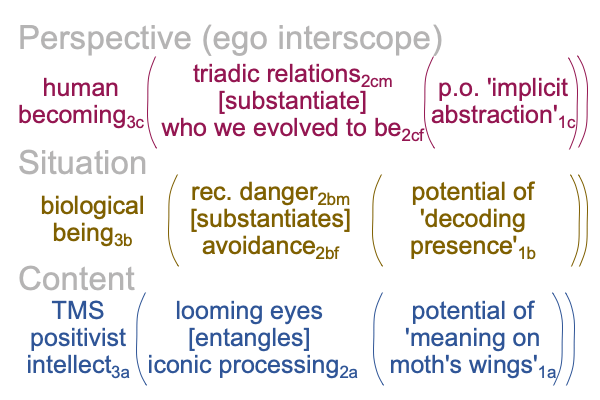
0633 It may sound uncomfortable, but take a look at the following sequence of perspective level nested forms.
0634 In regards to the universe of signs, Lotman challenges Marx’s paradigm.
Do material arrangements [substantiate] the human condition2cf?
Lotman begs to differ.
0635 In regards to the evolution of humanity, Peircean diagrams turn out to be useful for depicting the relational beings inherent in implicit abstraction.
Consider Comments on Michael Tomasello’s Arc of Inquiry (1999-2019), by Razie Mah, available at smashwords and other e-book venues.
0636 In regards to the human as a semiotic animal, one must not forget that both exemplar and interventional signs intercalate in the perspective level of an interscope.
The specifying, exemplar and interventional signs appear in Looking at John Deely’s Book (2010) “Semiotic Animal”. This sequence of blogs appears in Razie Mah’s website in October 2023.
0637 What wonderful opportunities for the second ascendance of the TMS!
0638 But, that is not the only challenge that comes from this examination of the interview with Boris Uspenskij in the early 2010s and published in Sign Systems Studies in 2017.
I suppose that there is more than one way to denote primary, secondary and tertiary modeling systems, so why not advance one more?
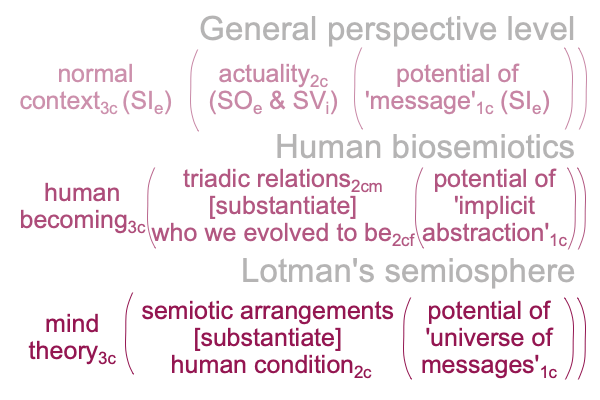
0639 Here is another proposal.
Consider three tiers of interscopes, with the perspective-level of each tier displaying the following nested forms.
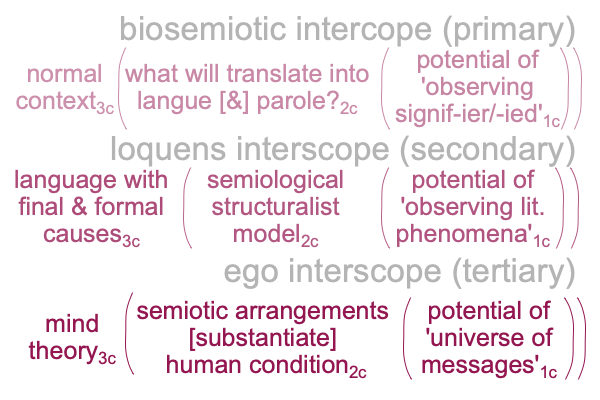
0640 To me, this sequence of primary, secondary and tertiary modeling systems suggest that Peirce’s diagrams may assist in knitting biosemiotics and TMS together into one overarching theoretical framework.
Three tiers of interscopes works well in the chapter on presence in Razie Mah’s How To Define The Word “Religion”. So, this might be a diagram worth mulling over.
0641 I thank the interviewer, Kaveli Kull, and Boris Uspenskij for engagements worthy of examination. I thank Ekaterina Velmezova for the translation into English.