Looking at Ekaterina Velmezova and Kalevi Kull’s Article (2017) “Boris Uspenskij…” (Part 1 of 19)
0377 The article before me is published by Sign System Studies (volume 45(3/4), 2017, pages 404-448) by two well-regarded semioticians. The full title is “Boris Uspenskij on history, linguistics and semiotics”. Kalevi Kull conducts the interviews. Ekaterina Velmezova performs translation.
The article consists of two sit-downs. The first takes place at the end of a eighth session of the Tartu Summer School of Semiotics, in August 25, 2011. The topic of the Summer School was Semiotic Modelling. The second takes place at Uspenskij’s home in Rome on May 27, 2012. The questions are based on his book, Ego Loquens: Language and the Communicative Space (2007).
0378 This examination seeks to appreciate how one of the leading figures of the Tartu-Moscow School of Semiotics, which flourished from the 1960s to the 1980s, weaves Saussure’s definition of spoken language as two arbitrarily related systems of differences, into a science-friendly inquiry into the literature of the Slavic civilization.
0379 Two arbitrarily related system of differences?
Parole (speech talk) also corresponds to the written word as well as symbolic artifacts. Parole can be observed and measured.
Langue (the machinations that automatically decode and encode speech talk) cannot be directly observed in the same way as parole. Yet, langue is there. It must be. Otherwise there is no way that someone can think before speaking, should that person choose to do so.
0380 Parole and langue are two contiguous real elements. The continuity, if placed in brackets is [arbitrarily related].
This configuration satisfies the definition of Peirce’s category of secondness, where one real element [is contiguous with] another real element. For Aristotle’s hylomorphe, the two real elements are matter and form. I label the contiguity, [substance] or [substantiates], but it also could be [entangles]. Substance is typical. Entanglement is tricky.
0381 Here is a picture of the comparison between Aristotle’s hylomorphe and Saussure’s definition of language.
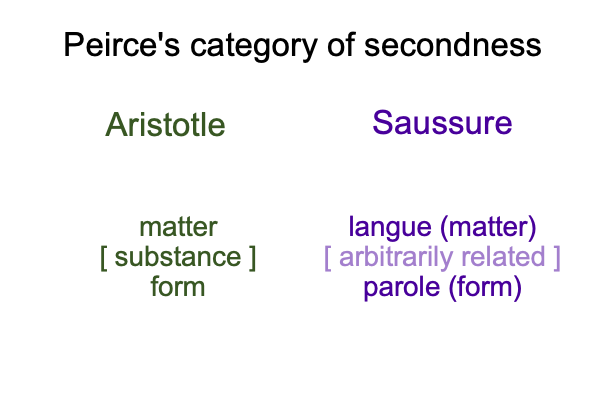
0382 Saussure’s definition of language appears to be scientific, because there is no substance. That is, there is no metaphysical reason for why what we think comes to be associated to what we say. So, the arbitrary relation is simply a conditioned response. A conditioned response conforms to truncated material and efficient causalities.
Another term for “conditioned response”?
How about “code” and “decode”?
0383 Okay, if that is the case, then what?
What if what we think (langue) is like matter? What if what we say (parole) is like form?
Then, the contiguity, [arbitrary relation], seems to say that we can attach any word to any thought, without structure. So, something structural would need to situate the content of a spoken word, even if that structure is a habit or a convention. Once that happens, then the hylomorphe, {langue as matter [substantiates] parole as form}2a, occupies the actuality2a on the content-level of a two-level interscope. Language2bm is the situation-level matter that induces a constellation of the content-level hylomorphe.
0384 Okay, if language2b is (by Saussure’s definition) the dyad, {langue2am [arbitrary relation] parole2af}, then how can language2b situate itself2a?
This can only happen if language2b is already participating as a situation-level category-based nested form involved in the production of statements2b.
0385 Here is a picture.
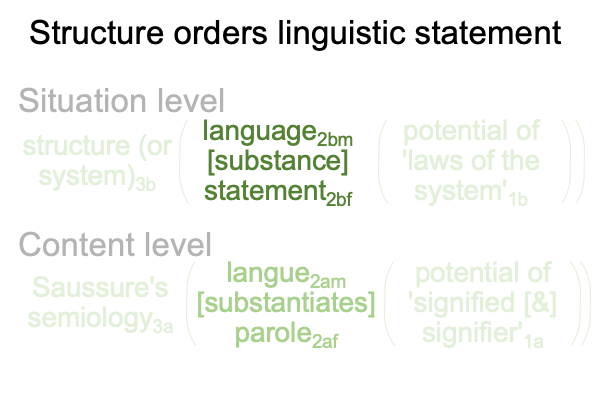
0386 It is as if the content-level actuality2a is immediately situated by a demand to substantiate a statement, as if language2b is matter and a statement2b is form.
0387 But, obviously, there is more.
The content-level actuality2a is accompanied by a normal context3a and potential1a.
So is the situation level actuality2b.
0388 For the content level, the normal context of Saussure’s semiology3a brings the dyadic actuality of {langue as matter [substantiates] parole as form}2a into relation with the potential of ‘a signified and its signifier’1a.
0389 For the situation level, the normal context of a linguistic structure (or genre or system)3b brings the dyadic actuality of {language as matter [substantiates] statements as form}2b into relation with the potential of ‘the laws of the system’1b.