01/10/26

Looking at Ekaterina Velmezova and Kalevi Kull’s Article (2017) “Boris Uspenskij…” (Part 19 of 19)

0627 Today, we no longer are who we evolved to be.

What does this imply?

We can no longer be who we evolved to be.

Our current Lebenswelt is not the Lebenswelt that we evolved in.

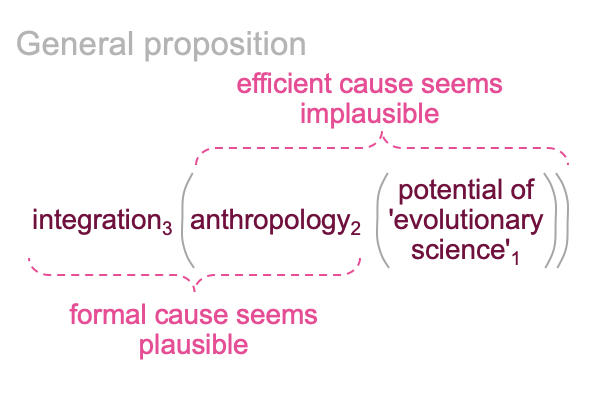
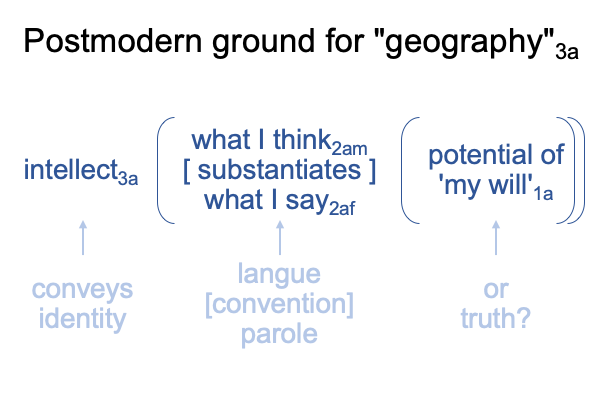
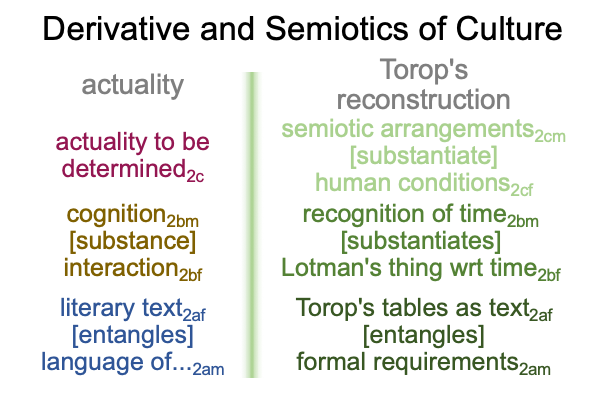
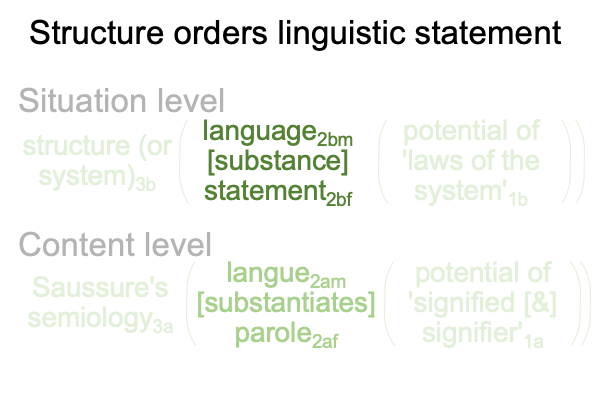
0628 Today, the general ego interscope presents a purely relational structure (a suite of triadic relations) that may be processed implicitly.  This is the configuration of langue, as opposed to parole.

Here is a picture.

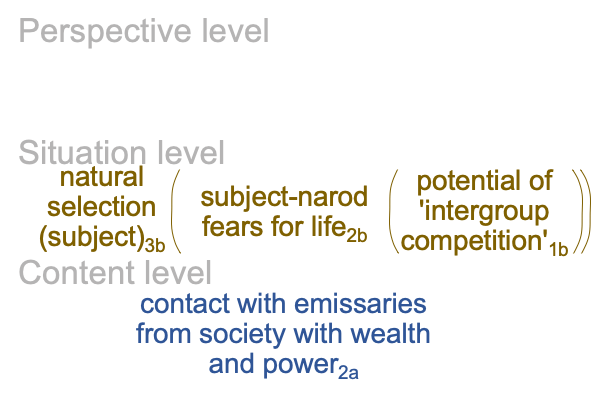
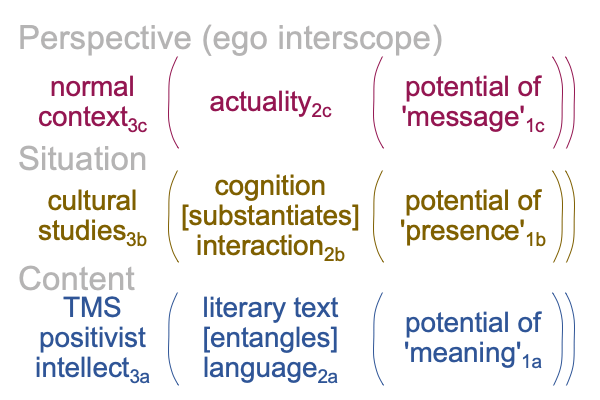
0629 Almost all of the elements of the interscope are filled with explicit abstractions.

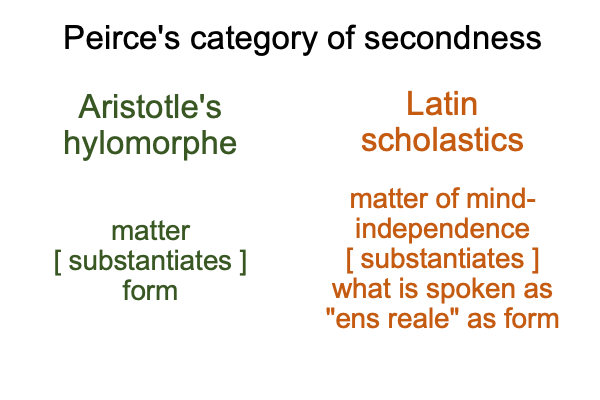
A trace of Aristotle’s philosophy resides in the Tartu-Moscow School of Semiotics. Upwellings from deep within Slavic civilization breathe into explicit abstractions

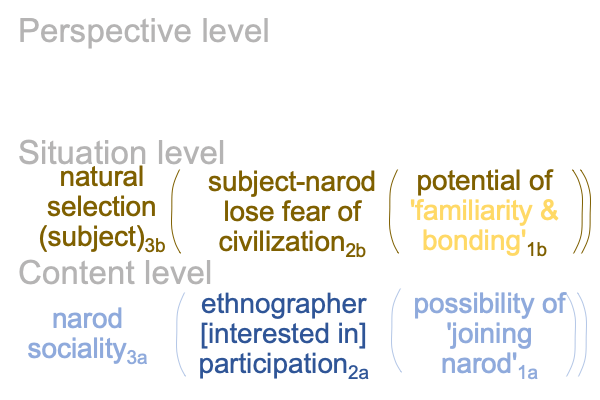
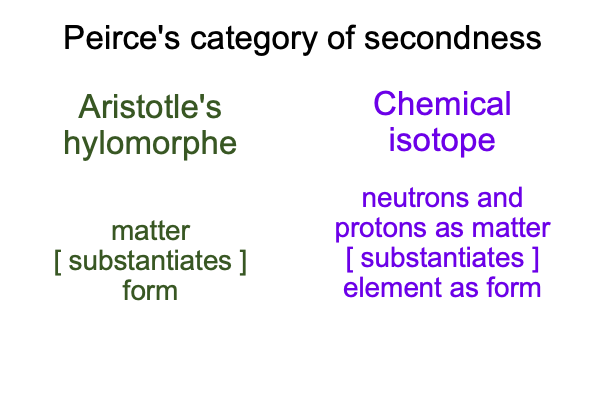
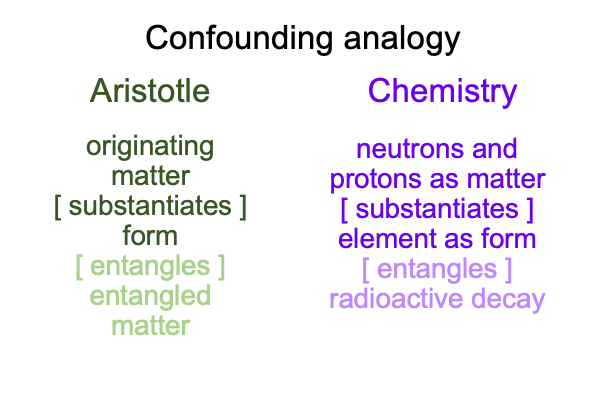
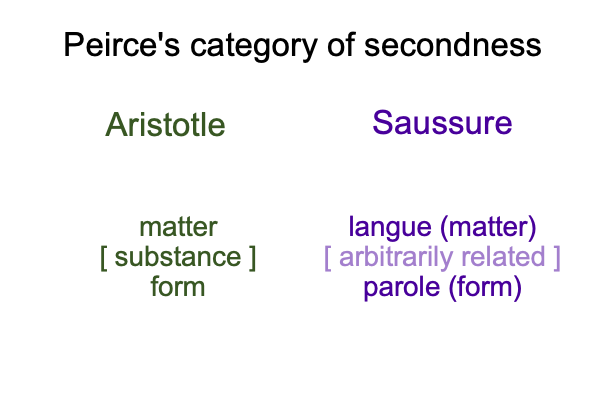
An archaeology can be seen in the structure of the content- and situation-level actualities.  According to Aristotle’s hylomorphe, matter [substantiates] form.  But, this Christianized pagan civilization realizes the inverse is also a thing.  Form [entangles] matter.

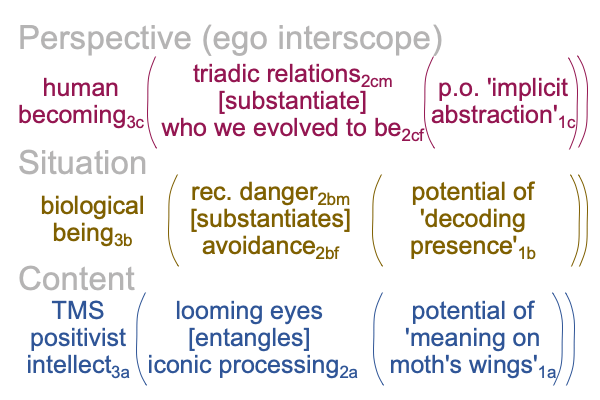
0630 In the example, the form of a small bird entangles the matter of a young initiate.

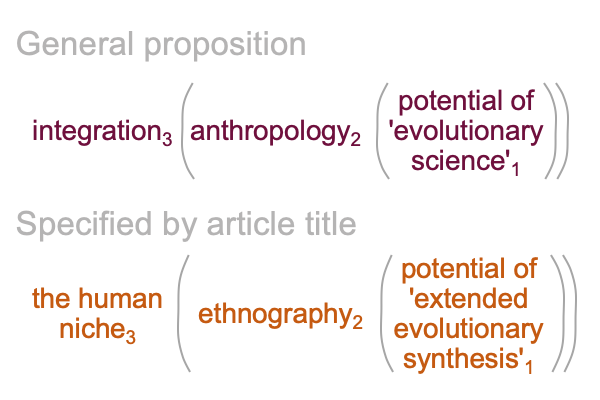
The claim coheres with the crucial claim of Razie Mah’s book on hominin evolution, The Human Niche.  Our niche is the potential of triadic relations

The lesson appears like a banner on the perspective level.

0631 This brings me to the joke about Juri Lotman’s soulful encounter with St. Methodius.

During the first ascent of the Tartu-Moscow School in the USSR, structural3b semiological3a models2c are on the scientific side of the fence.  The fence demarks the academic turfs of science (Marxist theory) and superstition (Christian faith, in all its diversity).

Now, the second ascent of the Tartu-Moscow School occurs as the USSA, the maven of technology without meaning,claims the mantle of science (psychometric theory) as opposed to superstition (still Christian faith, in all its diversity).

0632 Does the second ascent of TMS forgo occupation of the science side of the fence?

Or does it straddle the fence?

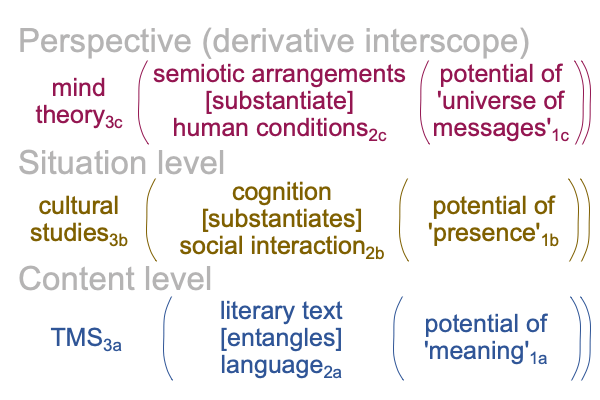
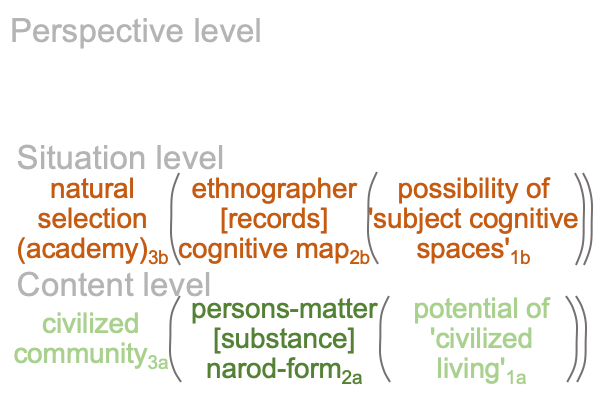
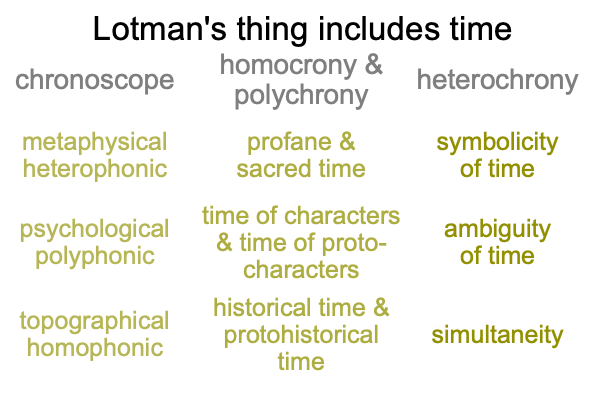
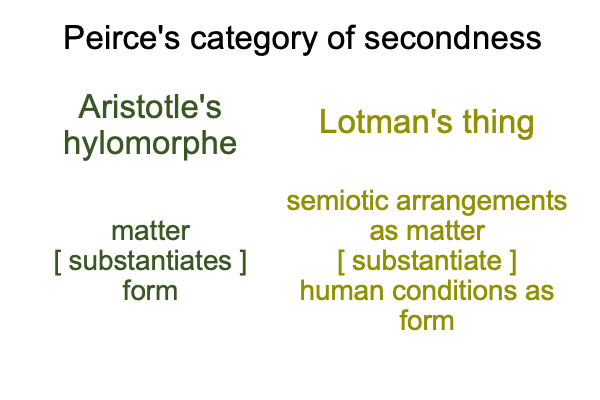
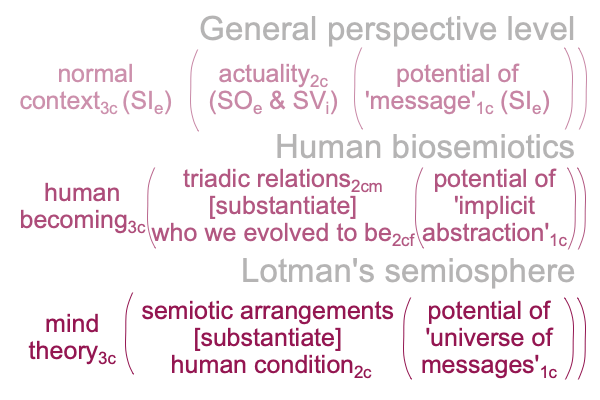
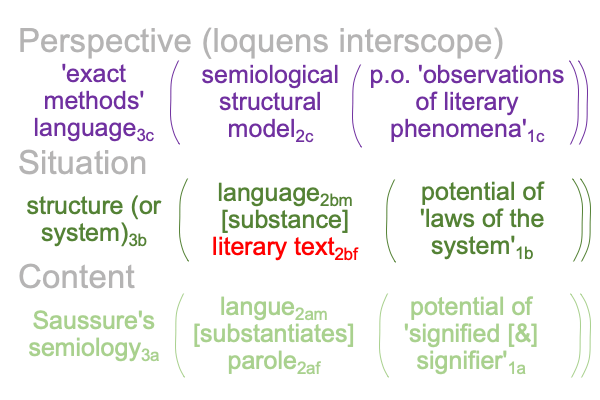
0633 It may sound uncomfortable, but take a look at the following sequence of perspective level nested forms.

0634 In regards to the universe of signs, Lotman challenges Marx’s paradigm.

Do material arrangements [substantiate] the human condition2cf?

Lotman begs to differ.

0635 In regards to the evolution of humanity, Peircean diagrams turn out to be useful for depicting the relational beings inherent in implicit abstraction.  

Consider Comments on Michael Tomasello’s Arc of Inquiry (1999-2019), by Razie Mah, available at smashwords and other e-book venues.

0636 In regards to the human as a semiotic animal, one must not forget that both exemplar and interventional signs intercalate in the perspective level of an interscope.

The specifying, exemplar and interventional signs appear in Looking at John Deely’s Book (2010) “Semiotic Animal”.  This sequence of blogs appears in Razie Mah’s website in October 2023.

0637 What wonderful opportunities for the second ascendance of the TMS!

0638 But, that is not the only challenge that comes from this examination of the interview with Boris Uspenskij in the early 2010s and published in Sign Systems Studies in 2017.

I suppose that there is more than one way to denote primary, secondary and tertiary modeling systems, so why not advance one more?

0639 Here is another proposal.

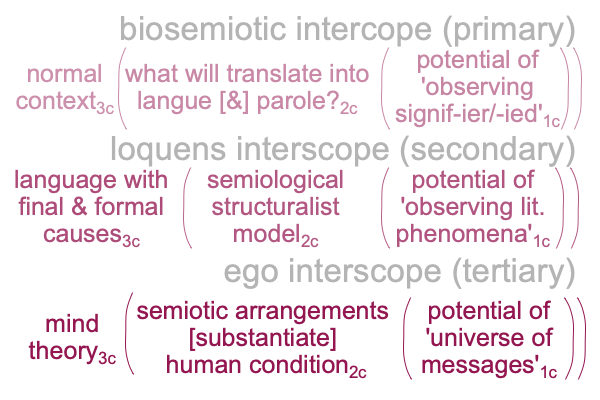
Consider three tiers of interscopes, with the perspective-level of each tier displaying the following nested forms.

0640 To me, this sequence of primary, secondary and tertiary modeling systems suggest that Peirce’s diagrams may assist in knitting biosemiotics and TMS together into one overarching theoretical framework.

Three tiers of interscopes works well in the chapter on presence in Razie Mah’s How To Define The Word “Religion”.  So, this might be a diagram worth mulling over.

0641 I thank the interviewer, Kaveli Kull, and Boris Uspenskij for engagements worthy of examination.  I thank Ekaterina Velmezova for the translation into English. 

01/9/26

Looking at Boris Uspenskij’s Article (2017) “Semiotics and Culture”  (Part 1 of 8)

0642 The article before me is published by Sign System Studies (volume 45(3/4), 2017, pages 230-248) by Boris Uspenskij (1937-present), one of the members of the first ascent of the Tartu-Moscow School of Semiotics, in the 1960s through the 1980s.  The full title is “Semiotics and culture: The perception of time as a semiotic problem”.  The paper was originally presented as a lecture held in Madrid in 2010.  Plus, the paper is based on a two-part article published under the title “History and Semiotics (the perception of time as a semiotic problem)” in 1988 and 1989.

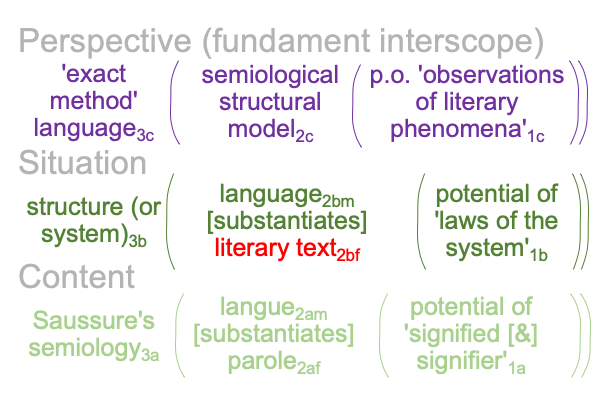
0643 The first ascent of the Tartu-Moscow School of Semiotics builds a fundament of semiology3a, structuralism3b and disciplinary languages3c that retain formal and final causations along with material and efficient causalities (called “exact methods3c“).  The result is an actuality2ca semiological structural model2c (SVi), that stands for a dyadic actuality2a where {the literary text2af (SOi) [entangles] a language2am of meaning, presence and message1a}.

0644 Here is a diagram of the fundament interscope.

0645 Exact methods3c?

Think of it3c as flying a probe2bm into a cloud of phenomena1c that cannot fully objectify the noumenon of a literary text2bf.  This scholarly data-collector2bm extracts observations and measurements1c that will be evaluated (using exact methods) on the basis of signification3a(1a) and structure3b(1b).

0646 Semiological structural model2c?

According to the empirio-schematic judgment, a disciplinary language (relation, thirdness) brings a mechanical or mathematical model (what ought to be, secondness) into relation with observations and measurements of phenomena (what is, firstness).  

A parallel construction follows.

A disciplinary language of exact methods3c (relation, thirdness) brings a semiological structuralist model2c (what ought to be, secondness) into relation with observations and measurements of phenomena1c within a literary text2bf (what is,firstness).

0647 Phenomena1c?

Phenomena are observable and measurable facets of a noumenon, a thing itself.

According to Kant’s slogan, a phrase that Kant may have never uttered but which is attributed to him in the same way that the entire Pentateuch is attributed to Moses, a noumenon cannot be fully objectified as its phenomena.  A thing itself cannot be reduced to its observable and measurable facets.

0648 Language2bm?

Language2bm is the situation-level matter (as opposed to form) constituted by Saussure’s definition of language2aentering into a structure (or system)3b, such as a mother tongue3b, a genre3b, a style3b, an artistic community3b, a tradition3b, and other civilizational beings3b.

0649 Clearly, the semiological3a structuralist3b model2c aims to capture an Aristotelian expression of how language as matter2bm substantiates a literary text as form2bf.

Without the literary text2bf, a semiological structural model2c cannot coalesce because there is nothing to delimit free-floating, unanchored language from the phenomena that an inquirer is interested in.  It is like matter without a form to substantiate.  It’s useless.

0650 So, in the fundament interscope, language as matter2bm gives substance to the literary text as form2bf.

At the same time, the literary text as form2bf allows the entire situation-level hylomorphe2b to take a shape where language2bm may be regarded as phenomena.

0651 Say what?

Language2bm substantiates the literary form2bf and, at the same time, may be regarded as phenomena of the literary form2bf.

It2bm is substantiating matter2bm (esse_ce) because it virtually situates the content-level actuality2a, {langue2am[substantiates] parole2af}.

It2bm is regarded as literary phenomena by the perspective-level potential1c.

0652 The substantiated form2bf (essence) is like a noumenon and its2bf substantiating matter2bm (esse_ce) serves as its2bf observable and measurable facets (that is, its phenomena).

12/31/25

Looking at Igor Pilshchikov and Mikhail Trunin’s Article (2016) “The Tartu-Moscow School of Semiotics” (Part 1 of 27)

0001 The article before me is published by Sign System Studies (44(3) (2016) pages 368-401) by two professors, Igor Pilshchikov and Mikhail Trunin, hailing from Tallinn University in Estonia.  The title is “The Tartu-Moscow School of Semiotics”. The subtitle is “A transnational perspective”.

0002 The abstract promises to situate the Tartu-Moscow School of Semiotics of the 1960s through 1980s.  The article delivers more than promised.

How so?

0003 The authors sketch dynamic developments among intellectual circles within the (now former) Union of Soviet Socialist Republics.

0004 The term, “transnational”, indicates that there are nations within the former Soviet Union.

During this period in history, the governments of Estonia and Russia (along with Czechoslovakia and Poland) owe fealty to an empire with the title, “Socialist”, in its name.

So, “transnational” tells me that the article looks back from the present, into a past era, with the intent of portraying ‘something’ historical, without acknowledging that the “Union” and the “Socialist” descriptors no longer apply (at least, not in the way that they once did).

0005 “Transnational” applies to the Union of Soviet Socialist Republics (USSR, 1918-1989) as well as the upcoming… um… Eurasian convergence?

Here is a picture with three city-sites.  Tartu and Moscow belong to the title.  Tallinn is the location where the authors write their article.  The blue is the Baltic Sea.

0006 “Transnational” steps over the boundaries depicted in black in the above figure.

Never mind the fact that the above territories reside behind, what American pundits once called, “the Iron Curtain”.

0007 Perhaps, one must appreciate an ambiguity to the term, “transnational”, given that there is another transit.  This transit is in time.  Or, even better, this transit is across a boundary between battles among Enlightenment gods.

Consider where the time period of 1960s to 1980s resides in the following timeline of Western civilization in the twentieth century.

Also consider the year when the article under examination is published.

Notice the boundary.

0008 The Tartu-Moscow School of Semiology constellates within one battle, as a transnational collaboration.

The TMS is remembered during another battle, which is not resolved, and so cannot be objectified as “historical”.  I suppose that it can be objectified as “cultural”.  Better yet, “theodramatic”.

Already, there is more to this article than meets the eye.

06/30/25

Looking at George Mikhailovsky’s Chapter (2024) “Meanings, Their Hierarchy, and Evolution” (Part 1 of 9)

1053 The text before me is chapter six of Pathways (see point 831 for book details, pages 101 through 136).  The author is one of the editors of Pathways.

1054 To me, the abstract introduces evolution writ large.

The abstract suggests that the interventional sign-relation precedes semiotic agency, as far as evolution writ large goes.  Evolution writ large includes the evolution of the inanimate universe along with the evolution of life.

1055 Before life, inanimate objects manifest only as meanings-in-themselves.  An evolving macroscopic thing may be labeled an “eventity”, which seems like a real initiating (semiotic) event2a (SVs) or an action that could be goal-directed2c (SVi).

Surely, some eventities rely on lower-level entities.  But, what about agency and subagency?

With non-human life, hierarchies of sub-agents3 operate within each living agent3 (or “holobiont”).

With human life, persons3, who are holobionts in terms of anatomy and physiology, operate as subagents within… what?… social circles?

1056 The introduction (section 6.1) starts with an observation.  The term, “meaning” is typically used in three situations.

Here is the list along with associated sign-elements.

1057 This coincidence is remarkable.  At the very start of the introduction, the author offers situational instances of “meaning” that correlate to the three sign-objects intrinsic to a three-level interscope.

The author then writes that he is interested in the first two types (the ones associated with semiotic agency) but not so much the third type (the one associated with the interventional sign relation), because this one is already well-developed in linguistic semiotics.

1058 But, there is another coincidence to note.

Recall that Peirce’s typology of natural signs is based on the categorical qualities of the sign-object.

The icon is a sign-relation whose sign-object is based on the qualities of firstness, including images, pictures, unities, wholes.  The logic of firstness is inclusive and allows contradictions.  A sign-vehicle stands for its sign-object on the basis of similarity or imagery.

The index is a sign-relation whose sign object is based on the qualities of secondness, including contact, contiguity, pointing, influence, cause and effect and so on.  The logic of secondness includes the law of noncontradiction.  A sign-vehicle stands for its sign-object on the basis of indication and pointing.

The symbol is a sign-relation whose sign-object is based on the qualities of thirdness, including normal context, mediation, judgment, habit, tradition and so on.  The logics of thirdness are exclusion, complement and alignment.  A sign-vehicle stands for its sign-object on the basis of convention.

1059 Since all sign-objects belong to secondness, I can assign Peirce’s typologies on the basis of the category of the level in a three-level interscope.  Icon goes with the level of content.  Index associates the situation level.  Symbolmatches the perspective level.

1060 Here is a list of associations.

1061 I ask, “How well do the two coincidences correspond?

1062 I start with thirdness, an exemplar sign is a symbol whose sign-object, SOe, denotes a goal2c on the perspective level.  The sign-object has the qualities of both acquired habit and innate disposition.  So, the assignment of symbolworks.

1063 For secondness, a specifying sign is an index whose sign-object, SOs, denotes a symptom2b on the situation level. I suppose that corresponds to information2b.  A symptom2b virtually situates its phenomenon2a in the same way that information3b virtually situates an initiating (semiotic) event2a.  The sign-object holds the qualities of indication and pointing.  So, the assignment of index works.

1064 For firstness, an interventional sign is an icon whose sign object, SOi, denotes something that is indicated or expressed in spoken words or symbols2a on the content level.  Does that correspond to intention expressed2a (SOi)?  Or, better yet, does that correspond to an image of intention expressed2a (SOi) that is contiguous with a real initiating event2a (SVsin the dyadic content-level actuality2a?

Is the third situation for “meaning” an image that is indicated or expressed in spoken words and symbols.

Imagine that!

‘Something’ is an image.

06/20/25

Looking at George Mikhailovsky’s Chapter (2024) “Meanings, Their Hierarchy, and Evolution” (Part 9 of 9)

1137 The material that I cover in my portrayal of C1 and C2 using Frege’s triangle goes with section 6.3, titled “Potential Meanings During the Abiotic Period of the Evolution of the Universe”.

Here is a picture.

C4 (is missing because it) covers the genesis of atoms with masses greater than helium.  Technically, C4 follows C5, as written above.  Why?  Atoms with masses greater than helium are produced by nuclear fusion in stars.  The story bifurcates from the cosmic sequence to the substance sequence.  The substance sequence starts with atoms with masses greater than helium and proceeds through the emergence of life.

1138 The Frege triangles for C1 and C2 are easy compared to what follows in section 6.4 (“Evolution of Meanings in Biological Systems”) and 6.5 (“The Evolution of Meanings in Human Societies and the Relationship between Hierarchies of Substance (that is, biology) and Semantics (that is, within our current Lebenswelt)”).

Nevertheless, my exercises demonstrate the utility of Frege’s triangle in the extension of the biosemiotic interscope into all aspects of postmodern inquiry, including into abiotic noumena, the domains of physics and chemistry.

1139 There are many threads to follow in this demonstration.

The first thread is obvious.  Can this be done for all noumena listed in Table 6.2?

The answer is yes.  Once one starts a spiral, other spirals follow, and they diverge, and they coalesce, and who knows what else.

1140 The starting point of the author’s cosmos chain (C1) is obviously the Big Bang.

But, one can say that other starting points can be imagined, hence theories of the multiverse.  The multiverse consists of many universes, each with different energy, space, natural laws and constants.  Physicists can simulate these many “universes”.  Hollywood movie makers can fashion plotlines from the conceptc.  It is all very theatrical, including the name for the start of our own universe, “the first singularity”.

1141 The starting point of the author’s substantial chain (S1) is atoms, made in stellar furnaces because (up to the atomic configuration of iron) fusing atoms releases a tremendous amount of energy, enough to keep a star from falling in on itself from gravity.

Anyone who has cracked a chemistry textbook knows that there is no “first singularity” to be found in this discipline.  One can imagine that each element in the periodic table constitutes its own singularity.  Spirals diverge and coalesce in the most fantastic ways, so there is no telling which molecules are the precursors to life and which are not.

1142 This is where Frege’s terms complement Peirce’s.

Frege’s terms serve as spoken labels.  Labels are used for symbolic operations.  Symbolic operations undergird grammar (that is, language).  So, Frege’s terms point to the somewhat disturbing intimation that speech-alone talk (or a theoretical equivalent) is intercalated into semiotic agency and, by way of bridging, to significance that is outside of semiotic agency (that is, the interventional sign-relation).

Here is a picture.

1143 Peirce’s terms also serve as spoken labels.  These labels apply to the contiguities between real elements in the actualities of all interscopes.  These labels apply to something like [substance], in a contiguity between something like matter and something like form.  To a greater or lesser extent, all dyads in Peirce’s secondness pay tribute to Aristotle’s hylomorphe as an exemplar.

1144 The biosemiotic interscope reifies into the biosemiotic noumenal overlay, including both semiotic agency and the interventional sign-relation.

This chapter presents an impossible challenge.  Spirals (or hierarchies) go back to the first singularity, thirteen billion years ago.  Each spiral brings the inquirer to a new level.  Some spirals write small, others write large, but they all begin … for us … with a clot.  A pen touches paper, then moves to portray a diagram, a purely relational structure, portraying what all living things have in common.

1145 This examination recites all that has gone before.

This examination is a refutation to those who think that modern science knows enough to weave these spirals into a vision of our universe, as well as of us, the images of the one who speaks the universe into being.

1146 I say, “Diagram spirals!”

Perhaps, the author agrees and anticipates that Frege’s triangles will reveal a hierarchy… or is it?… a spirality that portrays meanings and their evolution.

06/19/25

Looking at Lorenzo Magnani’s Chapter (2024) “Anchors of Meaning” (Part 1 of 7)

1147 The text before me is chapter eighteen of Pathways (see point 831 for book details, pages 379-400).  The full chapter title is “Anchors of Meaning: The Intertwining of Signs, Abduction and Cognitive Niches”.  This chapter opens Part IV of Pathways.  The title of Part IV is “Meanings in Humans and Beyond”.  

1148 The author belongs to the Philosophy Section of the Department of Humanities at the University of Pavia, Italy.  He has a scientific affiliation as well, being a member of the Computational Philosophical Laboratory.

1149 The abstract tells a story that mirrors this examination (so far).  Biosemiotics is not only semiotic agency.  Biosemiotics encompasses semiotic agency and the interventional sign relation.  The two are bridged through the contiguities of [conceptc] and [symbola].

Human brains thrive on semiosis.  The brain generates a series of signs (specifying and exemplar) that latch onto an apparently external sign-relation (interventional) with the two contiguities of [conceptc] and [symbola].

1150 Or, should I use the word, “anchors”?

Here is the picture of the [conceptc] and the [symbola] as corners that anchor Frege’s triangle. 

[Conceptc] is the contiguity within the perspective-level actuality2c of a goal2c.

A banner wraps around the interventional sign-relation.

[Symbola] is the contiguity within the content-level actuality2a of a real initiating (semiotic) event2a.

1151 In section 18.1 (“Humans as Ecological Engineers and Chance Selectors”), the real initiating (semiotic) event2aencompasses innately anticipated systems of differences.  For, example, the infant expects to interact with persons.  Each person has his or her own face.  It’s like a system of differences (Saussure’s view) or a symbolic order (Peirce’s approach).

The family is one of the smallest social circles of the Lebenswelt that we evolved in.  Since roles are re-enacted generation after generation within this social circle, one might think that the each person2a images an appropriate role2c.  This happens at first…

…and one sees it when an infant gets separated from its mother.

That tyke is not taking any chances.

1152 The child is born with innate expectations of the smallest social circle (SOe) [and that means] family (SVi).

Does this look like Frege’s corner 2c?

1153 If so, then the interventional sign-relation, which stands outside every agent in the family, yet is the reality in which each agent participates, follows.

Family members2c (SVi) stand for their particular social roles2a (SOi) in regards to (a normal context like) what is happening3a operating on (a possibility like) the potential of ‘something’ happening1a (SIi).

1154 Here is a diagram of the interventional sign-relation for a newborn.

1155 Is this cultural-niche construction?

If so, then who or what is constructing this niche?  Or does the niche construct itself because it exploits an opportunitythat arises from the independent actuality of sign-relations?  Just like a bat exploits acoustics to echo-locate, humans exploit sign-relations to abduct who mommy must be.

Sign-relations are immaterial beings that entangle the material.  The materiality of the family members2c (SVi) signify the manifestation of ‘home’2a (the immaterial manifestation of family belonging, SOi) in regards to the normal context of the birth of an infant3a operating on the potential of ‘a successful birth’1a (SIi).

06/12/25

Looking at Lorenzo Magnani’s Chapter (2024) “Anchors of Meaning” (Part 7 of 7)

1216 This lion-man ivory is valuable.

Why?

1217 He is an agent, with a disembodied mind.

The other agent, the human, practices hand-speech talk, and occasionally is faced with moments when consultation may be advisable.  The community faces difficulties.  What are we to do?

Let the community-leader ask the lion-man.

1218 The Neanderthal cannot do this, because Neanderthals only practice hand-talk.

The humans practice hand-speech talk.  The ivory figure cannot hand talk.  So, the lion-man must speak.

1219 At this point, I enter the terrain of a precocious book, proposing that modern consciousness rises from the ashes of the breakdown of whatever is going on when the Paleolithic community-leader is speaking to lion-man, or rather, hearing the disembodied voice of lion-man.  The book is The Origin of Consciousness in the Breakdown of the Bicameral Mind(1976), by Princeton psychologist and psychohistorian, Julian Jaynes (1920-1997).

1220 The lion-man speaks in an interventional sign-relation.

Here is a picture.

Today, lion-man would be an app on an i-phone.

1221 This example brings this examiner through section 18.5 (“Material Anchors for Conceptual Blends”) and into section 18.6 (“Conclusion”).

1222 I rest my pen.

My thanks to the author, Lorenzo Magnani, and his team at the Computational Philosophy Laboratory.  May they find a way to portray the semiotics of a world that does not compute, otherwise labeled, the Lebenswelt that we evolved in.

06/11/25

Looking at Alexei Sharov and Morten Tonnessen’s Chapter (2021) “Human Agency” (Part 1 of 5)

1223 The text before me is chapter three of Semiotic Agency (2021, book details on point 830, pages 59-94).

1224 The abstract raises the question of evolution.  The question is addressed earlier in this examination.  Points 0710 through 0752 assert that the actualities of adaptation2b and phenotype2b are not the same.  One does not situate the other.  Instead, their nested forms intersect in such a manner as to constitute a single actuality2.  Adaptation2b and phenotype2b intersect to constitute a living being2.

1225 How shall I proceed?

Semiotic Agency yields the Sharov and Tonnessen noumenal overlay by taking an interscope that is similar to the scholastic interscope for how humans think and transubstantiating it from thirdness to secondness.

In thirdness, the scholastic interscope contains the specifying and exemplar sign-relations.

1226 Here is a diagram.

In secondness, the elements from these triadic sign-relations fit into a dyad, characteristic of Peirce’s secondness.

1227 The dyad consists of two contiguous real elements, very much in tune with Aristotle’s exemplar, matter [substance] form.

The following depicts a dyad within a dyad.  Each dyad exhibits its own configuration.

For the fundament, the specifying sign, SOs is like matter, SVs is like form, and SIs is [substance].  In a sense, a form of the sign-vehicle calls forth the matter of a sign-object, in the way that say, the form of a traffic stop sign2a (SVs) calls forth the matter of stopping the vehicle2b (SOs). 

For the resonant, the exemplar sign, SVe is like matter, SOe is like form, and SIe is like [substance].  The matter of me following the rules of the road2b (SVe) stands for my successful arrival at my driving destination2c (SOe) in regards to making sense3c operating on the possibility that if everyone obeys the rules of the road then each one of us will get where we are going to1c (SIe).

1228 This dyad within a dyad performs what phenomenology claims to do, that is, identify what the noumenon must be.

The noumenon of what?

Biosemiotics.

Or, should I say, “Biosemiotics as an exercise of the Positivist’s judgment, however compromised the positivist intellect may be.”?

1229 Of course, this is a fantastic claim.  But, this examination of Semiotic Agency (see point 830 for book details) and Pathways to the Origin and Evolution of Meanings in the Universe (see point 831 for book details) bears me out.  Sharov, Tonnessen and Mikhailovsky set the stage for a paradigm that not only is phenomenological, but accounts for how phenomenology works.  This examination adds value by presenting the diagrams.

06/6/25

Looking at Alexei Sharov and Morten Tonnessen’s Chapter (2021) “Human Agency” (Part 5 of 5)

1260 Say what?

Here is the intersection, once again.

1261 Yes, I can make out a configuration that looks like an exemplar sign-relation.

One version of the exemplar relation goes like this.  Information2b (SVe) stands for a goal (SOe) in regards to a normal context asking something like, “Does this make sense?”3c operating on the potential of ‘situating information’1c (SIe).

In the above diagram, information2b (SVe) is adaptation2H.  The goal2c (SOe) is the power to live as an agent.  The [contiguity] (SIe) is an intersection with the phenotype3c operating on the potentials that the phenotype provides1c.

1262 For the -darwinism version of exemplar sign-relation, the two actualities are adaptation2b (SVe) and the power to live as agent2c (SOe).  The contiguity is the normal context of an intersection with one’s phenotype3c, operating on the potentials that the phenotypes provide1c (SIe).

1263 For the neo- version of the exemplar sign-relation, the two actualities are phenotype2b (SVe) and the disposition to live as an agent2c (SOe).  The contiguity is the normal context of an intersection with one’s adaptations3c, operating on the potentials that adaptations provide1c (SIe).

1264 What do these two exemplar sign-relations tell us?

Adaptations express power?

Adaptations allow survival to the extent that the phenotype allows them?

Phenotypes express dispositions?

Phenotypes are expressed as a suite of adaptations whether the agent needs them or not?

No wonder biologists cannot “define” evolution concisely.

1265 Surely, this argument does not please the positivist intellect of the physicists and the chemists.

Biological evolution is a mystery, the intersection of two independent sciences, natural history and genetics.

But, that is not all.  I can delineate an implication for one of the contradictions inherent in biological evolution.

Phenotype is necessary for a -darwinian explanation, where “evolution” operates as an agent.  Phenotypic dispositions are inseparable from individual adaptive powers.

1266 Also, adaptation is necessary for a neo- (or genetic) explanation, where “evolution” operates as an agent.  Adaptive powers are inseparable from species-specific dispositions.

1267 Yes, I am arriving at a contradiction that cannot be resolved into either natural history or genetics.  Both of these discipline’s semiotic agency have the same agent, “evolution”.  But, what is the ‘final causality’?

1268 Here, the logics of firstness come into play.  The logics of firstness are inclusive and allow contradictions.  Evolution as an agent3 brings the actualities of adaptation and phenotype as semiotic agencies2 into relation with ‘a creative potential that evolutionary scientists regard as real’1.  But, it is unreal, because it represents a ‘final causality’ that stands beyond anything than the human can imagine.

After all, humans are evolved living beings.  What are we imaging when we try to picture this ‘final causality’?

1269 Modern evolutionary biologists may attribute the reality of the creative potential underlying evolution as an agent to matter alone, rather than matter [substance] form.

Postmodern biosemioticians may attribute the reality of the creative potential to triadic relations, such as the triadic relations reified into the matter [substance] form of semiotic agency.

1270 What does this imply?

The attribution of the biosemiotician encompasses the attribution of modern evolutionary biology.

The answer approaches the metaphysical in precisely the way that the Aristotle-tolerating positivist intellect currently uses the term, “metaphysics”, for “religious”.

The positivist intellect declares, “Religious empirio-schematic models are not allowed.”

1271 And, this raises a question, “How to define the word “religion?”

This question is the title of one of Razie Mah’s three masterworks.

More on that later.

06/5/25

A Brief Overview of What Razie Mah offers Biosemioticians in 2025 (Part 1 of 3)

1272 Biosemiotics challenges the current scientific vision of human evolution (as of 2025).

Okay, maybe I should correct that.

Razie Mah presents a challenge.  Biosemioticians can board the academic siege-apparatus at their leisure.

Leisure?

In 2010, in the book, Semiotic Animal, John Deely describes the owl of Minerva taking wing in the twilight of the modern Age of Ideas.  He, Thomas Sebeok and (no doubt) biosemiotician Alexei Sharov, know that the Third Age of Understanding comes to a close.

1273 In October 2023, Razie Mah blogs a review, titled Looking at John Deely’s Book (2010), “Semiotic Animal”.  This examination contains the scholastic interscope for how humans think.  The initial version of this interscope is developed in Razie Mah’s e-book, Comments on John Deely’s Book (1994) New Beginnings.  The interventional sign-relation comes into view in Comments on Sasha Newell’s Article (2019) “The Affectiveness of Symbols”.

1274 Then, starting in July and running through October 2024, Razie Mah offers a series of examinations in his blog, including Looking at Steve Fuller’s Book (2020) “A Player’s Guide to the Post-Truth Condition”; Joesph Pieper’s book (1974) “Abuse of Language: Abuse of Power”; Vivek Ramaswamy’s book (2021), “Woke, Inc.”; Michelle Stile’s book (2022), “One Idea to Rule Them All”; and N.H. Enfield’s book (2022), “Language vs. Reality”.

These reviews, full of diagrams of the interventional sign relation and detailing its relevance to the current historical moment, are collected in three e-books, Parts 1, 2 and 3, of Original Sin and The Post-Truth Condition.

1275 The owl of Minerva lands in the dawning Age of Triadic Relations.

1276 This brings me to the question of human agency.

Section 3.6 of Semiotic Agency is titled, “Development of Human Agency in Historical Perspective”.

The authors’ story begins with the Neolithic Revolution of the Fertile Crescent, starting around 12,000 years ago, then seamlessly drifts to our own current day.  It reads as if our current Lebenswelt starts with the Neolithic archaeological period.

1277 This story of the development of humanity is not much different from the written myths of the ancient Near East, where humans are um… created… when some differentiated god places special seeds in the soil… or something like that.  These ancient myths are recorded on cuneiform clay tablets, that are preserved by their incineration in royal libraries thousands of years ago.  

Yes, incineration.

The tablets are made of clay.

The capital burns.  Clay fires to brick.  Brick lasts so long that an archaeologist can read the script of a tablet millennia later.

1278 The origin myths of the ancient Near East testify that humans are recent creations, formed from differentiated gods, for the god’s own purposes.  That sounds like our current Lebenswelt to me.  That sounds like the “Development of Human Agency in Historical Perspective”.

Why don’t civilized humans have the agency to see beyond the start of their own civilizations?

1279 Biosemiotics has an answer.  Civilized humans practice a type of semiosis that differs from the type of semiosis that their ancestors practiced.

What am I talking about?

The evolution of talk is not the same as the evolution of language.

1280 Our current Lebenswelt of civilizations practices speech-alone talk.  Speech-alone talk offers the comforts of implicit abstraction (characteristic of icons and indexes) and facilitates the unexpectedly profitable rewards (and the unanticipated costs) of explicit abstraction.  Speech-alone talk can attach a label to anything.  In short, anything can become a sign-vehicle (SVs), just by speaking the label.

1281 So, what does a spoken word mean?  Is the nature of its presence merely a label?  What message does that send?  The answers to all these questions are explicit abstractions.  Spoken words facilitate explicit abstractions based on the purely symbolic-sign qualities of symbols.

1282 The Lebenswelt that we evolved in practices hand-talk (for the Homo genus) and hand-speech talk (for the species Homo sapiens).  Hand talk permits implicit abstraction.

What do I mean by “implicit abstraction”?

The diagrams in my examination of Alexei Sharov’s and Morten Tonnessen’s book, Semiotic Agency, depict purely relational structures that hominins adapted to over the course of millions of years.  The idea is mind boggling to the modern.  However, implicit abstraction accounts for modern trends, such as the appearance and success of phenomenology in a civilization prospering on empirio-schematic inquiry.

1283 One of the first items of value for the biosemiotician are works that are contained in the series, A Course on Implicit and Explicit Abstraction, by Razie Mah, available at smashwords and other e-book venues.

1284 The Lebenswelt that we evolved in practices only implicit abstraction.Our current Lebenswelt also practices explicit abstraction.