0154 Section nine offers some parting thoughts.
The author proposes an integrated anthropology.
Integrated with what?
An extended evolutionary synthesis.
0155 Recall that the full title of the article is “The Extended Evolutionary Synthesis, Ethnography, and the Human Niche: Toward an Integrated Anthropology”.
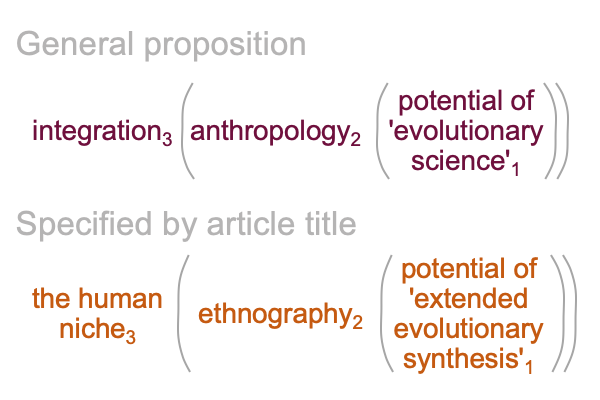
The proposition of an integrated anthropology and the title associate to a category-based nested form.
0156 The problem?
Anthropology2 does not constellate under the normal context of the human niche3 and within the potential of ‘the niche-construction version of an extended evolutionary synthesis’1.
Instead, ethnography2 is anthropology’s adaptation to the normal context of community3 operating on the potential of ‘communal cognitive spaces’1.
0157 This makes sense, in terms of Aristotle’s causalities, which are cleverly re-imported from philosophy into scientific inquiry by the academic discipline of Anthropology.
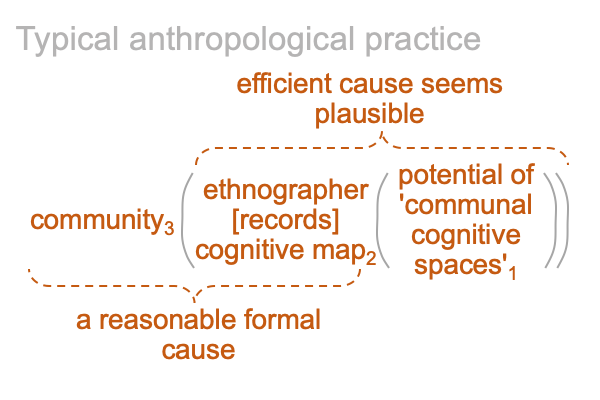
0158 Yes, humans evolve. So, it seems that contemporary anthropology2 should be contextualized by a need for integration3 with the potential of ‘evolutionary science’1.
0159 This expectation brings in a second problem, corresponding to the Greimas square of Dugin’s typology in Comments on Alexander Dugin’s Book (2012) The Fourth Political Theory (by Razie Mah, available at smashwords and other e-book venues).
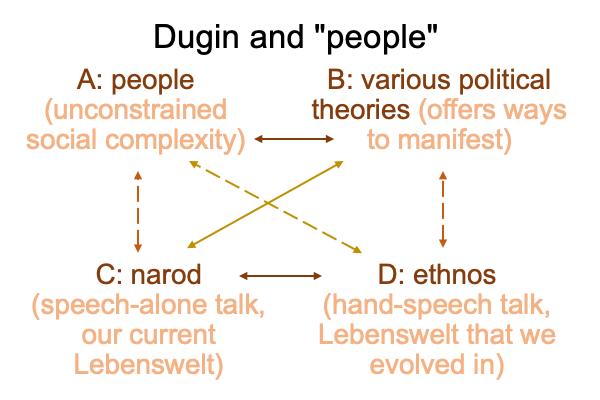
0160 This examination of Augustin Fuentes’s article adds value by elaborating the elements within this Greimas square.
0161 The people (A) are here represented by the ethnographer, operating within an institution (of “the people”), that manifests its organizational objectives in terms of contemporary political theories (including notions (B) on how the discipline of anthropology should train ethnographers capable of receiving (and mapping) the cognitive spaces within a narod (C)).
0162 In other words, the ethnographer as anthropologist (A) contrasts with the various theoretical apparatuses (B) that sustain the academic discipline.
Plus, these various theoretical social constructions (B) are what makes a people capable of practicing a level of social complexity that appears as wealth and power in the view of the limitations of any particular community or narod (C).
Finally, the narod (C) is a traditional society in our current Lebenswelt that cannot return to a corresponding ethnos (D) that would exist in the Lebenswelt that we evolved in.