02/28/26

Looking at Mihhail Lotman’s Article (2017) “History as Geography”  (Part 1 of 8)

0744 The article before me is published by Sign System Studies (volume 45(3/4), 2017, pages 263-283) by Mihhail Lotman in the Department of Semiotics at Tartu University, Estonia.  The full title is “History as Geography: In Search for Russian Identity”.  This particular volume is dedicated to semiotics and history.

0745 The year is 2026.  Hundreds of thousands of young men from the currently sovereign states of Ukraine and Russia are now buried in the geography of their sovereign states.  The war is senseless to anyone who is not moving money or armaments.  A theoretically defensive NATO (North Atlantic Treaty Organization) covets a vulnerable ember of the former USSR (Union of Soviet Socialist Republics).  Or is this a proxy war between the USDB (Unsuspecting Subjects Dominated by Bigilibs) and the CCP (Communist Chinese Party)?

Bigilib?

Big-government (il)liberal.

0746 Is Estonia’s geography its history?

Surely, the way the map of sovereign territories alters over the past few centuries is a sign of historical turmoil.

But, do not expect the corporate media to broadcast any information that does not comport with the interests of their clients.

You know, the ones moving money and armaments.

History appears to be irrelevant.  Geography and client interests are all that matter.

The form is war.

0747 And, the most important territory to be occupied seems to be what people say.

Corporate broadcasters talk about territory. Territory establishes that we all agree upon the ideology.  If we speak the same rhetoric about geography in a time of war, then we must all think the same.  How obvious is that?

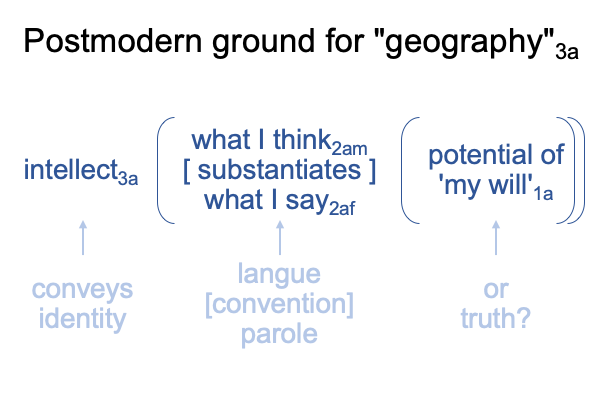
The hylomorphe, where what I say (as form) is substantiated by what I think (as matter), turns out to be very useful for empirio-normative domination.  See Razie Mah’s three part e-book, Original Sin and the Post-Truth Condition, available at smashwords and other e-book venues.

0748 So, what are the interests of the citizen?

Who is the citizen?

The citizen is the subject (the empowerer) and the object (the um… “subject”) of sovereign power.

The truth serves the interests of the citizen.

0749 If truth serves the interests of the citizen, then what serves the interests of the unelected bureaucrats?

Oh, it must be the will of the citizen.

0750 Is the citizen reasonable3a, when allowing experts to decide which tidbits of what I say2af shall be ascribed to um… the citizen’s will1a?

Here is the category-based nested form.

If perplexed, consult Razie Mah’s e-books, A Primer on the Category-Based Nested Form and A Primer on Sensible and Social Construction.

0751 I ask, “What is the author, Mihhail Lotman, searching for?”

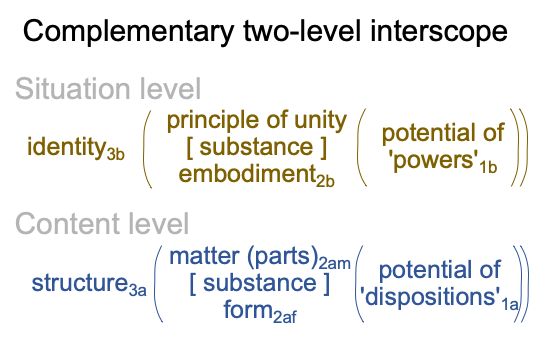
Intellect3a conveys identity.  There are two types of identity.  One is potentiated by truth1a.  The other is potentiated by my will1a.

Notice, that the term, “identity”, which labels my intellect3a based of the potentials of truth or my will1a, cannot be pictured or pointed to.  Like all normal contexts and potentials, identity is crucial for understanding.  But, what is understanding?  Understanding comes when an actuality2 is placed into its proper normal context3 and potential1.

0752 Identity3a is a style of understanding.  Is3a it not?

After all, it3a changes with potential1a.  Does it3a not?

One cannot picture or point to identity3a.

If one searches for it3a, it3a will always prove elusive, because it3a contextualizes3 and potentiates1 what I think2am and what I say2af.

Better to think2am and speak2af about geography.

01/20/21

Comments on Philip Marey’s Post (2021) “Insurrection” (Part 1)

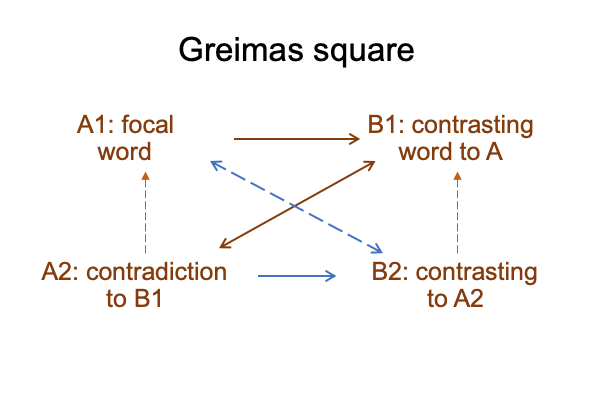
0001 The Greimas square is introduced in Comments on Gregory Sandstrom’s Essay (2013) “Peace for Evolution”, available at smashwords.  This purely relational structure is introduced as a way to visualize langue as a system of differences.  This is not the only way to visualize the word-in-mind.  But, it is useful in labeling a word as a node in a symbolic order.

0002 Here is a picture of the Greimas square.

Figure 1

0003 Philip Marey is a senior US strategist at Rabobank.  He contributes to the website, Zerohedge.  On Friday, January 8, 2021, at 18:25, Tyler Durden posts Marey’s short work, commenting on recent events.  The title consists of one word: insurrection.

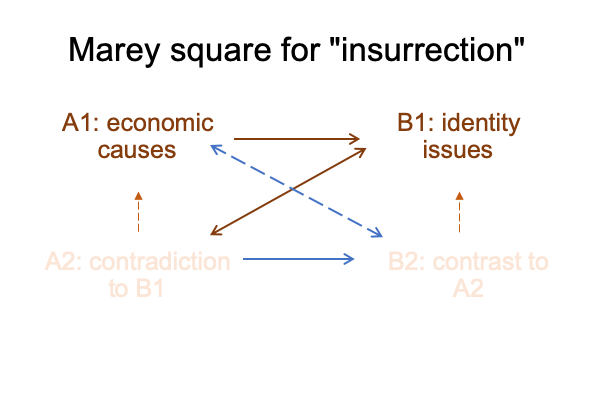
0004 “Insurrection2a” should go into slot A1, as the focus of attention.  However, the situating actuality2b is causality2b.  Marey’s post considers the projection of causality into the term.  What explains the presence of insurrection2a?

0005 The first cause that Marey raises comes from academics, in particular, economists.  The primary cause of insurrection is economic.

“Economic causes” go into slot A1.

0006 In contrast, Marey offers an alternate cause: identity.  His researchers show that the US political system becomes increasingly polarized after the 1964 Civil Rights Act.  This demonstration is a red herring, because polarization is already present in the 1964 presidential contest between Barry Goldwater (populist, “insurrectionist”) and Lyndon Johnson (party insider, “statist”).  The 1964 Civil Rights Act is a symptom, not a cause.

The cause is the expansion of the federal government, with its attendant religion, Big Government (il)Liberalism (BG(il)L).

0007 Perhaps, the relevant factor for the growth of identity politics in the US is to be found in the rapid expansion of state university systems in the 1950s and early 1960s.  New positions and fields of inquiry germinate a novel brand of Marxism.  Cultural Marxism exploits cultural distinctions, rather than economic.  

0008 “Identity” goes into slot B1.

Figure 02

01/19/21

Comments on Philip Marey’s Post (2021) “Insurrection” (Part 2)

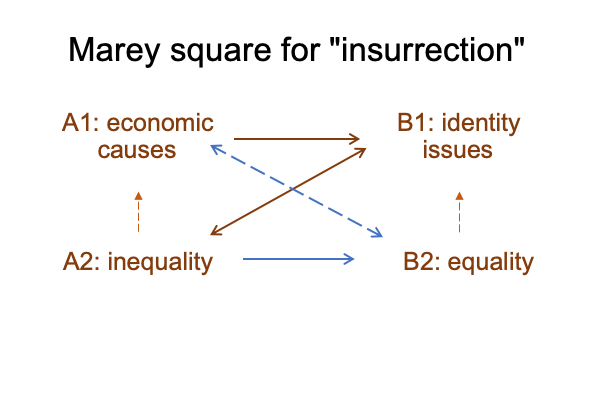
0009 The next slot, A2, speaks against identity issues.  Since identities are not equal, then the term, “inequality”, fits.  Yet, inequality is not the same as different identities, so the contradiction is real, yet confusing.  What happens when all identities are equal?

0010 What contrasts with inequality?

Equality, of course.

0011 Here is the completed Marey square for the causes underlying insurrection.

Figure 3

0012 What characterizes the word, “insurrection2a“, as situated by causality2b by modern academics?

Economic causation (A1) is the economist’s focal point.

Identity issues (B1) contrast with economic causation (A1) and lingers slightly below consciousness.

Inequality (A2) stands in contradiction to identity (B1) and complements economic causation (A2).  Indeed, many BG(il)L academics conclude that government policies should be designed to reduce economic inequality, in order to remove fuel for insurrection.

Equality (B2) contrasts with inequality (A2), speaks against economic causality (A1) and complements identity-as-cause (B1).

01/18/21

Comments on Philip Marey’s Post (2021) “Insurrection” (Part 3)

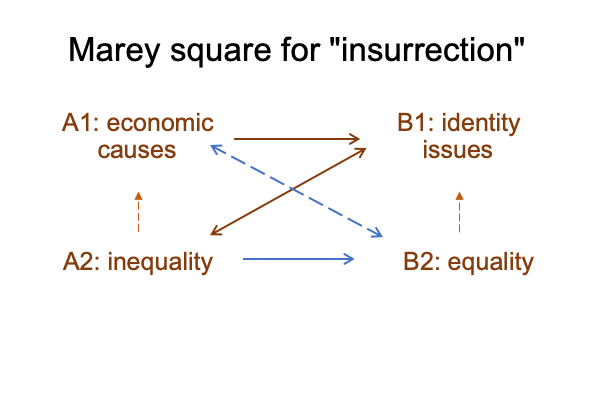
0013 Here is the complete Marey square, once again.

Figure 4

0014 Do I see a problem?

Modern economists advocate for federal policies to reduce income inequality (A2) as a way to keep the peace (A1).  In other words, inequality (A2) feeds into economic causation (A1).

Does the same pattern apply to the contrasting elements (B1 and B2)?

Should modern economists also address the contribution of identity?

Or does that responsibility rest with a different suite of experts?

You know, the one’s who argue that “identity” is fully malleable, yet behave as if it is fixed.

0015 Does the proposed solution of reducing economic inequality (A2) create an unintended consequence of forcing equality (B2) onto identity (B1)?

Is there a word that describes forcing equality (B2) onto identity (B1)?

How about the term, “conformity”.

If, identity cannot be fashioned out of the creative expression of experts, then identity is not something that readily changes.  Identity is not so easily altered.

0016 What happens to the proposed solution?

Reducing economic inequality entails conformity, which explains government and private-public sector behaviors subsequent to the incident in Washington DC on January 6, 2021, the so-called “insurrection”.

The US Congress passes legislation to crack down on “domestic terrorists”, that is, people who do not conform.  They also impeach, for a second time, a figurehead that serves as the “other”, the one who does not conform.  Onto this other, they project their own crimes.

Private-public sector companies purge their platforms of people who do not conform with their corporatist stance, where the federal government handles the problem of economic inequality.  In doing so, they promote equality of identity for those remaining on their platforms.  Those who remain are complicit in purging those who do not have identities worthy of equality.  Of course, those who are unworthy of equality do not believe the experts.

0017 Marey’s square identifies two experts.  One drives the broadcast conversation, attributing social unrest (insurrection) to economic causes, particularly inequality.  The other drives a hidden conversation, where favored identities conform to the narrative.  In the latter case, experts are cultivated in order to chastise those who do not conform and to justify exclusion from public-private platforms.

0018 In short, Marey’s brief article hones in on a serious entanglement, which cannot be discussed, binding a BG(il)L public narrative (A1) with a hidden agenda concerning  identity (B1).  Forced conformity (B1, B2) is as disturbing as economic inequality (A1, A2).