Looking at Augustin Fuentes’s Article (2016) “The Extended Evolutionary Synthesis…” (Part 1 of 16)
0001 The full title of the article before me is “The Extended Evolutionary Synthesis, Ethnography, and the Human Niche: Toward an Integrated Anthropology”. The work is published in Current Anthropology (volume 57, supplement 13, June 2016, pages S13-S26; DOI: 10.1086/685684). At the time of publication, the author is a Professor at the Department of Anthropology at the University of Notre Dame, Indiana. He has since been scooped up by Princeton.
Scooped?
Ask anyone in Human Resources what that term means.
0002 The material for this thought-piece is developed at the Center for Theological Inquiry in 2012-13, in a collaborative titled, “Inquiry on Human Nature”, and presented to a Wenner-Gren symposium in 2014.
0003 This is the time when the much-vaunted program of “niche construction” is in the Zeitgeist… er… air. The author seeks to capitalize on this extension of the evolutionary synthesis. The first extension, starting fifty years earlier, is from natural history into genetics, and is now called “Neodarwinism”.
And what does he want to invest that capital in?
An integrated anthropology.
0004 Integrated anthropology?
I suppose that anthropology is to integrate with evolutionary science.
This is precisely an interest of Razie Mah, as witnessed in his three masterworks: The Human Niche (2018), An Archaeology of the Fall (2012), and How To Define the Word “Religion” (2015).
0005 But, that is not the references that I really should be pointing to.
I should be indicating two primers, by Razie Mah, available at smashwords and other e-book venues. These are A Primer on the Category-Based Nested Form and A Primer on Sensible and Social Construction.
0006 Why?
The terms in the title of the work under examination associate to elements in a category-based nested form.
I associate “integration” to the normal context3.
I associate “anthropology” to the actuality2.
I associate “evolutionary science” to the potential1.
0007 The category-based nested form derives from the philosophy of Charles Peirce. It consists in four statements. The fourth is paradigmatic. A triadic normal context3 brings a dyadic actuality2 into relation with the monadic possibility of ‘something’1. The subscripts correspond to Peirce’s three categories.
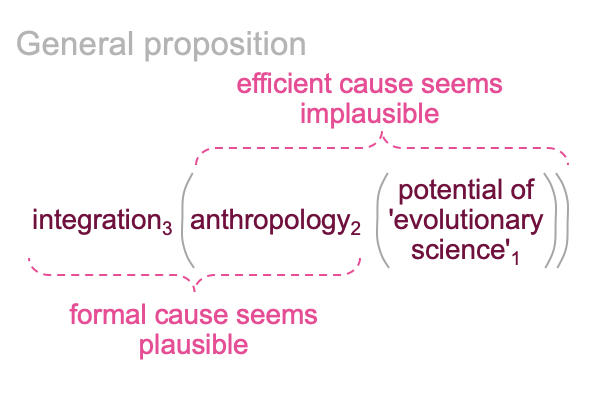
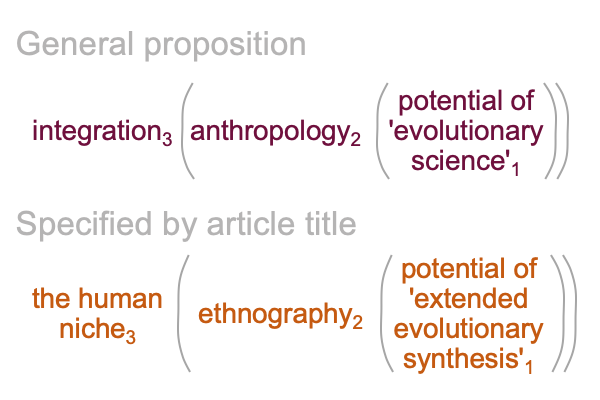
0008 Here is a picture of my associations, along with how each element gets specified by the title of this article.
0009 What do these associations imply?
The human niche3 is the “integration3” of an “integrated anthropology”.
As such, the human niche3 should contextualize ethnography2 (as a specific application of anthropology2).
0010 The formal causation in these statements seems reasonable.
But, does the efficient causation seem plausible?
Does anthropology2 emerge from the potential of evolutionary science1?
Can ethnography2 situate the potential of ‘niche construction (as a case-study for an extended evolutionary synthesis)’1?
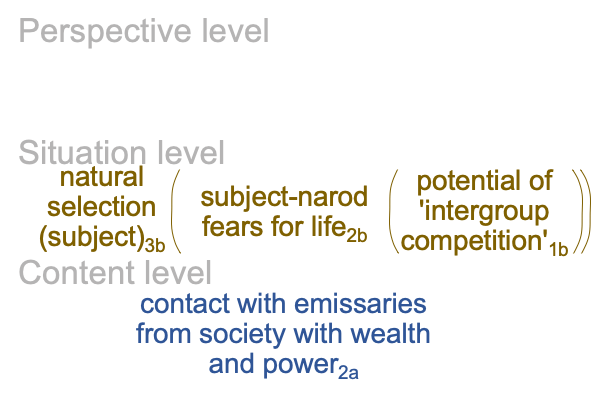
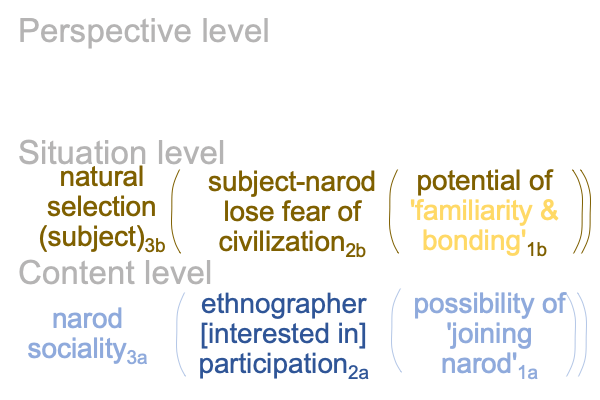
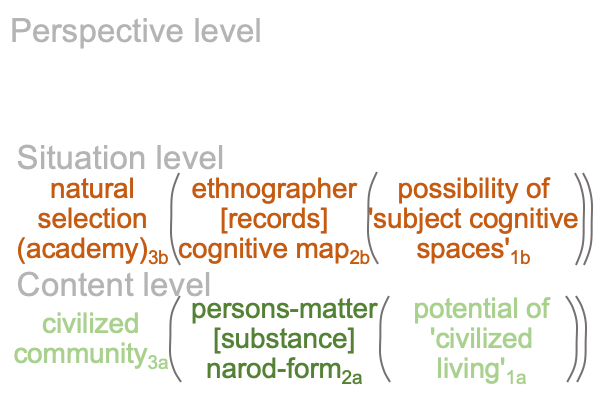
0011 The following figure distills the author’s challenge.