0001 The article before me is published by Sign System Studies (44(3) (2016) pages 368-401) by two professors, Igor Pilshchikov and Mikhail Trunin, hailing from Tallinn University in Estonia. The title is “The Tartu-Moscow School of Semiotics”. The subtitle is “A transnational perspective”.
0002 The abstract promises to situate the Tartu-Moscow School of Semiotics of the 1960s through 1980s. The article delivers more than promised.
How so?
0003 The authors sketch dynamic developments among intellectual circles within the (now former) Union of Soviet Socialist Republics.
0004 The term, “transnational”, indicates that there are nations within the former Soviet Union.
During this period in history, the governments of Estonia and Russia (along with Czechoslovakia and Poland) owe fealty to an empire with the title, “Socialist”, in its name.
So, “transnational” tells me that the article looks back from the present, into a past era, with the intent of portraying ‘something’ historical, without acknowledging that the “Union” and the “Socialist” descriptors no longer apply (at least, not in the way that they once did).
0005 “Transnational” applies to the Union of Soviet Socialist Republics (USSR, 1918-1989) as well as the upcoming… um… Eurasian convergence?
Here is a picture with three city-sites. Tartu and Moscow belong to the title. Tallinn is the location where the authors write their article. The blue is the Baltic Sea.
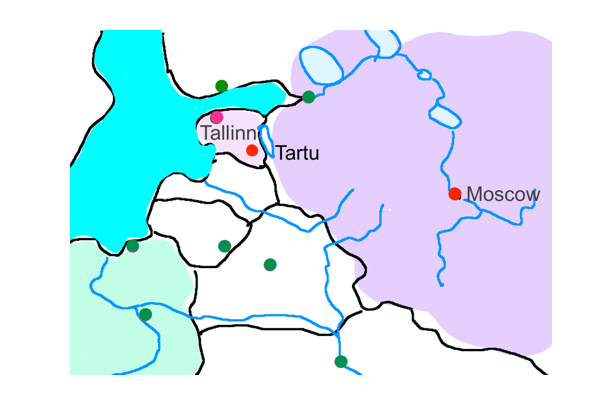
0006 “Transnational” steps over the boundaries depicted in black in the above figure.
Never mind the fact that the above territories reside behind, what American pundits once called, “the Iron Curtain”.
0007 Perhaps, one must appreciate an ambiguity to the term, “transnational”, given that there is another transit. This transit is in time. Or, even better, this transit is across a boundary between battles among Enlightenment gods.
Consider where the time period of 1960s to 1980s resides in the following timeline of Western civilization in the twentieth century.
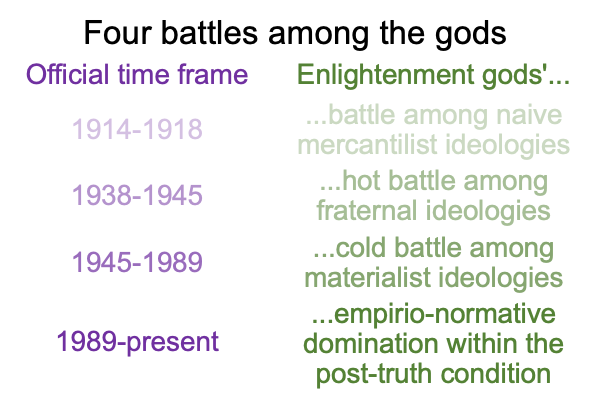
Also consider the year when the article under examination is published.
Notice the boundary.
0008 The Tartu-Moscow School of Semiology constellates within one battle, as a transnational collaboration.
The TMS is remembered during another battle, which is not resolved, and so cannot be objectified as “historical”. I suppose that it can be objectified as “cultural”. Better yet, “theodramatic”.
Already, there is more to this article than meets the eye.