0009 Where does “semiotics” enter into the picture?
Of course, the TMS is all about semiotics.
But, what is “semiotics”?
0010 According to Charles S. Peirce, a sign is a triadic relation. A sign-vehicle stands for a sign-object in regards to a sign-interpretant.
Peirce dies in 1914.
According to Ferdinand de Saussure, a sign is a dyad, composed of a signifier and a signified.
Saussure dies in 1913.
0011 May I now weave the two definitions of sign into Peirce’s category of secondness, the realm of actuality?
0012 According to Peirce, all existence comports with three categories.
0013 Firstness, the monadic realm of possibility, contains only one element. That element may be simple or complex.
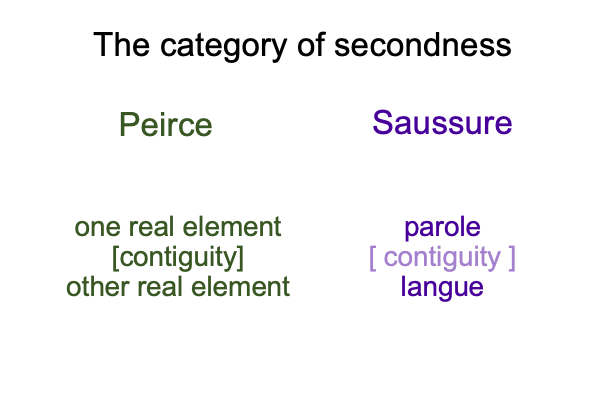
0014 Secondness, the dyadic realm of actuality, contains two contiguous real elements.
For notation, I place the contiguity in brackets, rendering secondness as the dyad, {one real element [contiguity] other real element}.
Aristotle’s hylomorphe serves as an example. The two real elements are matter and form. The contiguity is “substance”, yielding the hylomorphe, {matter [substance] form}.
Saussure’s characterization of sign accords to secondness, in so far as both the signifier and the signified are real elements. The contiguity, however, is missing. Perhaps, the contiguity is “arbitrary relation”. But, for the moment, I will leave the contiguity as a blank. For now, Saussure’s hylomorphe is the dyad, {signifier [contiguity] signified}. Here, the signifier is like matter and the signified is like form.
Uh-oh. What are the technical terms, “parole” and “langue”, doing there?
Also, isn’t parole more like form and langue more like matter?
Hmmm.
Dyadic actualities include the topics that science investigates.
Saussure’s semiology is considered to be scientific (more or less).
0015 Thirdness, the triadic realm of normal contexts, mediations, signs, judgments and so forth, contains three elements, one from each category.
A sign-vehicle stands for a sign-object in regards to a sign-interpretant.
Peirce’s sign relation is paradigmatic, except for one rather unexpected twist.
The sign-interpretant belongs to thirdness. Both the sign-vehicle and sign-object belong to secondness, the realm of actuality. So, what is left to associate with firstness? The only words that are not accounted for are “stands for” and “in regards”. “Stands for” can be classified as a possibility “in regards” to a sign-interpretant. So, “stands for” may be an aspect of the sign-interpretant that belongs to firstness.
So, the sign-interpretant belongs to both thirdness and firstness.
0016 If that makes any sense, please take note.
A sign-vehicle (in secondness) stands for a sign-object (in secondness) in regards to a sign-interpretant (in both thirdness and firstness).
Of course, the sign is a triadic relation.
But, can the sign also be depicted as a dyadic actuality?
0017 What I am about to do may be considered a travesty.
The sign-vehicle and the sign-object may be considered real elements. So, the contiguity must include the sign-interpretant, “in regards to” and “stands for”. “Stands for” goes with the realm of possibility. “In regards to” goes with the realm of normal contexts.
0018 May I say that in terms of Peirce’s categories?
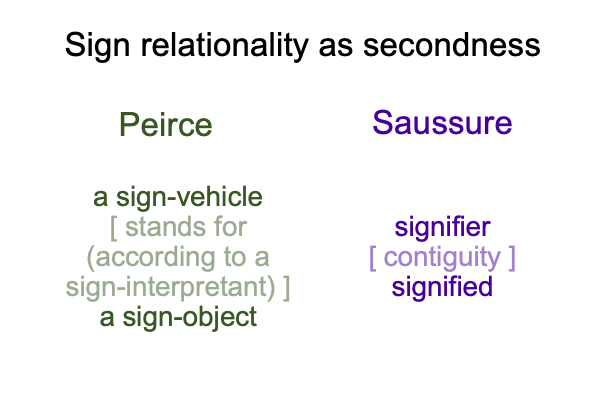
Two real elements, the sign-vehicle and the sign-object, belong to secondness. The sign is a triadic relation. It brings all three categories into relation. So, the contiguity – the “substance” – manifests both firstness and thirdness, which I package as [stands for (according to a sign-interpretant)].
0019 Here is a picture of two permutations of secondness.
Oh, there are the terms, “signifier” and “signified”.
0020 Obviously, both diagrammatic representations are incomplete, especially in regards to the contiguity. Saussure’s contiguity is not labeled. Peirce’s contiguity looks like a mess.
The real elements may be productively compared. A sign-vehicle corresponds to a signifier. Both seem to be like matter, in so far as both pour into (?) the sign-relation. A sign-object goes with the signified. Both seem to be like form, in that they both manifest the shape (?) of the sign-relation.
0021 But, what about semiotics and history?
The figure on the right originally associates to the term, “semiology”.
Peirce’s sign-relation associates to the term, “semiotics”.
So, is it fair to associate the figure on the right to the term, “semiotics”?
I suppose that it is.
The title of the article testifies to the fairness of the association.
0022 Plus, if both Peirce and Saussure die right at the start of the first battle among the Enlightenment gods, then this pair of confounded associations takes over a century to clarify.
0023 This is a very curious historical muddle. The transnational subtitle, which is the explicit subject of the article, and the transit from the first to the fourth battles among the Enlightenment gods, which is implicit, coincide. Actuality is visualized by a pair of dyads in the mold of Aristotle’s hylomorphe, manifesting Peirce’s category of secondness and hybridizing the explicit (labels) and the implicit (relational diagrams).
Explicit transnational transits in space entangle implicit intramodern transits in time. Implicit transits in timesubstantiate explicit transits in space.
It makes me wonder whether there is an even wider gyre, an upwelling that goes back centuries, that moves within the bowels of the authors’ story.
Is it like some sort of civilizational fart, that just comes out in the end?