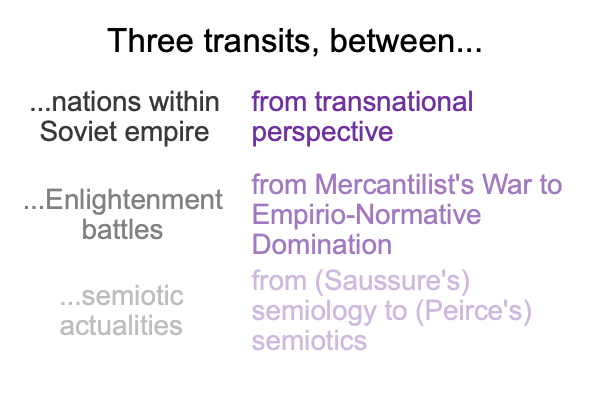
0024 While considering the abstract, I drift into an expectation. This article may touch base with three historical transits, each operating on a different level and each entangling the others.
Here is a picture.
0025 But, what is “entanglement”?
I wonder.
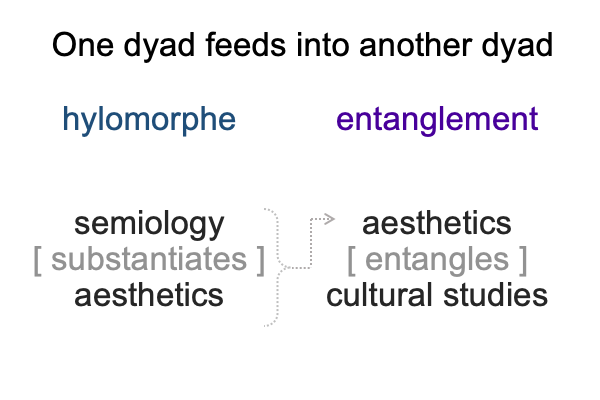
The authors use the term to point to the meetings of minds from different states within the Union. “Entanglement” occurs as one mind influences another. In this way, academics studying aesthetics get tangled up with semiological notions (such a structuralism) and then get caught up with a general theory of culture.
To me, this sequence may work in the following manner.
And, this is confounding.
0026 Aesthetics is already a form, when semiology is introduced as matter. I could say that aesthetics as formentangles semiotics as matter, since aesthetics already exists when Saussure proposes his breakthrough ideas on the scientific nature of spoken language. But, the result is notable, because the ‘thing’ that has the matter of semiology and the form of aesthetics has a label: “structuralism”.
Surely, “structuralism” sounds “scientific and progressive”, as opposed to “formalism” which sounds “traditional and backwards”.
0027 Later, structuralism, as a thing composed of matter and form, entangles another field of inquiry, cultural studies.
Here, a technical difficulty arises, since the discipline of cultural studies is already appropriated by the Marxist dialectic.
0028 Nonetheless, I have arrived at another definition of “entanglement”.
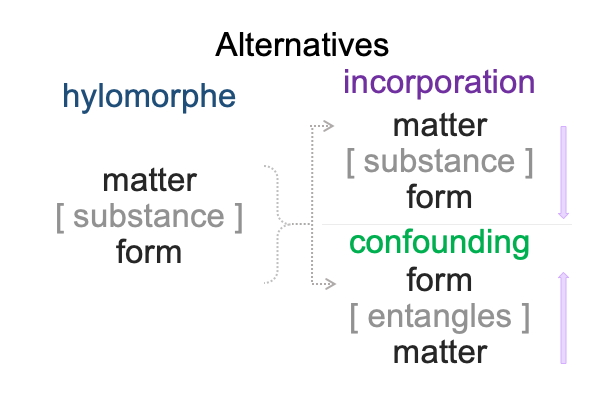
Entanglement mirrors the hylomorphe, as shown in the following diagram.
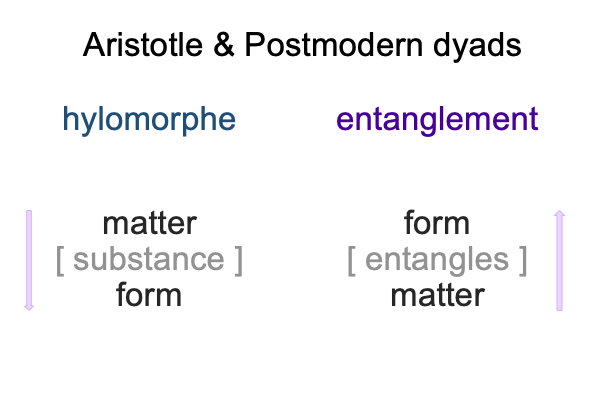
0029 Aristotle’s hylomorphe describes a thing.
Does Aristotle’s entanglement do the same?
If so, then a “thing” may manifest as matter that substantiates form or as form that entangles matter.
0030 To me, it seems that the former leads to a thing, according to classic (or timeless) Greek philosophy. If the latter leads to a thing, then the originating matter sustains the form and the form entangles matter, until the confounding resolves. If the resolution favors entanglement, the once-entangled matter substantiates the form.
And, the weird part is this: One form may relate to two matters, one originating and one entangled.
0031 Finally, in addition to confounding (which is admittedly a little odd), a thing may enter a hylomorphe as matter, as shown in the following diagram.
I say, “Watch out when anyone uses the terms, ‘confounding’ and ‘incorporation’.”
There is no telling what type of flatulence is about to escape.