0032 The article is neatly segmented into eight (8) sections.
I will number sections as I go along.
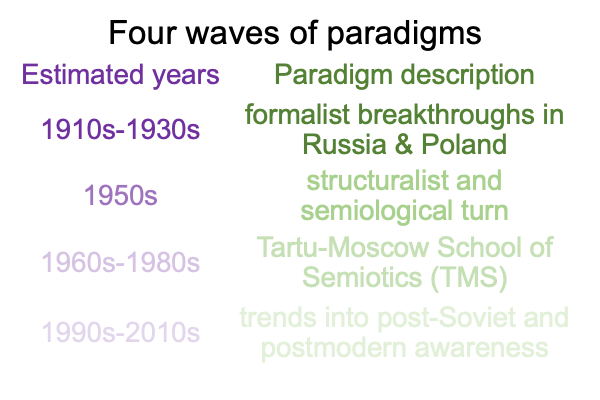
0033 In the first portion (1), the authors give an overview. They see four waves of paradigms sweeping over the linguistic academic communities in Russia, starting around the time when Peirce and Saussure pass to their rewards.
0034 Formalist breakthroughs?
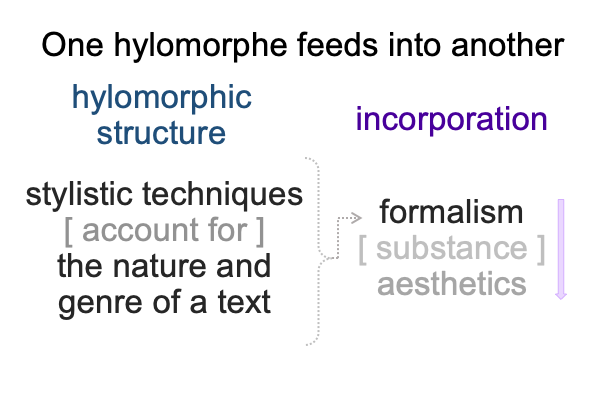
The earliest modern academic paradigms approach literature and language from a typological point of view. The paradigms start in Germany and pass to Poland and Russia. Aesthetics may be formally regarded as an appreciation of the craft of the author. So, formalism [substantiates] aesthetics.
0035 This period corresponds to a time when science is a subject of intense philosophical scrutiny. For example, Edmund Husserl (1859-1938) works on phenomenology in Germany. Jakob Von Uexkull (1864-1944) postulates the concepts of “sign-worlds” called the “Umwelt” for animals and “Lebenswelt” for humans.
0036 Later, Saussure’s Course on Linguistics shocks the field of linguistics by proposing a scientific definition of language. Spoken language consists of two arbitrarily related systems of differences, parole (or speech talk) and langue (what goes on in one’s head in order to decode and encode speech talk).
0037 So, what is a spoken word?
A spoken word is a placeholder in two (arbitrarily related) systems of differences.
Saussure reveals a structure to language.
I can depict that structure as a hylomorphe.
This hylomorphe may then go into academic matter that substantiates a modern discipline of aesthetics or “art appreciation”.
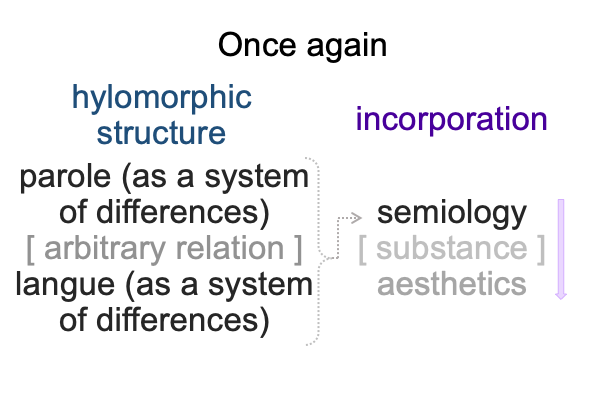
0038 For the hylomorphe depicted above, parole is like matter and langue is like form. The study of the structure of the spoken word (semiology) serves as matter that substantiates the form of the discipline of aesthetics.
0039 So, what am I suggesting?
Is semiology all that different from formalism?
Both are academic ways of thought.
Or, is “aesthetics” just a spoken word?