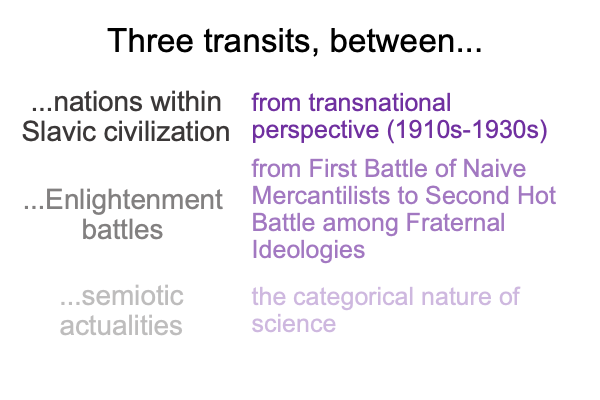
0040 The authors mention two Russian scholars working in language studies at this time. One is Jan Mukarovsky (1891-1975). The other is Roman Jacobson (1896-1982). Both start as literature scholars. Both turn towards structuralism and semiology during the second wave of paradigms.
The timeframe includes the First (1914-1918), Second (1939-1945) and the start of the Third (1945-1989) Battles among the Enlightenment gods.
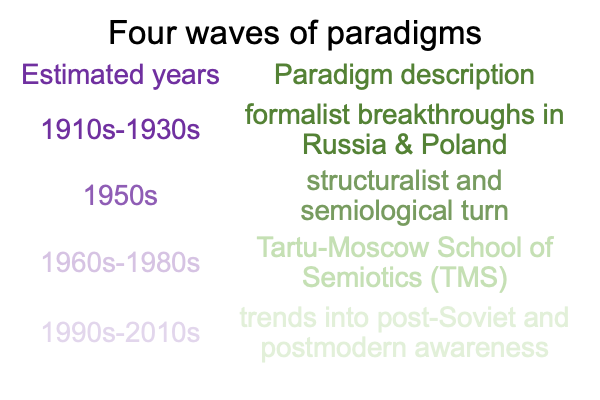
0041 Here is a picture of the three transits, tailored to this specific timeframe.
0042 The question bears asking, “What moves Soviet academics in literature towards semiology and away from formalist analysis?
0043 During the first half of the twentieth century, science appears triumphant. The new government of the Soviet Union advertises itself as a scientific style of governance. And, Europe does not need to advertise, having fought the First Battle Among The Enlightenment Gods with mechanized infantry, chemical gas warfare, and other technical novelties. Technology and science embody the Zeitgeist. Even propaganda acquires its own technology and empirio-schematics.
Saussure is not the only science-minded luminary. The discipline of quantum mechanics catches the imagination of many. So does psychoanalysis. Niels Bohr (1885-1962) runs a physics circle in Copenhagen. The first celebrity psychoanalyst, Sigmund Freud (1856-1939) operates out of Vienna. Carl Jung (1875-1961) applies psychoanalytic concepts to cultural domains.
0044 Russian and Polish formalists are already reacting to the civilizational conditions of the first Battle among the Enlightenment gods. Science catches the eye of both Mukarovsky and Jakobson. They move towards integrating semiology into the study of literature.
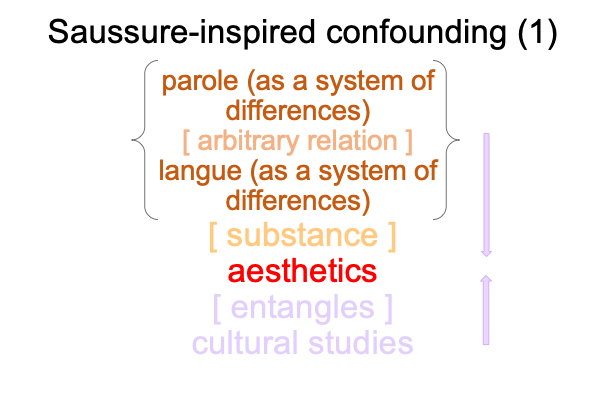
0045 Or rather, they move towards the use semiology as matter in order to substantiate a modern form of aesthetics.
Unfortunately, as soon as they do so, aesthetics as form gets entangled.
Didn’t I warn about the word, “confounding”?
0046 Yes, there is a hidden problem that does not appear with formalism.
Saussure’s paradigm models speech-alone talk as two contiguous real elements, parole (the speech act) and langue (the associated mental act). The contiguity is a purely arbitrary relation.
But, what is a purely arbitrary relation?
It is a purely conventional habit.
Culture consists of purely conventional habits.
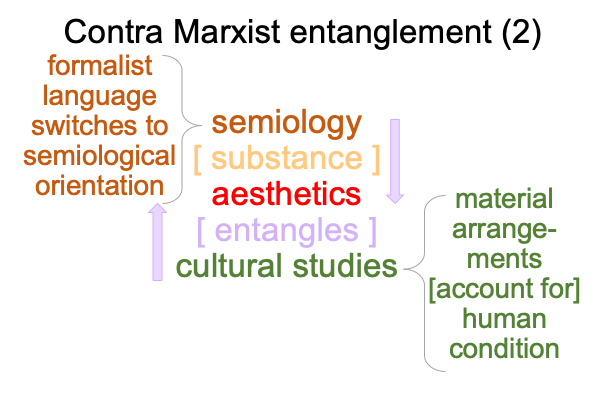
0047 Suddenly, aesthetics as form [entangles] culture as matter.
Once aesthetics is conceptualized as a scientific form in {semiological matter […] aesthetic form}, the dyadic reality of {aesthetics [entangles] culture} becomes more and more apparent as a noumenon (a thing itself).
0048 The problem?
Well, Marxist dialectics already lays claim to an understanding of culture as the dyadic actuality of {material arrangements [account for] human conditions}. Plus, the Soviet regime considers that causality to be both foundational and scientific.
Here is a picture of the dilemma.
0049 What does that imply?
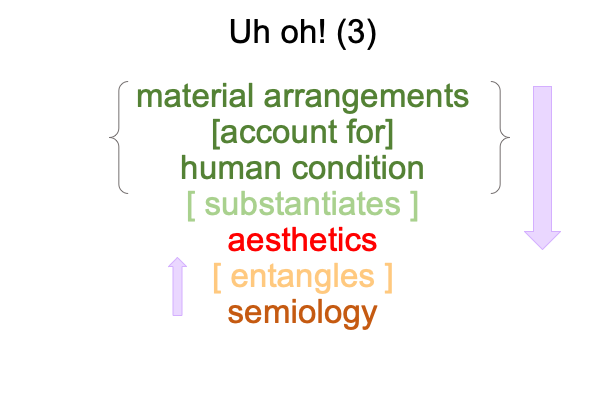
Is the dog of Marxist materialism wagging the tail of the academic discipline of aesthetics?
Welcome to the USSR.
Professors in literature in Soviet academies want to become more scientific in order to comport with the socialist program and they entangle cultural studies as matter, and, in doing so, they confront a possibility that the confounding will resolve in favor of the entanglement.
0050 How curious.
The authors tell a story of the adoption of semiology by formalists within the Soviet Empire, where Marxism is the state ideology. The authors do not mention that their story comports with a very interesting proposition presented in Sign System Studies.
History itself is semiotic.
0051 Nor do the authors consider the nature of science itself.
What the hell is “science”?
At this time, some western philosophers are trying to figure science out. Others are certain that they know what it is,even though they cannot clearly define what it is.
0052 Edmund Husserl (1859-1938) participates in the debate. So do the members of the so-called “Vienna Circle” (meeting in the 1920s and 1930s). Husserl invents “phenomenology”. The Vienna Circle promotes the doctrine of “logical positivism”.
These are not the only philosophers wrestling with the issue. In Paris, the French Catholic, Jacques Maritain (1882-1973), and (at the same time, in the same city) the Russian Orthodox, Nicolay Berdyayev (1874-1948), struggle to address the question, “What is science?”
0053 Razie Mah writes two reviews on books by these authors.
One is Comments on Jacques Maritain’s Book (1935) Natural Philosophy.
The other is Comments on Nicholas Berdyaev’s Book (1939) Spirit and Reality.
Both are available at smashwords and other e-book venues.