0054 In section two (2), the authors mention the formalist breakthroughs in the 1910s and the initiation of the Moscow Literary Circle, starting in 1915, right before the Russian Revolution. End-of-century Germans engage in formal art criticism, which conveys all the clinical qualities of a dissection of a literary text.
Clinical?
Shall we isolate and identify the various rhetorical and linguistic devices used by an author?
0055 Needless to say, at the time, the German chemical industry is unsurpassed in dissolving materials and isolating chemical substances.
So, why not literary things?
0056 Roman Jakobson is the first president of the Moscow Literary Circle (MLC). The Prague Circle, concentrating on linguistics and literature, starts in 1926. Jan Mukarovsky is a member. Of course, the Second World War changes everything, except the categorical nature of science.
0052 So what is science?
Science is the Positivist’s judgment, as noted in Comments on Jacques Maritain’s Book (1935) Natural Philosophy.
0057 Okay, what is a judgment?
A judgment is a triadic relation containing three elements: relation, what ought to be, and what is. When each of these elements is assigned to a unique Peircean category, the judgment becomes actionable.
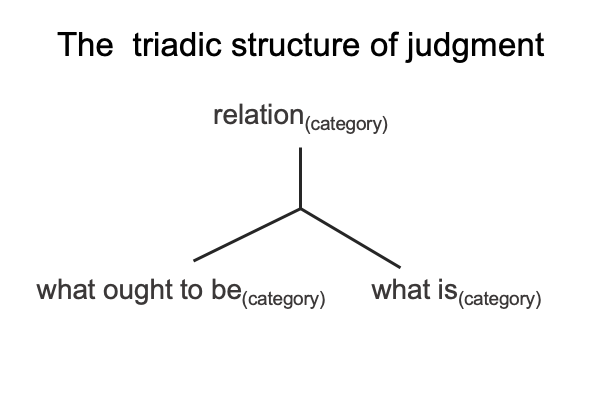
0058 The Positivist’s judgment is a difficult relational structure. It is a judgment that contains a judgment as what ought to be.
Here is picture.
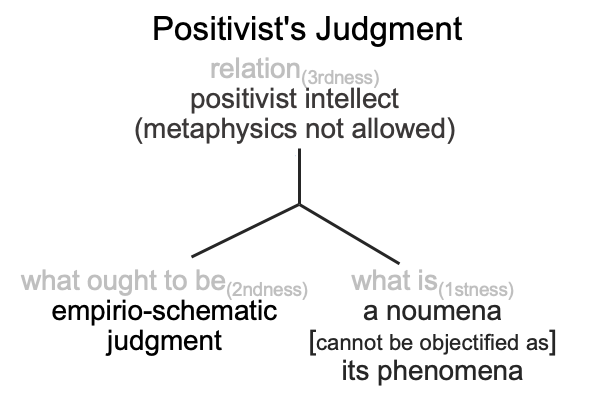
0059 A positivist intellect (relation, thirdness, M) brings an empirio-schematic judgment (what ought to be, secondness, N) into relation with the dyad, {the thing itself [cannot be objectified as] its observable and measurable facets} (what is,firstness, O).
0060 Let me dwell on each element (M, N, O).
The positivist intellect (relation, thirdness, M) has a rule. Metaphysics is not allowed. Such is the way of science. Science promotes truncated material and efficient causalities. “Truncated”? Yes, “shorn of formal and final causalities”.
0061 Say what?
Consider a thing.
A thing is a hylomorphic actuality.
Material causality operates within the contiguity between matter and form2.
The Aristotelian mind supplements material causality with formal causality. The formal cause operates between the normal context3 and actuality2. Formal causes build a category-based nested form. Formal causation contextualizes material causality.
(In case of confusion, consult A Primer on the Category-Based Nested Form and A Primer on Sensible and Social Construction, by Razie Mah, available at smashwords and other e-book vendors).
0062 Here is a picture of how difficult the separation of material causality from formal causation can be for an example in literature studies.

0063 Only the normal context3 and actuality2 appear in this figure. The actuality2 displays a model, fashioned in the style of Aristotle’s hylomorphe. The two real elements are language as matter2m and literary text as form2f. The contiguity… the “substance”… consists of technical devices.
Doesn’t that sound scientific?
0064 Imagine how difficult it would be to find the material causality associated with rhetorical devices when the formal cause is neglected. For example, imagine a publication with an introduction, methods, data, results, and conclusion as its literary devices2. Of course, the inquirer can readily guess the genre of this literary work3.
It’s an opinion piece on the benefits of capitalism or socialism.
(See Razie Mah’s multi-part e-book, Original Sin and the Post-Truth Condition, to appreciate that joke.)
0065 Also, the Aristotelian mind supplements efficient causality with final causality.
Both contribute, in distinct and complementary manners, to understanding the entire nested form.
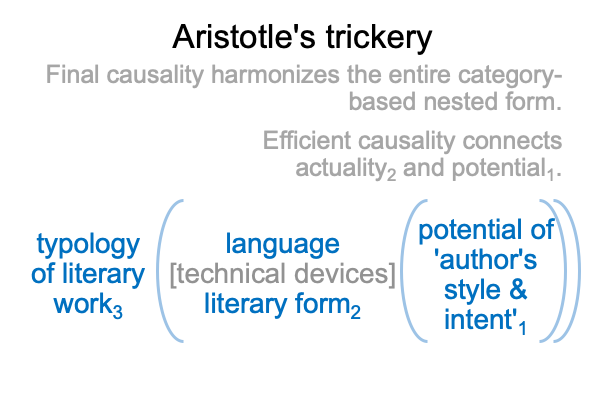
0066 The triadic normal context of the type of literary work (formal)3 brings the dyadic actuality (material) of {language (as matter) [literary devices] literary work (as form}2 into relation with the monadic potential of ‘the author’s style (efficient) and intention (final)’1.
0067 The efficient cause couples the actuality2 with its underlying potential1.
But, the efficient cause makes no sense when divorced from its final cause, because the author’s intent1 is to construct a particular type of literary work3.
0068 Without a final cause, sociological reductionists may replace an ‘author’s intent’ with ‘social conditions’. In doing so, the sociologist assigns the efficient cause to the author’s social conditions and loses harmony among all three elements in the category-based nested form.
Psychological reductions may replace the ‘author’s intent’ with ‘psychological powers and dispositions’, as well as ‘ideological fixations’ (or perhaps, ‘neurochemical imbalances’.)
A communication reductionist may replace the ‘author’s intent’ with ‘a signal-based paradigm of {source [transmission] receiver}’.
0069 In sum, extracting formal and final causationfrom scholarly inquiry into language and literature turns the discipline into a branch of sociology, psychology, communicology, or some other reductionist science.