0070 Of course, academics in the Department of Slavic Languages and Literature reject this option.
Consequently, if investigators of literature are going to take on the mantle of science, they have to sneak in Aristotle’s formal and final causes under the guises of material and efficient causalities. Their models must include hylomorphes as actualities2. Then, an unstated normal context3 and a potential1 will accompany that actuality2.
0071 So, the positivist injunction outlawing Aristotle’s metaphysics must be reconfigured into a refusal to entertain religious mumbo-jumbo.
The positivist intellect (relation, thirdness) of a Professor of Literature must encourage models that (1) are not religious (that is, Christian) and (2) (somehow) allow formal and final causalities.
0072 So far so good, what about the other two elements of the Positivist’s judgment (N and O, see point 0060)?
Let me turn to what ought to be (secondness, N).
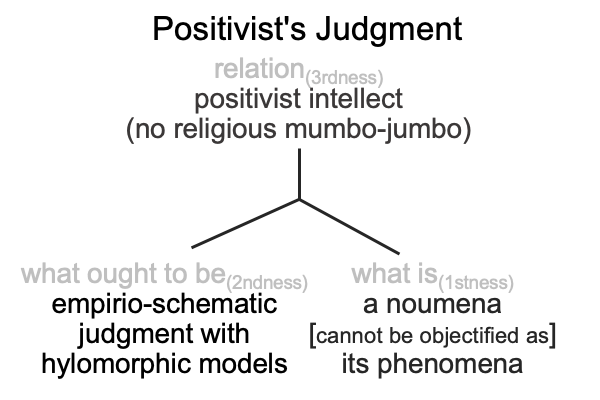
0073 The empirio-schematic judgment (what ought to be, secondness) should belong to thirdness, but it does not. It is a judgment that is imbued with secondness (the dyadic realm of actuality). To many scientists, the empirio-schematic judgment is more real than the thing itself.
In the empirio-schematic judgment, disciplinary language (relation, thirdness, N3) brings mechanical and mathematical models (what ought to be, secondness, N2) into relation with observations and measurements of phenomena (what is,firstness, N1).
0074 The disciplinary language of aesthetics (relation, thirdness, N3) adopts explicit terminology that implicitly evokes formal and final causalities. Metaphysics is apparently excluded. “Metaphysics” characterized as “religious thinking”, is definitely excluded. In the West, the definition of “metaphysics” has trended from “excluding Aristotle’s formal and final causalities” to “not religious”.
0075 The model (what ought to be, N2) is doubly dipped in actuality. The model is assigned to secondness in the empirio-schematic judgment. The empirio-schematic judgment is assigned to secondness in the Positivist’s judgment. If one poses dyadic models (expressing the relational structure of Peirce’s category of secondness), then the elements in dyadic models may be explicitly formulated, while retaining implicit connotations of formal and final causalities.
0076 How so?
Dyadic actualities entail material and efficient causalities. These causes may be explicitly abstracted using a disciplinary language. These causes are required for modeling.
At the same time, a dyadic actuality2 must be contextualized by a normal context3 (formal causality) and potentiated by possibilities1 (efficient and final causalities). These causes are implicit abstractions that are difficult to explicitly label. These causes contribute to understanding.
0077 What about observations and measurements of phenomena (what is, firstness, N1)?
The disciplinary languages of literary science (relation, thirdness, N3) discuss observable and measurable facets of the thing itself (what is, firstness, N1), in a critical manner, as to support or undermine a dyadic model as a hypothesis(what ought to be, secondness, N2).
0078 What is (firstness, O) of the Positivist’s judgment is even more curious.
The dyad, {the thing itself [cannot be objectified as] its observable and measurable facets}, appears to belong to secondness, since secondness consists of two contiguous real elements. But, it does not. It belongs to firstness, the monadic realm of possibility. Indeed, the noumenon and its phenomena label the same entity from different points of view.
0079 Philosophy considers the noumenon and initially seeks to portray the thing itself as a hylomorphic structure, similar to Aristotle’s dyad {matter [substance] form}.
And that is confusing, because science totally ignores the noumenon.
Science observes and measures phenomena. Science presumes that… um… there is a noumenon. Phenomena are the observable and measurable facets of a noumenon. So, as long as the scientist has observations and measurements… then the noumenon must exist… right?
0080 Here is a picture of the Positivist’s judgment, unfolded into a category-based nested form.
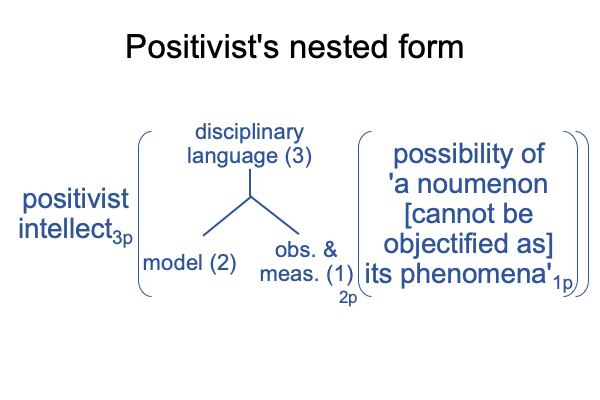
The subscript, “p”, stands for the Positivist’s judgment. Plus, the labels M, N and O will no longer be used as guides.
The normal context of the positivist intellect3p brings the actuality of the empirio-schematic judgment2p into relation with the potential of the dyad1p, {the thing itself [cannot be objectified as] its observable and measurable facets}1p.
0081 Section three (3) discusses the history of the Moscow Linguistic Circle (MLC, starting in 1915). The participants do not appreciate that they wrestle with the Positivist’s judgment. But, they do know that the author’s intent cannot be reduced to social conditions (as proposed by sociologists) or conscious or unconscious processes (as proposed by psychologists). All factions of the MLC agree that a literary text is a noumenon, and not a phenomenon produced by social, personal, or other truncated material and efficient causalities.
In short, the text (the noumenon) cannot be objectified by its observable and measurable facets (its phenomena).
Without the text, literary phenomena do not exist.
0082 What about the empirio-schematic judgment (what ought to be, secondness)?
By 1929, the disciplinary language of structuralism (relation, thirdness) brings systemically and hierarchically arranged material, formal, efficient and final causes (what ought to be, secondness) into relation with observations of textual phenomena (what is, firstness). These causes are not mechanical. They are organic.
In short, a literary text is like a living thing. So, the normal context of inquiry3 focuses on the construction of a system3. Or, is that “a systemic construction3“? Or, could I say, “system of constructions”3?
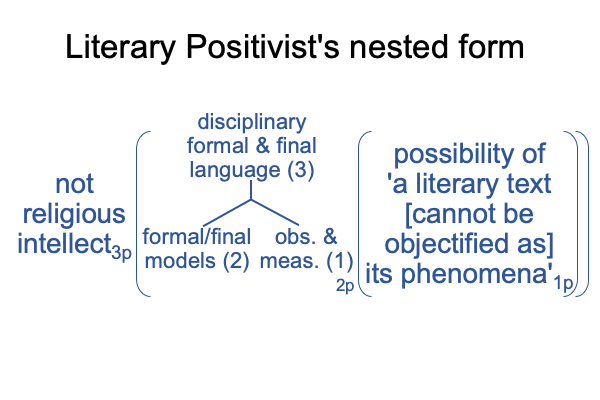
0083 Do not let me forget the not-religious intellect3.
Here is a picture of the Literary Positivist’s nested form.
0084 The issue of reductionism, once again, cannot be avoided.
The term, “structuralism”, what does it mean?
I recall that the ‘thing’ that has the matter of semiology and the form of aesthetics has a label: “structuralism”.
0085 Obviously, the disciplinary language of “structuralism” satisfies the positivist intellect’s injunction by redefining “metaphysics” as “religious mumbo-jumbo”.
Structuralist models are not truly reductionist because the disciplinary languages of semiology and aesthetics (secretly) incorporate Aristotle’s formal and final causes, through the fact that dyadic models (hylomorphes) are actualities2 that demand a normal contexts3 and potentials1.
0086 In contrast, the sociological, the psychological and the communicational reductionist can propose models (based on truncated material and efficient causalities), where the observable and measurable facets of a thing itself (the literary text) are accounted for by cultural, psychological and communicative arrangements (all materialist, of course).
Sociologists, psychologists and communicational reductionists satisfy the positivist’s injunction according to its original formulation, where “metaphysics” refers to “Aristotle’s formal and final causalities”.