0087 Perhaps, the terminology is not really clear. Formalism and structuralism are not identical. Neither are they completely different.
In section three (3), the authors quote Jakobson, writing in 1971, that the term, “structuralism” belongs to modern science in all its manifestations. The same cannot be said for the term, “formalism”.
0088 What does this imply?
The label, “structuralism”, should apply to the models. “Formalism”? Not so much.
Nevertheless, the models (whatever they are called) include formal and final causalities. In sum, they contain a dyadic actuality2. Plus, a triadic normal context3 and monadic potential1 are along for the ride.
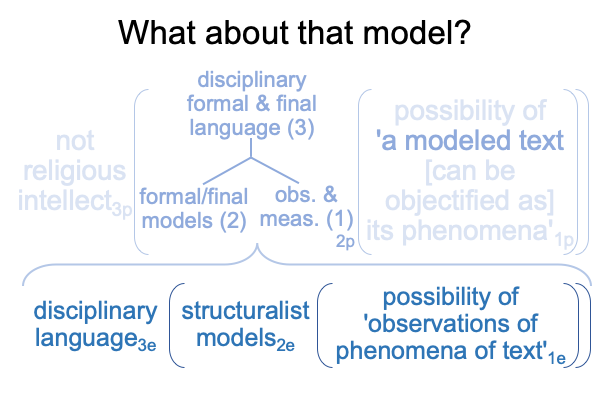
Once again, the subscript “p” stands for the Positivist’s judgment. The subscript “e” signifies the empirio-schematic judgment.
0089 Let me first consider potential1p for the Positivist’s judgment.
The noumenon should be the literary text.
The triumphalist scientist proposes to substitute a successful model for the noumenon.
Then, the model substituting for the noumenon [can be objectified by] its phenomena1p.
0090 Now, I turn to the empirio-schematic judgment2p for the Literary Positivist.
The terminology is most difficult, because both “formalism” and “structuralism” denote models that are “not religious” (fitting the mandate of “no metaphysics”), yet implicitly evoke formal and final causations.
0091 After all, “structuralism” is “semiology [substantiating] aesthetics”. So the disciplinary language of structuralism3e, while sounding “not metaphysical”, contextualizes dyadic relations2e (and triadic relations disguised as dyadic relations) that are naturally (and for humans, instinctively,) contained in category-based nested forms.
0092 So, how does “structuralism” as part of a disciplinary language3e operate on the possibility of ‘observations of phenomena within a text’1e?
Structuralism situates semiology in terms of the aesthetics of systems. If semiology is the study of spoken language, where “spoken language” consists of two arbitrarily related systems of differences, parole and langue, then each habitual association between one parole and one langue (or “sign”) must be situated by a structure or a system.
0093 Consequently, the structure3 is a normal context3. Its potential1 is ‘the laws of a system’1. The actuality2 is a dyadic structure that takes semiological matter into a form that emerges from (and situates) that potential1.
A structuralist model2e (what ought to be, secondness) within an unfolded empirio-schematic judgment2p manifests all four of Aristotle’s causalities (material, formal, efficient and final).
0094 Yes, that is well and fine, but I still do not have a diagram of what goes into a structuralist model2e.
That is because there is something about the structuralist model2e to keep in mind.
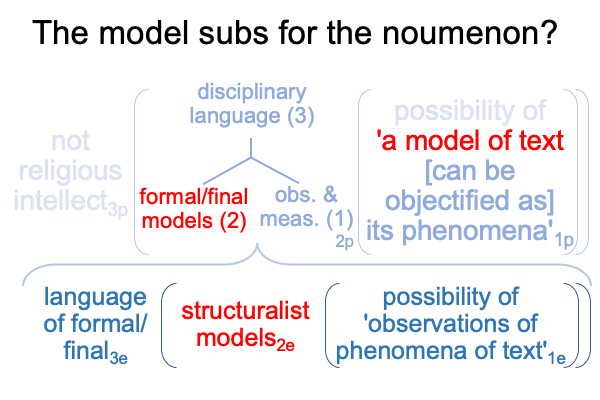
0095 If one follows triumphalist scientists, then this model of the text2e may serve as a substitute for the text itself1p. That is, the model of the text2e (what ought to be, secondness) may re-present the noumenon1p in the Positivist’s judgment (what is, firstness).
After all, the model2e, in its empirio-schematic reality2p, encompasses the phenomena of the literary text1p.
0096 The following figure color-codes that message.
0097 In section three (3), the authors distinguish two schools of formalism in Russia: The Society for the Study of Poetic Language (in St. Petersburg) and the Moscow Linguistic Circle (MLC, with Jakobson as president). The two branches aim to adhere to the Positivist’s judgment, with the literary text as the thing itself.
Marxist or Freudian or communication-based reductionist paradigms are discouraged. Holistic approaches are encouraged. Formalist and finalist models cannot be fragmented into merely mechanical processes, acting as truncated material and efficient causalities.
0098 Do the terms, “formalist” and “finalist” have anything to do with the most metaphysical of Aristotle’s four causes?
Of course they do.
0099 So, I wonder, “Can one satisfy the positivist’s rule by building models that explicitly use mechanical and efficient terminology while implicitly recruiting formal and final causalities?”
Hmmm.
Did I already answer that question?
0100 Section three (3) reports that Juri Lotman (many years later), in his Lectures on Structural Poetics (appearing in the first issue of Sign Systems Studies, published in 1964), criticizes previous so-called “formal methods” that focused on the matter of language and the form of the literary text. “Formalists” discern various literary devices in the text. These devices work in a mechanical fashion and are not “structuralist”, in so far as they do not elucidate interdependent and hierarchical wholes.
0101 As far as I can see, during the first transit (1910s-1930s), academics in linguistics and literature widen their focus of inquiry to include two contemporaneous European trends, logical positivism (the interests of the Vienna Circle) and phenomenology (the return to the “noumenon” proposed by Edmund Husserl).
Within these European trends, a subtle replacement is both encouraged (by the logical positivists) and challenged (by the phenomenologists). Noumena, which cannot be objectified by their phenomena, are increasingly veiled by successful models, which can be objectified by their phenomena.
0102 But, disagreement mounts.
Logical positivists (or “triumphalist scientists”) want to replace each noumenon with its mechanical or mathematical model. This gives birth to the academic laboratory sciences.
Phenomenologists rely on a method, devised by Husserl, to figure out what the noumenon must be. This path supports further observations and measurements of phenomena that objectify what the noumenon must be. This fuels the social and psychological sciences.
0103 As far as I can see, literature studies and linguistics are more akin to biology (where phenomenology seems more relevant) than chemistry and physics (where triumphalist scientists are hard to dismiss).
But, my opinion does not stand in the way of triumphalist science.
0104 So, let me take a closer look at this structuralist model2e.
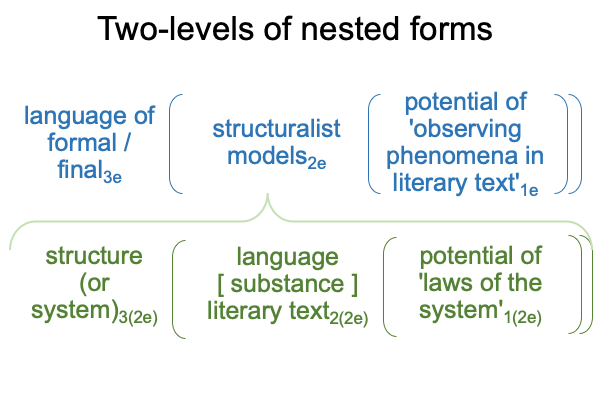
0105 While scientists and intellectuals in the West snip formal and final causalities away from their material and efficient causalities, the linguistic circles in what becomes the Soviet empire unwittingly embrace Aristotle’s trickery. The structuralist model2e contextualizes a lower-level category-based nested form.
0106 On the upper line, the empirio-schematic unfolds into a nested form. The triadic normal context of the language of formalism (where “formal” touches base with Aristotle’s formal and final causalities)3e brings the dyadic actuality of structuralist models2e into relation with the monadic potential of ‘observing phenomena in a literary text’1e.
0107 Then, on the lower line, the structuralist model2e itself harbors an Aristotle-friendly category-based nested form,as if it3(2e) belongs to the adjacent lower category. If the structural model2e belongs to the perspective level, then the adjacent-lower category-based nested form belongs to the situation level.
This situation-level nested form reads like this: The triadic normal context of a structure (or system)3(2e) brings the dyadic actuality of {language as matter [substantiates] literary text as form}2(2e) into relation with the monadic potential of ‘laws within the system’1(2e).
0108 Does that category-based nested form look like an answer the the question, “What is “structuralism”?
The subscript “2e” designates the higher-level structuralist model2e. This subscript will soon change to “c”, standing for a perspective-level of a three-level interscope.
0109 More on that later, because I would like to cast my eyes upon hylomorphes and entanglements and confoundings. The form in the dyadic actuality at the core of the structuralist model2e (the form in the actuality2(2e) within the actuality2e) entangles matter2p that engages the normal context3p and the potential1p of the Positivist’s judgment.
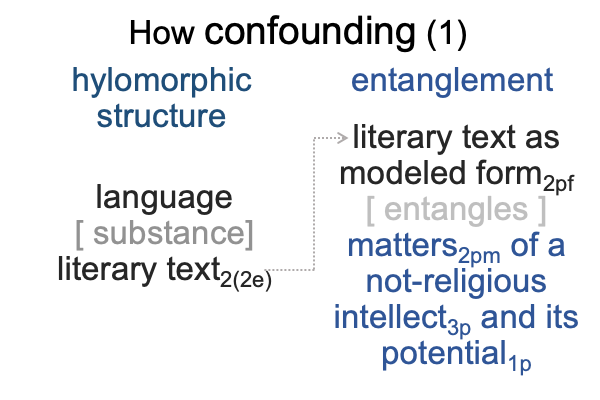
To this confounding, I attend.