Looking at Mikhail Trunin’s Article (2017) “Semiosphere and history” (Part 1 of 8)
0841 The article before me is published by Sign System Studies (volume 45(3/4), 2017, pages 335-360) by Mikhail Trunin in the School of Humanities at Tallinn University, Estonia. The full title is “Semiosphere and history: Towards the origins of the semiotic approach to history”. This particular volume is dedicated to semiotics and history.
0842 Juri Lotman (1922-1993 AD) and Boris Uspenskij (1937-present) are central characters in the first ascent of the Tartu-Moscow School of Semiotics during the 1960s through the 1980s.
Lotman’s treatment of a semiotics of history connects to his conceptualization of the semiosphere. Of course, “semiotics” stands in the place of “semiology”.
Uspenskij’s treatment of the semiotics of history starts with the Latin phrase, “historia sub species semioticae”. The phrase transliterates (more or less) into “history as a species of semiotics”.
Or maybe, “historical under the semiotic species”.
Of course, “semiotics” stands in the place of “semiology”.
0843 Previous examinations of articles in this and other volumes of Sign System Studies provide a way to appreciate what these semiologists have in common.
0844 So, let me briefly review.
The academic development of semiological consciousness for humanities scholars starts in the Departments of Slavic languages, during the so-called “Cold War”, since the Union of Soviet Socialist Republics casts its dominant ideology as that of science. These humanities scholars begin to frame their interpretations of Slavic literature in terms of Saussure’s semiology and structuralism. After all, semiology and structuralism are scientific, aren’t they?
0845 Semiology deals with content, the relation between parole (spoken words) and langue (corresponding ideation). Technically, the relation between speech and thought is not motivated (hence the qualifier, “arbitrary”), since spoken words do not image or point to their referents. Nonetheless, civilized humans behave as if they do. But, that behavior may be attributed to grammatical structure (for a mother tongue) or a style system (for specialized discourse).
0846 Structuralism deals with how content is situated. Humans do not behave as if a spoken word is arbitrarily related to a mental act (or thought). Humans act as if words and thoughts are one thing.
Rather than attributing this behavior to an innate trait evolved under conditions where a parole (manual-brachial word gesture) images and indicates its referent (by way of the natural sign-qualities of icons and indexes, respectively), the modern scientist must attribute the behavior to truncated material and efficient causes.
In this case, the situating efficient and material causes are due to a system3b. Both mother tongue and specialized discourses3b operate on the potential of ‘laws of the system’1b.
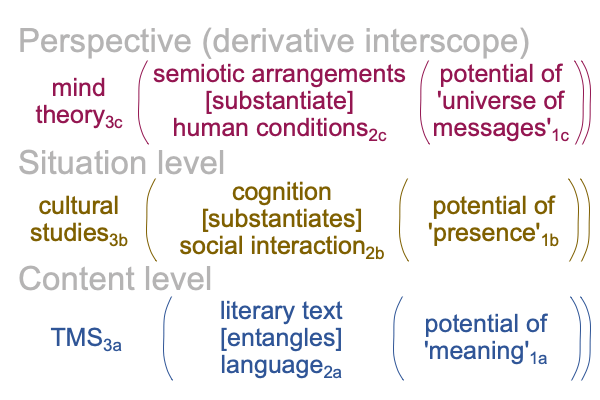
0847 Here is a fundamental interscope containing semiology3a and structuralism3b.
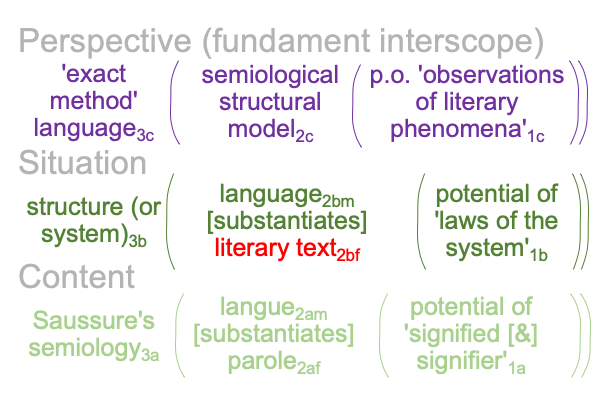
0848 On the content level, the normal context of Saussure’s semiology3a brings the actuality of the dyad {langue as matter2am [substantiates] parole as form2af}2a into relation with the potential of ‘signifier and signified’1a.
Cleverly, the content-level potential1a buries the evolution of language in the milieu of hand-talk in the ambiguity of the co-existence of signifier and signified. Can a signifier exist without a signified? Of course not. They must be belong to a monad, a single element.
Can a thought about ‘something’ exist without an image or indication of that ‘something’?
Does a manual-brachial word-gesture picture or point to its referent?
0849 Ironically, both Charles Peirce (1839-1914 AD) and Ferdinand de Saussure (1857-1913) live right before the monumental, civilization transforming battles among the enlightenment gods. Peirce focuses on the nature of signs as triadic relations. Saussure focuses on language as a thing (that is, a dyadic actuality).
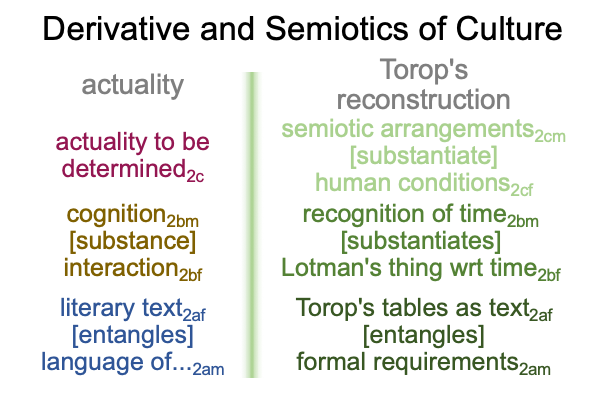
0850 The above figure tells the tale. The content and situation level actualities2 are dyads, as suggested by Saussure. Normal contexts3 and potentials1 are presumed in Saussure’s tradition, but explicit in terms of Peirce’s categories.
The category-based nested form is a triadic relation. Triadic relations constitute the human niche. Hominins adapt into the potential of triadic relations.
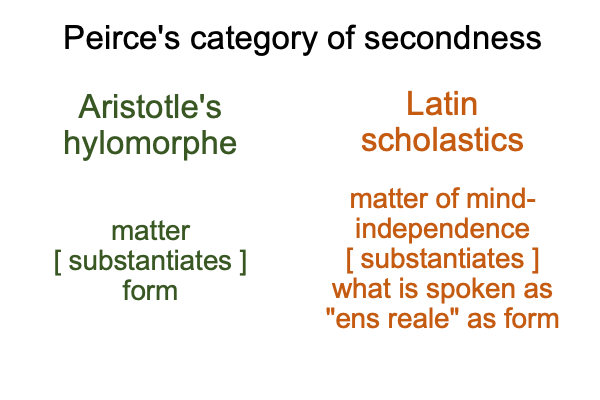
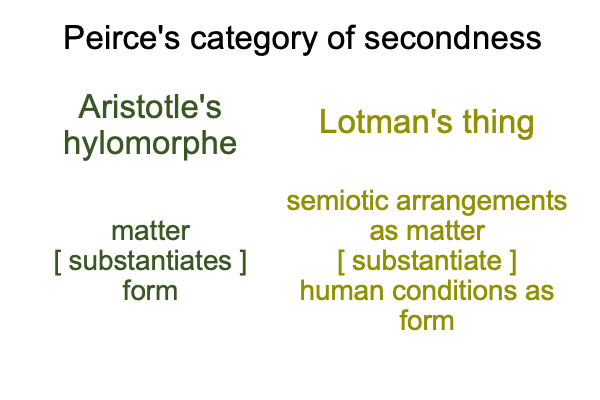
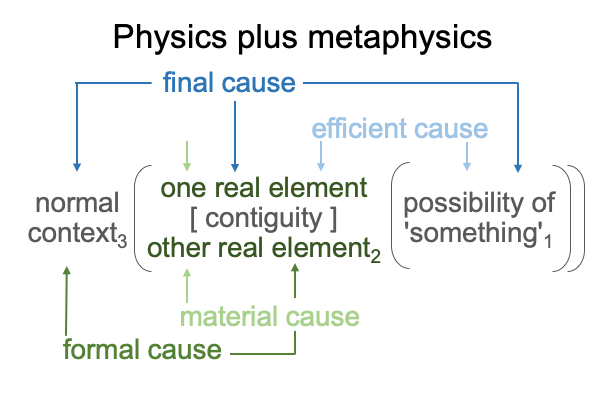
The content-level appears to be a reasonable expression of Saussure’s semiology because it expresses a triadic relation. Not only that, but the content-level category-based nested form manifests all four of Aristotle’s causalities. The dyadic actuality, corresponding to Peirce’s category of secondness, parallels Aristotle’s hylomorphe, the home of material causes and one terminus for efficient causation.
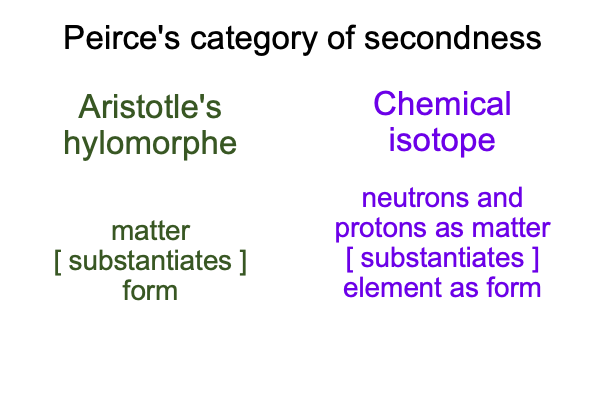
0851 Here is a picture of the category-based nested form as a manifestation of Aristotle’s causalities. Peirce’s category of secondness contains two contiguous real elements. For Aristotle’s hylomorphe, the one real element is matter. The other real element is form. The contiguity is [substantiates] or [substance].
0852 So, what does this imply?
First, Lotman and Uspenskij start out as scholars of Slavic literature in Russia, under a socialist regime, which extols its scientific credentials. Academics in literature adapt to regime incentives by adopting Saussure’s scientific approach to language. Saussure’s semiology is regarded as a scientific theory explaining the phenomena of language in our civilized world.
Second, the fundament interscope starts with Saussure’s semiology3a as a content-level nested form. The actuality2 is {langue2am [substantiates] parole2af}.
Third, the category-based nested form manifests all three of Peirce’s categories as well as all four of Aristotle’s causalities.
Fourth (and yet to be discussed), Lotman’s and Upsenskij’s treatment of history and semiology starts with the fundament interscope. Semiology characterizes a content-level interscope. History enters the picture as a literature-based situation-level form2bf.
0853 If these implications stand, then Upsenskij’s Latin title, “history as a species of semiotics”, will convert into “history as a species of literary text”.