0507 So, where was I?
Where have I traveled?
I have walked through the first of two interviews with a prominent member of the Tartu-Moscow School of Semiotics at its first ascendant. Because my approach capitalizes (some would say, “exploits”) Peirce’s formulations, my examination adds value to the discussion. Diagrams of purely relational structures, such as the interscope, permits a visualization of semiotic changes and developments through time.
0508 The second interview, starting on page 425, discusses thirteen questions. Predefined questions offer an awkward format for an interview. Given the hyperventilation that occurs during the interview on August 25, 2011, the hope is for a more structured encounter at Uspenskij’s villa in Rome on May 27, 2012.
The interview concerns Uspenskij’s 2007 book, Ego Loquens: Language and the communicative space.
0509 The Latin term, “ego loquens“, roughly transliterates into “I speak”.
Of course, the end of Descartes’ famous slogan immediately comes to mind, “therefore I am.”
I speak, therefore I am.
0510 But, what am I?
Perhaps, I am language2b (that another person can read like a literary text2b) as well as a communicative space (like the way that I, as a literary text2a, entangle a communal cognitive space called “language2a“).
0511 How confounding.
A communal cognitive… er… communicative space2a is the language2am that is entangled by the literary text2af, not as a thing itself2b, but as a model2c of structural3b and semiological3a signification3c.
0512 I hope that this statement justifies the use of the title of Uspenskij’s book to label the fundament and derivative interscopes, as shown below.
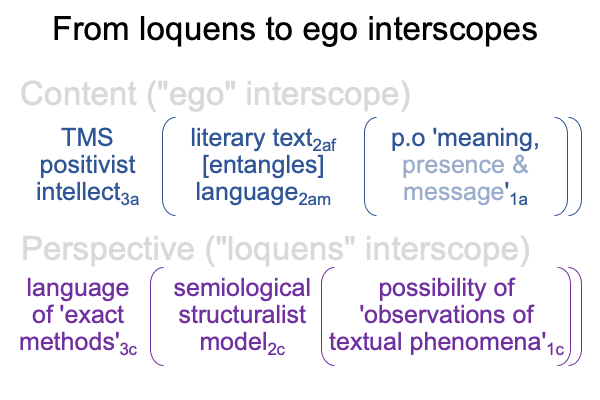
0513 Look closely at the above figure.
Can the reader see a triadic relation where a semiological3a structuralist3b model2c (SVi) stands for a literary text as form2af (SOi) potentiated by meaning1a, presence1b and message1c in the normal context of a defining intellect (SIi)?
0514 At this point, I would like to introduce the interventional sign-relation, first brought to visualization in Comments on Sasha Newell’s Article (2018) “The Affectiveness of Symbols” and then used as a tool in Looking at John Deely’s Book (2010) “Semiotic Animal“. Both works are by Razie Mah. The former may be purchased at smashwords and other e-book venues (while the time lasts!). The latter appears as a series in Razie Mah’s blog during October, 2023).
0515 The interventional sign-relation?
How informative.
Please tell.
0516 In general, the interventional sign-vehicle (SVi) is a perspective-level actuality2c.
The interventional sign-object (SOi) is the represented content-level actuality2a.
The interventional sign-interpretant (SIi) consists in the content-level normal context3a and potential1a.
0517 An interventional sign-vehicle (SVi) stands for its sign-object (SOi) in regards to an interventional sign-interpretant (SIi).
0518 Here is a general diagram.
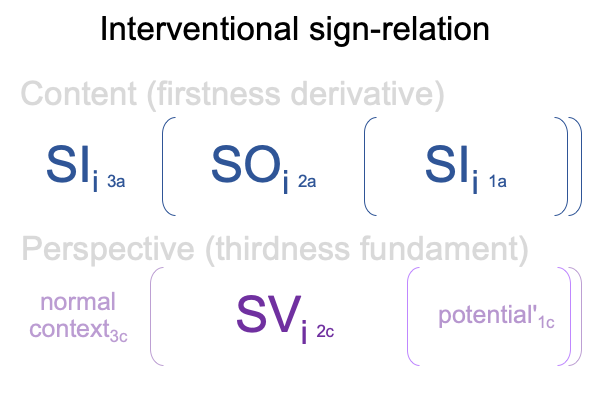
0519 This rendition of Peirce’s sign-relation in terms of Peirce’s category-based nested forms is founded on the notion that both the SV and the SO belong to secondness, the realm of actuality, leaving the SI to include both thirdness and firstness. Since nested forms occupy levels in an interscope, the SO occupies the actuality on the adjacent higher level than the SV. The SI occupies the same level as the SO.
0520 This rendition implies that there are three signs contained within any three-level interscope.
Each sign connects the levels of two adjacent categories, except for the interventional sign, which goes from thirdness to firstness. One dare not call that “prescission”.
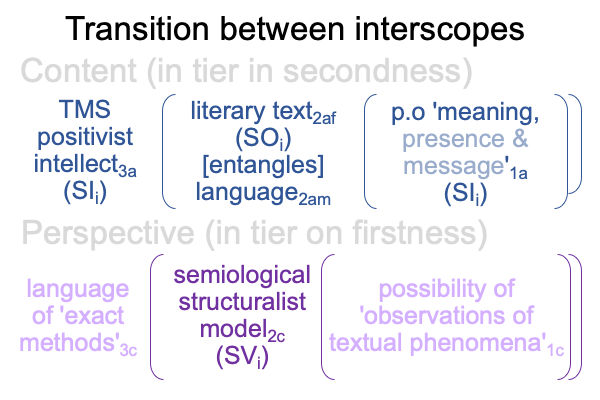
0521 Unless, one imagines, not precission among levels, but among interscopes.
The interventional sign-relation constellates precission between two interscopes.
In this case, the “tiers” belong to firstness and secondness.
How informative.
0522 Tiers of interscopes is not new.
Precission among tiers of interscopes can be found in Razie Mah’s chapter on presence in How To Define The Word “Religion”. Ten primers belong to the corresponding course, for those interested in a step-by-step exposition.
Precission among tiers is also intimated in the very structure of the article under examination. The first interview, part one, deals with the possibility of exact methods3c virtually bringing structuralism3b into relation with the potential of semiology2a. The second interview, part two, deals with Uspenskij’s literary text2af, Ego loquens, and considers the possibility of meaning1a, presence1b and message1c.