0523 “Precission” is a very specific term, indicating that a higher category arises from an adjacent lower category. Theoretically, a category-based nested form contains two precissions, from firstness to secondness and from secondness to thirdness. Actuality2 emerges from potential1. Normal context3 contextualizes actuality2.
0524 The fractal nature of precission allows a repetition where one category-based nested form belongs to firstness(content) and an adjacent higher category-based nested form belongs to secondness (situation). Thus, the interscopemanifests as a fractal image of the category-based nested form on an adjacent larger scale.
Then, three-tiers manifest on the adjacent higher scale than the interscope.
0525 Notably, the scale of the TMS inquiry is limited to two tiers, belonging to firstness and secondness.
At least, that is how it seems to me.
Within each interscope, two signs connect adjacent levels (precission) without qualification. One requires qualification.
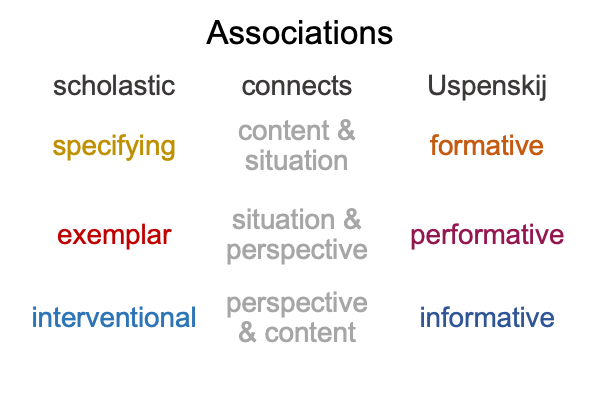
Medieval scholastics label the regular signs as specificative extrinsic formal causality (the specifying sign) and exemplar extrinsic formal causality (the exemplar sign). The former joins content and situation. The latter binds situation and perspective. If the signs occur within a system, then the causalities change from extrinsic to intrinsic.
0526 Uspenskij offers a typology of three signs (listed during the second interview on page 431). To me, they associate to the scholastic labels quite nicely.
0527 The second interview, conducted May 27, 2012, asks thirteen questions.
0528 The first question concerns how Uspenskij defines the word, “sign”, with the implication that, if the answer is a triadic relation, then the definition goes with Peirce’s framework, called “semiotics”, and if the answer is a dyadic relation, then the definition goes with Saussure’s framework, called “semiology”.
The old man says that a sign has both form and meaning (page 425-426).
0529 Of course, this is a semiological formulation. “Form” associates with signifier1a (and for speech-alone talk, parole2af). “Meaning” associates with signified1a (and for speech-alone talk, langue2am).
0530 But that is not all, there is an unspoken third term. This third term comes into play as Uspenskij rules out some disciplines as not semiotic (that is, dealing with form and not meaning) and classifies some disciplines as semiotic (dealing with both) (pages 427-428)
The third is “a relation between form and meaning”.
0531 Uspenskij characterizes a “sign” as having form and meaning.
Is that the same as the relation between literary form2af and the potential underlying a positivist language2am?
This question is left unspoken, because making the connection is obviously a human trait. Humans connect a sign-vehicle (SV) and its sign-object (SO) all the time. Plus, they occasionally realize that they are exercising a sign-interpretant (SI). One funny implication is that, for a scientist, this realization gets labeled “metaphysics”, at best, and “anthropomorphism”, at worst.
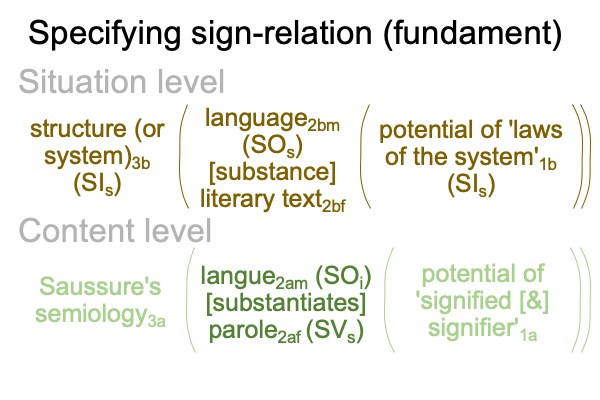
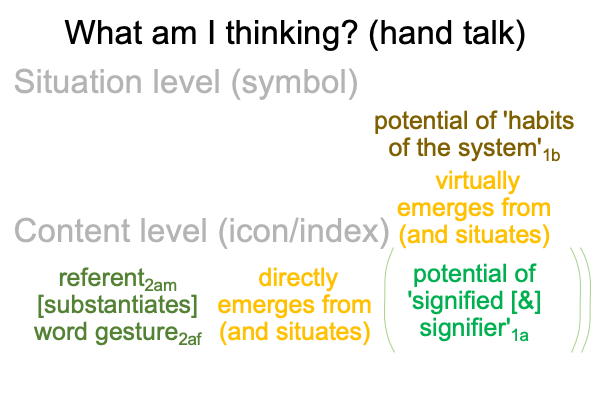
0532 What happens to the specifying sign-relation when I suggest that the signified is not langue2am, but rather a sign-object (SOi) and the signifier is not parole2af, but rather a sign-vehicle (SVs), as shown in the following figure?
0533 In response, a reader may ask, “Is that a trick question?”
If it is, it is a nice trick.
0534 It suggests, as does Uspenskij’s answer to the first question, that there is a third term, “the relation between a signifier and its signified1a in the normal context of Saussure’s semiology3a“.
The process of identifying the signified1a and the signifier1a, as well as naming the SOi and the SVs, seems obvious in our current Lebenswelt. We neglect the SIi, which may the only sign-element that requires an explanation.
0535 Fortunately, speech-alone talk allows us to label the SIi as the normal context3 and potential1 of the actuality2 of the SOi, thereby making each sign-element subject to inquiry.
How can speech-alone talk do that?
Speech-alone talk can label anything, even things that cannot be pictured or pointed to.
See A Primer on Implicit and Explicit Abstraction, by Razie Mah, available at smashwords and other e-book venues. Or, read on.
0536 Could explicit abstraction occur ten-thousand years ago, at the very end of the Lebenswelt that we evolved in?
No, hand- and hand-speech talk cannot engage in explicit abstraction. Our ancestors could not explicitly abstract the terms, “mumbo-jumbo” or “anthropomorphism”.
Instead, hand- and hand-speech talk facilitates implicit abstraction. Signs operate. Humans are aware of sign-processes. Signs are performed, rather than analyzed.
0537 The specifying sign may serve as a case study that involves self-reference (discussed on pages 431 and 432).
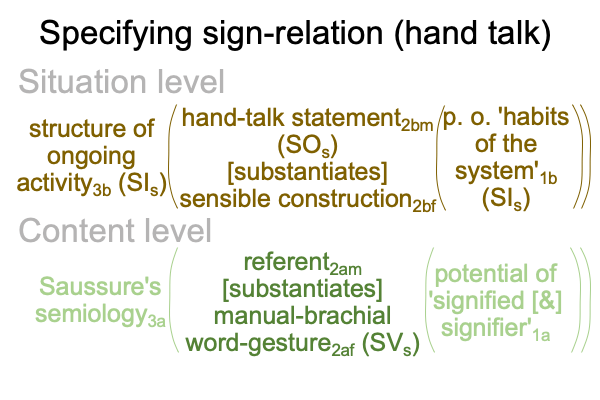
Here is an expression of the specifying sign-relation that corresponds to hand-talk in the Lebenswelt that we evolved in.
0538 In hand talk, “I” may be performed as [point to MYSELF].
In semiology3c, [Point to MYSELF]2af is substantiated by me (the referent)2am.
This is how hand- and hand-speech talk works, the word-gesture (although habituated) pictures or points to its referent.
0539 Twelve-thousand years ago, my hunting team approaches a water hole where a single gazelle drinks, ignoring the other gazelles who have wandered through a passage in a nearby stand of rocks. The other gazelles do this in anticipation of our approach. But, not this buck!
0540 I have a bright idea. I wave to catch the attention of the other members of the team.
[Point to MYSELF][point to PASSAGE IN ROCKS][image HIDE][image JUMP][image CLUB][point to gazelle].
One of my team points to himself. [ME TOO].
0541 It’s clear that I have a signified and a signifier in mind.
0542 While the rest of the team slows their approach, we run into the rocks, make it to the passage, and prepare to jump. When the team sees that we are ready, [wave CLUB], they speed their approach in order to spook the gazelle in our direction.
We jump into the passage, and the gazelle is coming fast and… BAM!
All I see is the gazelle leaping…
0543 When I revive, with a bloody nose, the team is there. My friend clubbed the gazelle that could not quite leap over me. Everyone is happy. They are relieved that I am miraculously uninjured. They have a catch to bring home.