0544 Nobody likes getting hit in the face.
Nobody likes a question that goes unanswered.
If the inquirer is able to construct a specifying sign-relation from the example, then the construction should make sense.
Specifying signs are formative.
Specifying signs initiate sensible construction.
0545 But, can one ignore the adjoining interventional sign-relation?
In the following snippet of the fundament interscope, the potential of a presumed interventional sign-interpretant (SIi) supports both the actuality of langue2am (the thought2am (SOi) behind the spoken word2af, SVs) and, virtually, the potential of the specifying sign-interpretant (SIs).
Where does this interventional sign-interpretant (SIi) come from?
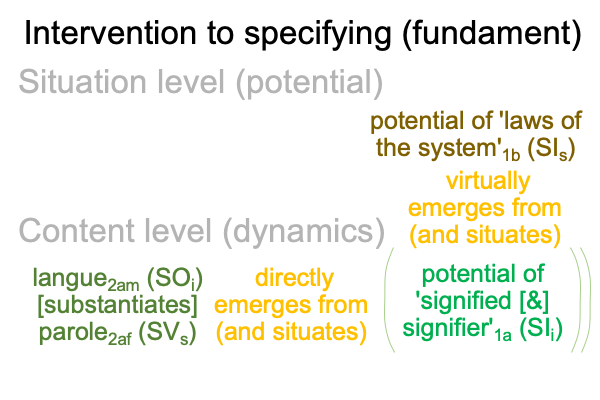
Oh, I can see a part of SIi.
0546 On page 435, the interviewer asks Uspenskij about his use of the word, “sense”, then claims that the author uses the term in a variety of ways.
Uspenskij answers in two sentences. The words in a text have sense. Sense is a phenomenon of the text.
Of course, for the fundament interscope, these statements imply that “sense” is a way to observe the linguistic phenomena1c within a literary text as form2af.
0547 What about the derivative interscope?
Does this interscope also contain a specifying sign-relation that supports sensible construction?
Yes, it does.
0548 Here is the picture.
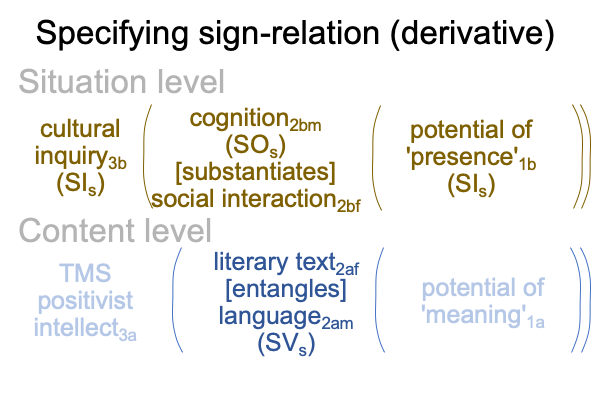
0549 Here, the two uses of the word, “sense”, make… um… sense.
The literary text as form2af entangles a language2am (SVs) that stands for both sensible cognition2bm (SOs) and sensible interaction2bf in regards to cultural studies3b operating on the struggle to find the right words that label the presentation1b (SIi).
This is like what happens during the first ascendant of the Tartu-Moscow School of Semiotics. Cognition2bm, based on semiological3a structural3b models2c, is objective. Scholarly collaborative social interactions2bf, framed in terms of meaning1a and presence1b, are intersubjective.
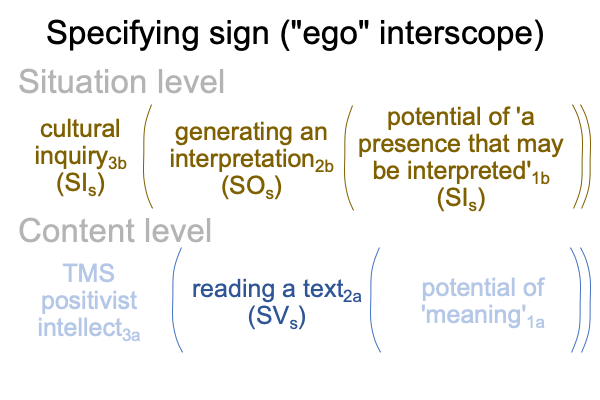
0550 For example, reading an author’s text2a (SVs) stands for generating and sharing an interpretation2b (SOs) in regards to cultural frameworks3b that the text supports1b (SIs).
0551 Uspenskij lists six criteria for “making sense” (pages 435 and 436).
The first two (A and B) are most important.
0552 Here are the two, using my own words.
For A, all the words must pertain to a particular situation. If we cannot figure out the situation, then the words are meaningless.
For B, a statement makes sense when we can assess its content, discuss it, and estimate under what conditions it is true or false.
0553 Some of the other items on the list are curious.
(E) The reader may assume a text makes sense, until proven otherwise.
This criteria is curious, leading me to wonder, “How widely does this apply?”
0554 Does this rule apply to artifacts belonging to the Lebenswelt that we evolved in, such as the Upper Paleolithic (say, 70 to 10 kyr)?
When an archaeologist recovers an artifact from this period, there is a choice. If the artifact has an obvious utility, then the archaeologist applies the label, “tool”. If the artifact does not have an obvious function, then the expert applies the label, “symbol”. Tools have obvious meaning. Symbols do not, but we must presume that represent ‘something’.
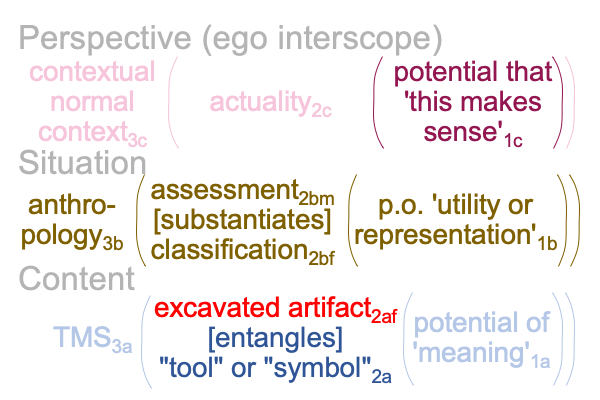
0555 Here is a picture of the specifying sign-relation.
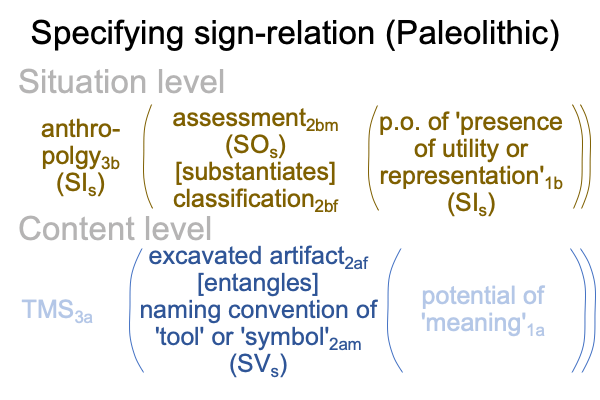
0556 The dyadic actuality, {excavated artifact as form [entangles] meaningful labels as matter}2a (SVs) stands for the dyadic actuality, {anthropological assessment as matter [substantiates] classification as form}2b (SOs) in the normal context of anthropology3b operating on the possibilities of ‘utility or symbolic representation’1b (SIs).
0557 Does that make sense?
An answer to that question corresponds to the potential of ‘message’1c.
0557 What does that imply?
An exemplar sign-relation is about to launch.
The SOs of the specifying sign is contiguous with the SVe of the exemplar sign.
Here is a picture.
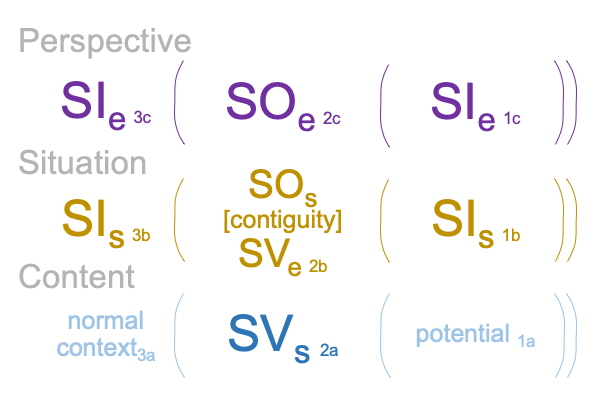
0558 The specifying sign crosses from content into situation. The specifying sign is formative.
The exemplar sign crosses from situation to perspective. The exemplar sign is performative.
0559 The discussion, so far, only suggests that the exemplar sign may be present.