0560 I continue the example of an archaeologist’s conundrum.
The situation-level dyad, {assessment as matter (SOs) [substantiates] classification as form (SVe)}2b stands for a perspective-level actuality2c (SOe) in regards to a perspective-level normal context3c operating on the potential that ‘what the archaeologist is doing makes sense’1c (SIe).
Can I imagine what that perspective-level normal context3c and actuality2c must be, given the example of a Paleolithic artifact2af that has been recently unearthed?
May I speculate on the exemplar-sign relation?
0561 Does it involve translation?
Consider the scene.
During an archaeological excavation, the participants anticipate finding something. Let me say that it consists of two relatively thin, flat pieces of fossilized wood, almost identical, both notched and worn on one end, as if a fiber cord had been tightly wound around one end of each, but not the other.
The discoverer waves another excavator over.
0562 Here is what they say.
0563 “What have we here?” one digger says2af.
Well, it2bf sure looks like it must be human. Not a human. Something made by a human2bm. The wood is clearly petrified. So, the cellulose served as a site for mineral precipitation over time.
It obviously has a use. So, what are we talking about? There is a hearth nearby. That structures the scene. Closely examining the phenomenal aspects of the forms1c, the researchers propose a model2c. The excavated artifact is a tool, but also a symbol. The cord marks show that it2af is an adornment, worn around the neck of someone attending communal cooking, and it2af is tool, because it is flat and narrow, perfect for lifting food from a campfire.
0564 Soil is taken and sealed in a bag. Later, the soil will be radiocarbon dated.
So far, all this makes sense. The fossilized tools are like parole2af, in that they are saying something. The fossilized pair are like a literary text as form2af substantiated by the language of an archaeological team2bm.
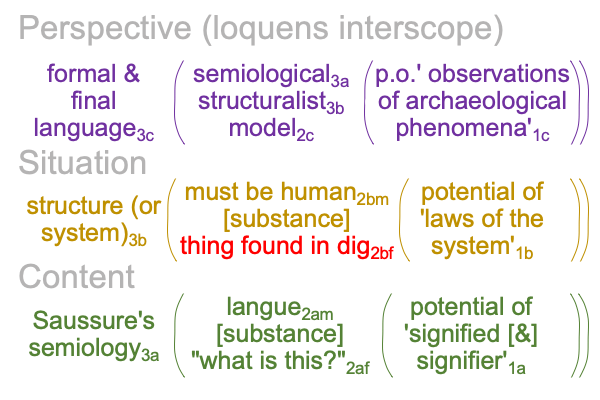
0565 The content and situation levels constitute a specifying-sign relation. The spoken words attracting the attention of others2a (SVs) stands for the matter of being human [substantiating] the things as forms2b (SOs) in regards to the structure of a modern archaeological excavation3b operating on the potential ‘order of geological deposition of materials’1b (SIs).
0566 Yes, so far all this makes sense, and that sensible construction is modeled2c in an exemplar sign relation, connecting the situation and perspective level. When sensible construction works, the perspective level cannot even be recognized. Things go so smoothly. The exemplar sign-relation basically confirms that the specifying sign-object (SOs) is… well.. sensible.
0567 Oh, the specifying sign-object (SOs) and the exemplar sign-vehicle (SVe) are contiguous. They both occupy the situation-level actuality2b.
The thing found in a dig2bf and must be human-made2bm (SVe) stands for a sign-based3a excavation-structured3bmodel2c (SOe) in regards to the language of physical anthropology3c operating on the potential of ‘these particular archaeological phenomena’1c (SIe).
In other words, the specifying sign-relation makes sense. The exemplar sign-relation not only confirms the conclusion,but packages the specifying-sign object2b (SOs and SVe) and its sensible representation2c (SOe) into an interventional sign-vehicle2c (SVi) to launch to the next tier.
The exemplar sign-relation passes like a nod of the head.
0568 Then, the interventional sign-relation proceeds, connecting the fundament and derivative tiers.
The semiological3b structuralist3a model2c (SVi) stands for {an excavated artifact as form2af [entangling] the language of meaning as matter2am} (SOi) in regards to a defining intellectual normal context3a operating on the potential of ‘meaning’1a (SIi).
0569 Here is a picture of the derivative interscope.
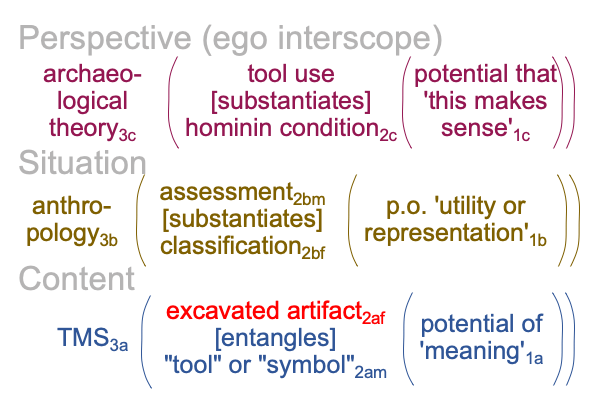
0570 The content-level dyad of entanglement2a initiates a specifying sign-vehicle (SVs) that stands for the actualization of the presence of meaning2b (SOs) in regards to the normal context of anthropology3b operating on the potential of ‘what makes meaning present in this particular investigation’1b (SIi).
0571 Okay, what makes the meaning of “tool” or “symbol” present1b?
A tool has utility. A symbol does not.
A symbol represents ‘something’, even though the inquirer does not know what that ‘something’ is.
0572 Does that make sense?
With this question, the pattern starts to become more apparent.
In both interscopes, the specifying sign-relation is supposed to make sense.
The exemplar sign-relation either validates, or sets conditions, or tells the inquirer how the specifying sign-relation makes sense.
0573 On page 437, after the interviewer uses Uspenskij’s own criteria to query about the terms, “sense” and “meaningful”, Uspenskij simply admits that he is interested in language (first of all), especially what is sensible in language.
0574 So, I suspect that his research constructs an exemplar sign-relation in the derivative interscope.
Surely, this is not a simple task.