0575 Page 437 introduces a question (#7) concerning translation.
Why is adequate translation between languages impossible?
There are two specifying sign-relations in the TMS regime.
0576 In the first specifying sign-relation, in the fundament interscope, the literary text2bf is substantiated by the language2bm (SOs) that virtually situates spoken words2a (SVs) as langue2am and parole2af of a particular mother tongue. Translating a literary text into another mother tongue risks misreading the content character of a literary text2af, especially when the text is rich with word-play.
0577 Here is the specifying sign-relation for the loquens interscope, in general.
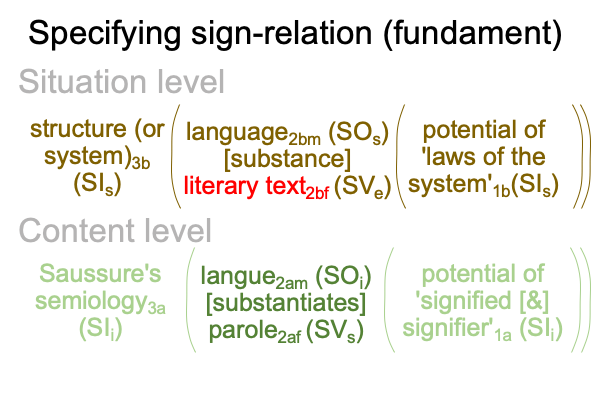
Parole2af (SVs) stands for language2bm (SOs) in regards to a structuralist paradigm3b((1b)) (SIs).
0578 If the word-play is not translated, the text does not make sense.
In other words, an alien reader may not be able generate an adequate semiological3a structuralist3b model2c of the original text.
The text2bf is not funny anymore.
0579 In the second specifying sign-relation, in the derivative interscope, social interaction2bf is substantiated by a cognition2bm (SOs) that virtually situates the language of meaning2am (SVs) that has been entangled by the literary text2af. Can this operation be translated into the various languages of a positivist intellect? What if the positivist language is too different? Then, will it be virtually situated by a style of cultural inquiry3b that makes no sense at all, such as computer operations3b.
0580 Say what?
Here is the specifying sign-relation for the ego interscope, in general.
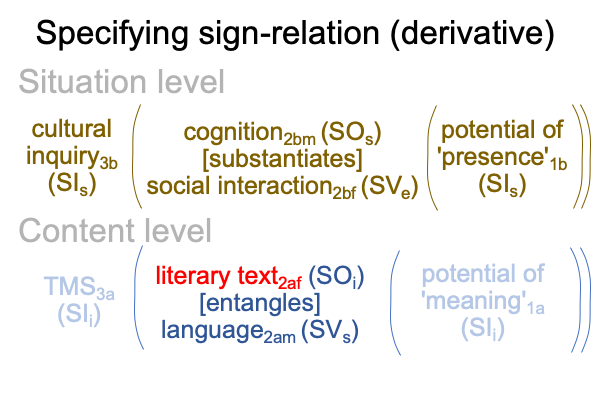
A positivist language2am (SVs) stands for cognition2bm (SOs) in regards to a cultural-studies paradigm3b((1b)) (SIs).
0581 What if the literary text2af is a series of apparently irregular scratches2af that the academic thinks are inscribed near the center of only one side of each of the before mentioned pieces of fossilized wood?
What could these scratches2af mean1b in terms of the language of anthropology2am?
0582 Of course, after the excavation, the researchers take the artifacts to Professor Rabenmann, who still has an office at the old Institute of Archaeology.
What will the old man have to say?
0583 They explain the find and give him the two flat pieces of fossilized wood. The Professor notes cord markings are on the opposing side of the scratches and much closer to the end of the flat pieces, than the marks.
Are the marks intentional?
What do these artifacts translate into?
0584 Hmmm. The professor is not sure. He opens the drawer to his desk and takes out a ball of string. He measures out a meter, then cuts the string with a scissors. Then, with a degree of deliberation, he places the stones face to face and starts to wind the string around the two pieces, retracing the one sided cord markings.
0585 Professor, what are you doing?
Give me a moment. I want to see.
You are not going to break them, are you?
Oh no, no breakage, these are hard as stone. Now, look I have tied them together.
Now what?
0586 Then, the professor takes a walnut that is on his desk, places it between the two pieces, right where the scratches are, and presses the stone slabs together.
0587 The novices almost pass out.
“There you go. It is a nutcracker.”, the professor says, while picking the meat of the nut away from the shell.
0588 Yes, the word “translation” now applies to two literary texts. The loquens2bf text (the one everyone talks about) is substantiated by the language of the mother tongue2bm. The ego2af text (the one that Uspenskij talks about) entangles the language2am of the TMS positivist intellect3a.
0589 Later, the students use interferometry to make three-dimensional images of each fossilized piece in order to demonstrate that, if the two cord-impressed ends are bound by a simulated structure, then enough force could be simultaneously applied to the opposing termini as to compromise the mechanical integrity of a Persian walnut.
Now, that is what I call, “translation”!
0590 I recall that at the very opening of the second interview, Part II, Uspenskij notes that the Tartu-Moscow School of Semiotics is primarily interested in culture. It does not regard inanimate and animate processes as significant.
0591 With that recollection in mind, consider a literary2af… er computerized input2af that entangles a coding language2am.
Here is a picture.
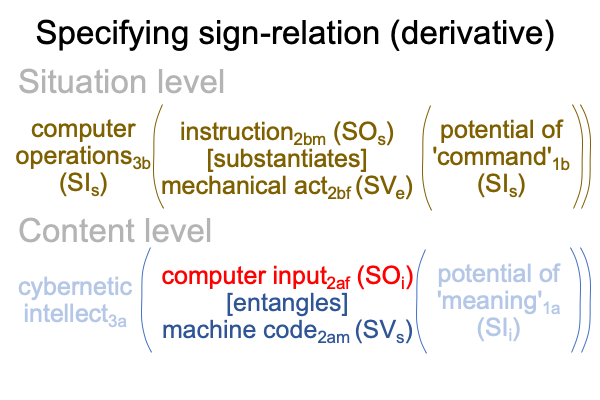
0592 Does a cybernetic intellect3a turn computer input2af into machine code2am according to the potential that ‘each word of the input translates into a sequence of machine codes’1a?
0593 Does the answer imply that entanglement is translation, broadly speaking?
Entanglement is translation.
Does this apply especially to the content-level actuality2a of the “ego” interscope, in so far as it embodies the sign-object of an interventional sign-relation (SOi) and the sign-vehicle of a specifying sign-relation (SVs)?