0753 So, we talk about one thing (geography) and search for another (identity).
Each spoken term is a placeholder in a system of differences.
At least, that is how Ferdinand de Saussure (1859-1913 AD) characterizes spoken language.
Spoken language consists of two arbitrarily related systems of differences: parole (speech act) and langue (mental act). The contiguity between langue as matter2am and parole as form2af is purely arbitrary, that is, based on habit and convention.
In contrast, for hand- and hand-speech talk, the contiguity is motivated, not arbitrary. Each parole (gestural word) pictures or points to its langue (referent) (except, of course, for word-gestures that have purely grammatical functions, then the referent is purely relational).
0754 The implications?
Oh, that must be a topic for future semiotic inquiry.
0755 Instead, I ask, “If each parole is a placeholder in a system of differences, then is there a semiotic tool that illuminates adjacent parole in that system?”
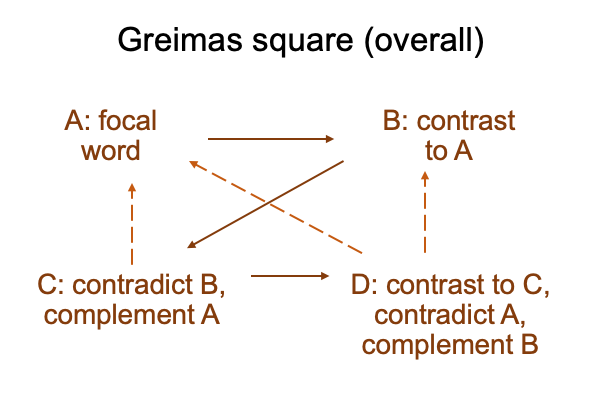
0756 One answer is provided by the Greimas square. The Greimas square consists of four elements, represented as four corners of a box.
The first corner, A, is the term under consideration.
The second corner, B, contrasts with A.
The third term, C, contradicts (or “speaks against”) B and complements A.
The fourth term, D, contrasts with C, speaks against A and complements B.
0757 Here is a picture.
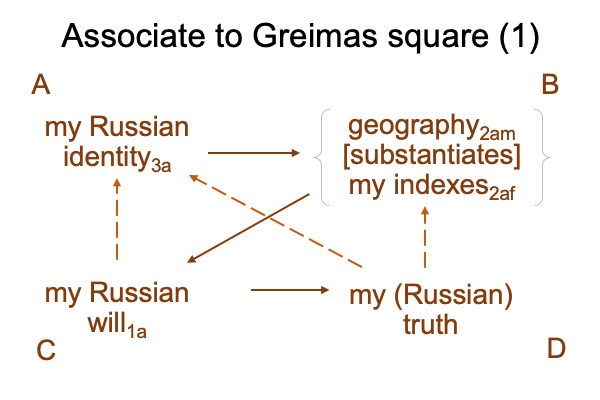
0758 I now ask, “Does the postmodern ground for “geography” associate to Greimas square?”
Well, I suppose that my Russian identity3a is the term under consideration (A).
In contrast (B), what I think2am takes geography as matter. What I say2af forms geographic indexes that are contextualized by my identity3a operating on my will1a (or maybe, the truth1a of me). The indexes2af tell me where I am.
0759 My Russian will1a (C) speaks against the dyad (B) of {geography as matter2am [substantiates] indexes as form2af}. How so? My will1a can potentiate a diversity of dyads, all taking the structure of {what I think2am[substantiates] what I say2af}. As such, my will1a complements my identity3a.
Finally, standing against my will1a is the truth (that is, the truth1a that should potentiate my identity3a, but obviously does not).
How do I know this?
Since when does geography2am determine identity3a?
0760 Here is a picture that answers that question.
0761 In the abstract, the author contends that spatial parameters constitute one of the most important constants in Russian history. Furthermore, this constant does not depend on ideology. Instead, ideology evaluates this constant. No one contests the dominance of spatiality. Russian ideologies have articulated all theoretical options for contextualizing geography through identity.
0762 What does this imply?
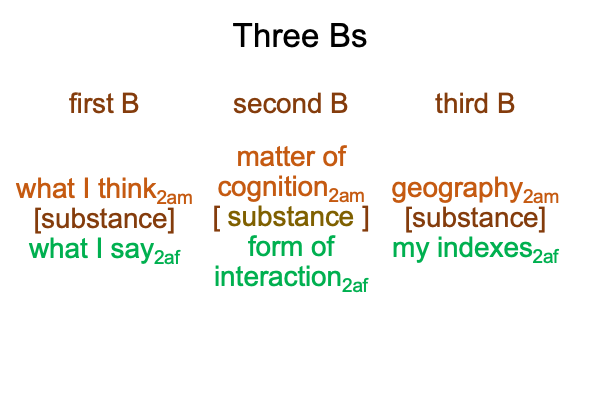
Geography2am goes with what I think2am and serves as matter in B, the contrast to A.
But, what is geography2am doing?
It is speaking to me. Not in spoken language. Rather, it speaks in the words of the divine2af.
0763 Geography2am gives substance to the ways that I orient myself in the world2af.
Consider the following three “B”s.
0764 However, the question remains.
How can matter2am determine normal context3a?