0496 Of course, no one knows what those last two statements imply, other than there is no way to proceed in a straightforward manner.
Maybe a gestalt shift is coming.
0497 Here is a picture of the transition between the fundament, the semiological3a structuralist3b intersubjective3cinterscope and the derivative, suprasubjective interscope that contains cultural studies3b (I). The transition moves from the perspective-level of the fundament to the content-level of the derivative.
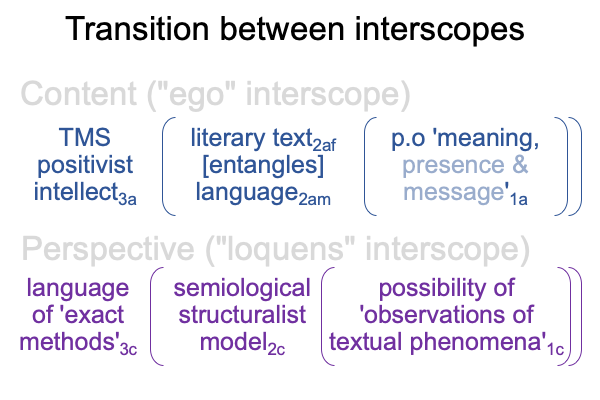
0498 In order to visualize a shift in orientation, two comparisons follow (J).
0499 The first compares the perspective-level nested form of the fundament with the empirio-schematic judgment.
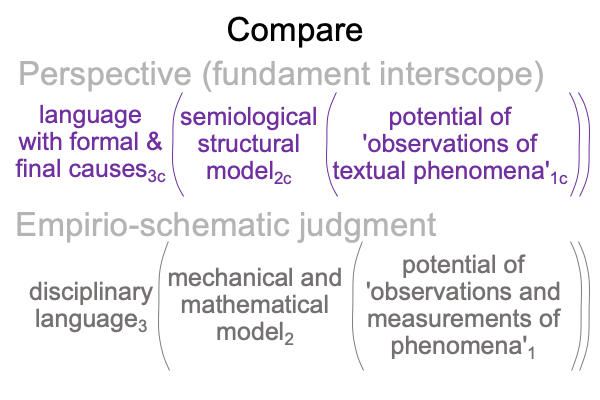
The similarity is stark enough to convince the vigilant Socialist authorities that the work of Lotman, Uspenskij and collaborators must be legitimate… that is… “scientific”. These bureaucrats are very interested in keeping the academy’s nose to the grindstone of godless inquiry. Compared to all the western quacks in the arts of superstition (religious studies) and capitalist sophistry (humanities), these researchers look like the real deal.
0500 The second compares the content-level nested form of the derivative with the definition of a spoken word that appears in Razie Mah’s e-book, How To Define The Word “Religion” (available at smashwords and other e-book venues).
501 Do not, for a moment, think that Razie Mah’s e-book offers a list of dictionary definitions.
Razie Mah offers ways to investigate the meaning, presence and message1 underlying the spoken word, “religion”. Each potential ends up with its own visual diagram. Each potential entails a unique purely relational structure. These relational structures do not depict phenomena of the noumenon of “religion”. These relational structures depict the immaterial thing itself. The noumenon, the thing itself, consists of immaterial relational structures.
0502 Here is a picture.
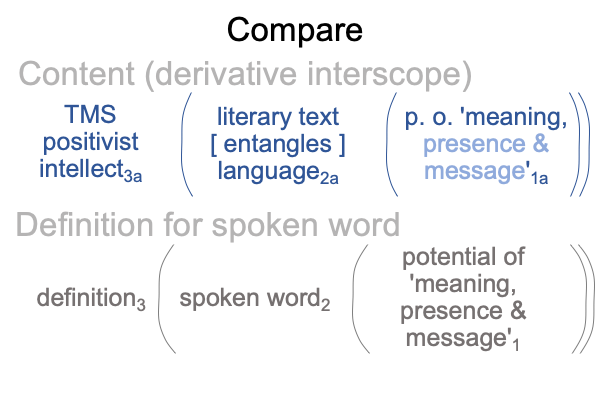
Aha! Where is the unfolded Positivist’s judgment?
Is this a Gestalt shift?
0503 Razie Mah’s category-based nested form of definition breaks the mold of the social sciences, whose models cohere with empirio-schematic formulations, and then triumphantly substitute themselves for their noumena.
The TMS school begins in a similar fashion. Then, rather than terminating in the Positivist’s judgment, with models substituting for noumena, the TMS3a launches an interscope that offers a language2am of meaning1a, presence1b and message1c. Meaning1a, presence1b and message1c are like phenomena that raise the question, “What must the noumenon2af be?”
0504 Is the noumenon contained in the virtual nested form in secondness for the derivative interscope?
That is a good question.
But, even without an official answer to the good question, a Gestalt shift from the Positivist’s judgment to a Peircean definition, may explain why the TMS is ignored by bigilib mainstream observation and measurement-oriented research establishments and systematically excluded from funding by review boards staffed by their mindless institutional compatriots.
0505 Put in terms of the scholastic interscope, TMS makes a leap from what is happening? to what does this mean to me?.
In Uspenskij’s terms, TMS jumps form loquens to ego.
This is precisely what the social sciences desire to do.
0506 The modern social sciences may build models of what is happening?, but they cannot make the leap to relevance, characterized as meaning, presence and message.
So concludes this interlude (see point 0093).