0470 Now, I want to get more serious.
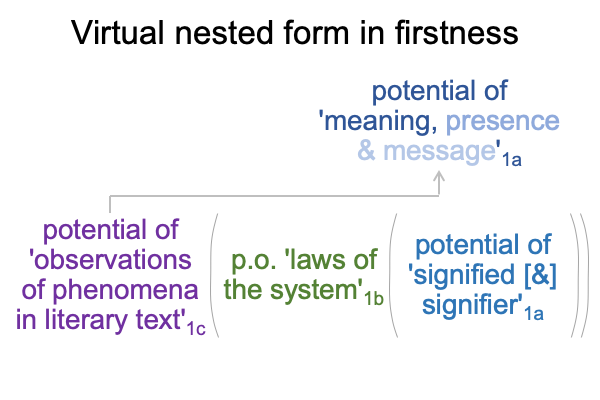
Here is a diagram of the virtual nested form in firstness for the fundament along with the potential for the content-level of the derivative.
0471 If I follow the arrow to the emergent possibility, then a question arises.
Does the virtual nested form in the category of firstness support the emergent potential of ‘meaning, presence and message’1a?
Of course, the first term stands boldly. The second and third terms fade, until attention proceeds upstairs to the situation and perspective levels, respectively.
But, that does not address the question at hand.
0472 From pages 422 to 425, the discussion touches base with this question, without coming close to articulating it, much less its foundations. It is the dance of a young interviewer eager to say something intelligent and an old academic trying to avoid saying something stupid. It is a beautiful dance, because every statement shimmers like a shiny fabric, glistening in the illumination of a beam of light.
That light is the radiance of the question at hand.
If I only knew what that question is.
0473 How many times in our evolutionary development and our civilizational history have humans created inventions, like writing, without really comprehending what they are doing?
The virtual nested form in firstness lists out the titular words of the journal that the Tartu-Moscow School inaugurates.
Who would have predicted that?
Only Peirce’s categories allows the inquirer to diagram the purely relational triadic structure of the interscope.
0474 The normal context of the TMS positivist intellect3a entails a new disciplinary language2am, or approach2am, or whatever matter one might imagine2am, emerging from (and situating) the potential of meaning1a.
0475 Here is a picture of the virtual nested form in thirdness along with the emergent content-level normal context3a.
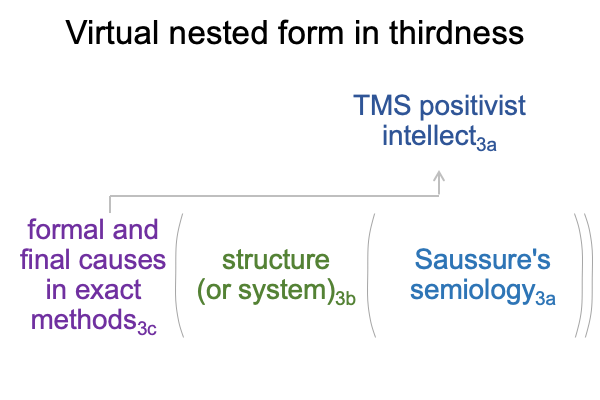
0276 This figure portrays the first ascent of the TMS during the 1960s through the 1980s.
I suspect that the second ascent will incorporate Peircean diagrams.
0477 Of course, the Tartu-Moscow School (TMS) does not constitute a unitary positivist stance3a. There are a specialized discourses for each manifestation of “literary text2af“.
This is the foundation upon which Juri Lotman builds his pivot to cultural studies.
I suspect that Uspenskij harbors doubts. In one statement, he admits that Lotman’s most important quality was his human charisma. In another statement, he wonders whether modern semiotics exists.
0478 During the first interview, conducted on August 25, 2011, at the conclusion of the Tartu Summer School of Semiotics conference on “Semiotic Modeling”, the aged linguist does not admit to much hope for the field of inquiry.
0479 Why?
Peircean diagrams of the invention of the TMS lie fifteen years in the future.
Consequently, the sessions do not provide hope that the exact methods3c of structuralist3b semiological3a models2c can withstand scrutiny by expertise in the natural and social sciences.
0480 Before the fall of the USSR, all the TMS had to show was that they were on the science side of the fence standing between superstition (okay, “religion”) and science.
Now, over twenty years later, the TMS needs to show that they can deliver what the natural and social sciences cannot deliver, guidance in how to define3a the literary text2af in terms of meaning, presence and message1a.
0481 Why do the editors of Sign System Studies publish, in 2017, interviews with one of the shakers and movers of the Tartu-Moscow School of Semiotics, recorded earlier in the decade?
Something foundational… er… cosmological happens in the 1960s through the 1980s.
Perhaps, the now-aged inventor knows what was invented. It is the exact methods3c of structuralist3b semiological3ainquiry into the literary text2bf (in the most expansive sense of the term).
But, no one knows the implications.
So, maybe, a look into the history of the invention will assist.