0456 The literary text2bf as form contains literary phenomena that can be objectively observed1c.
On the perspective level, the normal context of a language of exact methods3c brings the actuality of a semiological structuralist model2c into relation with the possibility of ‘observations of textual phenomena’1c.
0457 Then, a sign-relation leaps to a novel interscope.
The jump involves the interventional sign-relation.
In a sign-relation, a sign-vehicle (SV) stands for a sign-object (SO) in regards to a sign-interpretant (SI).
0458 The interventional sign-relation joins the perspective level of the fundament interscope (which I may also label “the semiological structuralist” or “loquens” interscope, for variety) to the content level of the derivative (“culture studies” or “ego”) interscope.
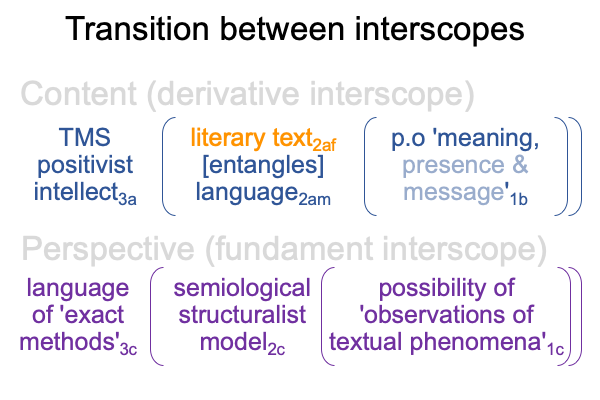
0459 Here is a picture of the transition.
0460 Here is how the interventional sign-relation reads.
The semiological structuralist model2c (SVi) stands for literary text as form2af (SOi), in regards to the positivist intellect of the Tartu-Moscow School3a operating on the potential of ‘meaning, presence and message’1a (SIi).
0461 The implications are telling.
The language of ‘exact methods’2c manifests a primordial image of empirio-schematic inquiry on the perspective level of the fundament interscope and signals a semiotic movement into the positivist intellect of the Tartu-Moscow School3a. The TMS positivist intellect3a contextualizes {the literary text as form2af [entangling] language2am}, but this language2am is technical, not literary. This technical language2am emerges from (and situates) the potential of meaning1a.
0462 May I state the interventional sign-relation once more?
The semiological structuralist model2c (SVi) stands for the dyad, {literary text2af (SOi) [entangles] language2am}, precisely because the model2c, forged from exact methods3c operating on observations of textual phenomena1c, attracts an entanglement2a, in the normal context of the TMS3a operating on the possibility of ‘meaning’1a (SIi).
0463 That is one long and complicated sentence!
And, long before I piece that sentence together, the interview, now on page 420, has veered deeper into the business of exact methods, as if exact methods are what makes the semiological structuralist two-level interscope viable. Exact methods do not lead to proof, they lead to intersubjectivity, the ability to dialogue about the literary text2bf (whatever it may be) objectively among colleagues.
0464 If collaborating intellects only talked subjectively, then they could never become objective enough to sustain an intersubjective discourse.
Intersubjective discourse, where collaborators discuss subject matter objectively, has the potential to achieve suprasubjectivity (the so-called God’s eye point of view, corresponding to what Latin-speaking medieval scholastics called “ens reale” (reality as a mind-independent being) as opposed to ens rationis (opinion as a mind-dependent being)).
0465 On page 420, the discussion grinds to “convincing” versus “nonconvincing” models.
On page 421, the (perhaps exasperated) old Uspenskij starts asking the questions, and the interview turns into something like a comedy. The interviewer launches into a monologue, about natural science and semiological models. They are not the same. Natural science models things. Semiotics models knowledge. Knowledge is based on signs. Science measures things. Differences cannot be conjured fast enough. The interviewer hyperventilates.
Recite this portion of the interview loudly and emphatically. Light-headedness quickly ensues.
0466 On page 422, the real discrepancy between structuralist3b semiology3a and the natural sciences condenses into a question, roughly asking, “How would a scientist observe phenomena within a literary text1c, and not have a psychological or sociological or communicative or economic model in hand?”
A literary scholar working within a science-oriented academy must find a path to visualize phenomena in a literary textirreducible to the models listed above. That path treats the words of the literary text as signs (using Saussure’s definition of language) within systems (playing off of the linguist’s assumption that language – in the widest sense of the word – has a structure).
0467 This brings me back to the crucial transition between interscopes.
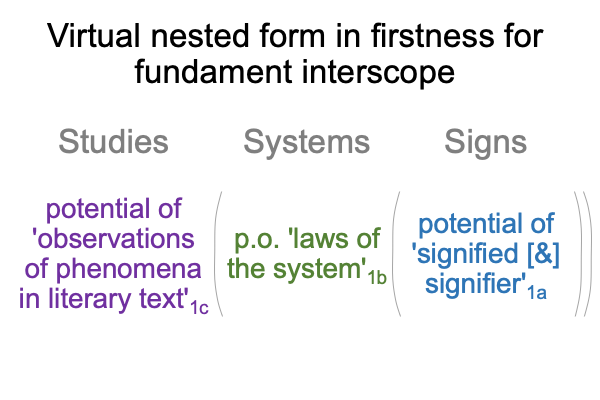
Here is a diagram of the virtual nested form in firstness for the fundament interscope. The diagram turns a column into a virtual nested form.
0468 The virtual nested form reads as follows.
The virtual normal context of ‘observations of phenomena in a literary text’1c brings the actuality of ‘the laws of the system’1b (that undergirds the literary text2b as an actuality within a system3b) into relation with Saussure’s curious coining of the terms, “signified” and “signifier”1a, as the foundation of semiology… er… semiotics.
0469 Here I ask, “Does the above figure remind anyone of the title of the journal, Sign Systems Studies?”
Of course, the question is purely rhetorical.
Sometimes, rhetoric is funny.