09/30/26

Looking at Dr. D. Basak’s Book (2025) “Sumerian Mythology…”  (Part 1 of 20)

0001 The full title of the book before me is Sumerian Mythology, Ancient Civilizations, and the Epic Search For Humanity’s Origins.  That is a great title.  This publication is the 13th in a sequence of 37 books downloaded into the Amazon product line between the end of July, 2025, and the start of January, 2026.  This literary output is staggering.

0002 Plus, it raises a question in my mind.

How does one identify an artificial intelligence (AI) produced article or book?

0003 Every sentence is well constructed.  The text is highly segmented.

Are these clues?

0004 For example, the preface divides into A (5 subsections) and B (1 subsection).  Each subsection contains two paragraphs.  The preface also includes additional material, C, informing the reader what to expect, why this is essential reading, and how this qualifies for understanding.

Of course, this is standard textbook formatting.

However, the two clues, well-constructed sentences and high segmentation, still apply to the question at hand.

0005 Here are some other clue.

Flat statements contain no wordplay.  The entire book consists of (1) direct statements and (2) a negative followed by an affirmative.  No, I don’t mean to be negative, it is obviously better to be positive.

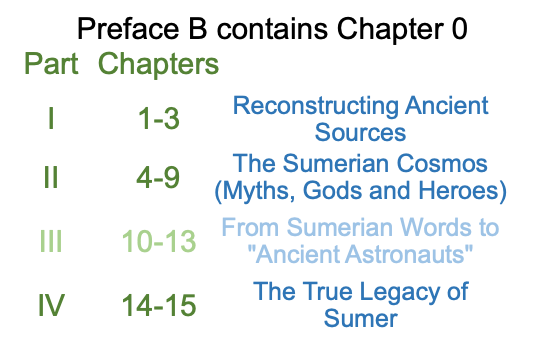
Fractal repetitions appear within the book’s organization.  For example, the preface’s B subsection constitutes (what may be called) “Chapter 0”, which recapitulates the topics of the subsequent 15 chapters.

0006 Here is a picture of the list of chapters.
0007 Even though the text itself does not state that it is AI generated, one may raise the question and ponder the clues. These clues do not prove an answer, one way or another.  But, they do raise another question.

If the work at hand is AI generated, then what does that imply?

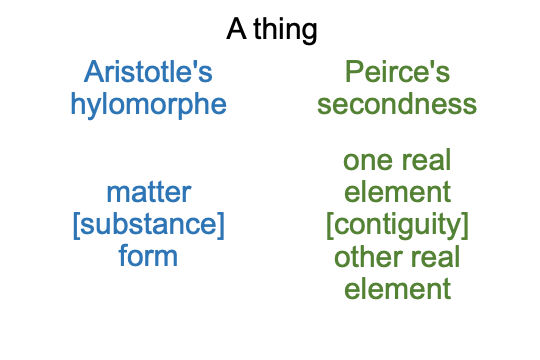
0008 The postmodern scholastic will start with Aristotle’s hylomorphe, which is an exemplar of Peirce’s category of secondness.  These concepts may be derived from Razie Mah’s e-books A Primer on the Category-Based Nested Form and A Primer on Sensible and Social Construction.

The book that I have before me is a thing.  A thing is composed of two contiguous real elements.  For Aristotle, the real elements are matter and form.  The contiguity is placed in brackets for clear nomenclature.

0009 Here is a diagram.
0010 My question as to whether the book is AI generated and what that implies is called “an entanglement”.  The following diagram is sort of confusing (something that an AI would avoid), because two expressions are linked in that they have the same form. 
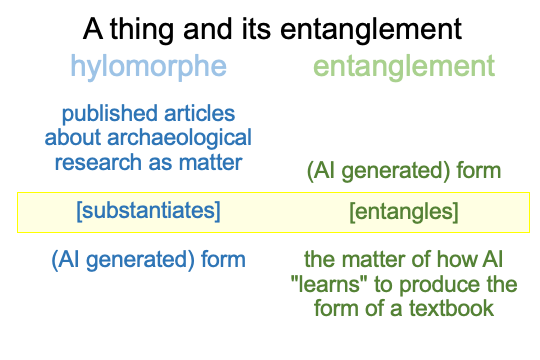
0011 In the hylomorphe, describing the book before me, the phrase, “AI generated”, is put into parenthesis because the question remains open.  The form is a book. 

In the second (upside down, so to speak) thing, the (AI generated) form entangles another matter.   That “other matter” is a question about how the AI learns what it is going to say.  Obviously, the answer will include the originating matter.  One may wonder, “What else?”

A thing and its entanglement consists in two matters (one originating and one entangled) and one form.  The technical name for this pair is “confounding”.

0012 With the above confounding in mind, I may consider Chapter 1.

Here is a list of the learning objectives.
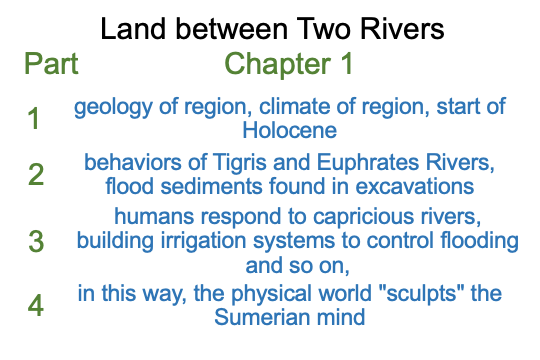
0013 This list suggests that the search for humanity’s origins, involving the Sumerian civilization and its mythology, arises in response to the precarious and fertile landscape between the Tigris and Euphrates Rivers.  Annual floods from both rivers deliver silt.  They can also deliver floods and destruction.

Excavations at locations in southern Mesopotamia find strata associated to floods during the Ubaid, Uruk, and Sumerian Dynastic archaeological periods.

0014 The irrigation systems control the rivers and redirect their water into productive agricultural uses.  These systems require large scale labor under central (yet local) authority.

0015 To me, these conclusions are precisely what an AI program would deliver, after processing the literature (web-pages) cited at the end of the chapter.  But, these are my suspicions.  I have no proof.

0016 However, I can construct a confounding.  There is one form, the land between the Tigris and Euphrates Rivers.  These rivers are subject to annual crests that deposit silt and may cause catastrophic flooding.  The originating matter is the geology and climate of southern Mesopotamia during the Ubaid, Uruk and Early Sumerian Dynastic archaeological periods.  The entangled matter is the mind of the Sumerian people, who celebrate the mythology that this book addresses.

0017 Here is a picture of the confounding.
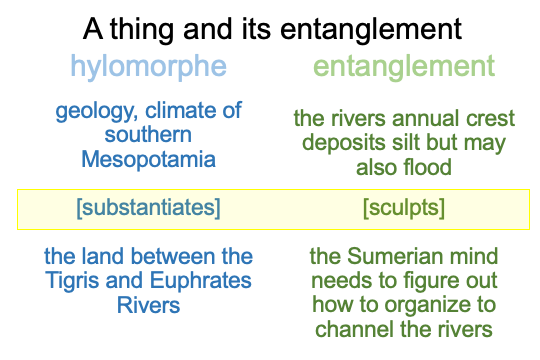
0018 The confounding leaves this reader with a hypothesis.  Sumerian mythology is an ideological component of an organizational imperative.  The Sumerians must figure out how to organize to channel the rivers in order to irrigate their fields and to avoid catastrophic flooding.

In the process, the organizational imperative captures the Sumerian imagination.
09/29/26

Looking at Jess Beck, et al.’s Article (2026) “Changing the Landscape of Archaeological Publishing”   (Part 2 of 20)

0019 Why am I concerned about AI?

0020 Well, I have another manuscript before me.  The article appears in Current Anthropology 67(1), pages 155-180 (https://doi.org/10.1086/739789).  The essay goes online in February, 2026, which is around the time when Dr. D. Basak finishes downloading his 37 books on various topics in human evolution, origins and archaeology.  Surely, none of the 23 authors of the proclamation in Current Anthropology know about Dr. Basak’s efforts.  Artificial intelligence is barely mentioned.

0021 If AI is not the future of publishing in Archaeology, then what is this lead essay about?

Young academics in the field of archaeology are getting crushed by their dual mandates of teaching and research.

0022 The article reminds me of when I heard about the beveled-rim bowl of Uruk.  This standardized hastily spun pottery found popularity as towns were becoming cities.  Some speculate that the bevel-rimmed bowl was used to measure rations of grains.

0023 The exploitation of labor by a religious and political system is not new.  Archaeologists, of all experts, should know that.  The irony of the contemporary complaints is startling.  Postmodern academics are caught in the same dilemma as the laborers who dredged canals or cast bricks of mud and clay, thousands of years ago.

0024 The first sentence of the article reads like a manifesto.  It is time to change academic publishing in archaeology.

If Dr. D. Basak has his way, it has already changed.

0025 The complaint is serious.  Twenty-three authors sign the manifesto.  These include Jess Beck (University of Ireland), Rowan Flad (Peabody Museum, Harvard University), Bridget Alex (Peabody Museum,), Ari Caramanic (Vanderbilt), Andre Costopoulis (University of Alberta), Nicholas Kawa (Ohio State University), Ben Marwick (University of Washington), Christina Warinner (Peabody Museum), Lewis Borck (University of Oklahoma), Kristina Douglas (Columbia Climate School), Alan Farahani (University of California, Los Angeles), Mackinley FitzPatrick (Peabody Museum), Lars Fogelin (University of Arizona), Laura F. Heath-Stout (Stanford), Scott R. Hutson (University of Kentucky), Matthew Magnani and Natalia Magnani (University of Maine), Ana Cecilia Mauricio (Pontificia Universidad Catolica de Peru), Lisa Overholtzer (McGill University), Mattaus Rest (University of Fribourg), Daniel Scott Souleles (Copenhagen Business School) and Renata Verdun de Silva Carmo (Universidade Federal do Rio de Janeiro).

I type each author’s name because each deserves a citation, adding to a number that… um… administrators might use in their promotion considerations.

0026 A citation is like a scoop of grain using a bevel-rimmed bowl.

Ironically, these academics are the winners in a “publications arms-race”.  They teach.  They write.  They review.  They work over forty hours per week.  Are they investigating what they love to study?  Do they feel that they are flourishing?  Or are they keeping the canals clear of sediments and the dikes capable of withstanding turbulent waters?

0027 What are these academics hoping for?

They hope that their activities further their academic careers.  Their rimmed-bowls of citations carry the promise of security.  Some call it “tenure”.  Some call it a false hope amidst economic turmoil.

0028 At the end of the introduction, the authors elevate three “tensions”.

First (1), the theory of publishing to communicate results to other scholars clashes with the practical incentives to please hiring, promotion and granting committees.

Second (2), on one hand, papers are supposed to be presentations of knowledge.  On the other hand, papers are products that publishing corporations leverage for profit.  There is a price that the author (or the author’s institution) must pay in order to establish open access.  Otherwise, the article goes behind a paywall.

Third (3), the academic must teach classes (and perform other pedagogical duties), which are not as valued (by the aforementioned committees) as productive (paper publishing) research.

0029 To me, by the end of the introduction, these young upcoming academics in archaeology articulate the same complaints as the corvee laborers during the Uruk period, saying (more or less), “We are compelled to labor in an exploitative system that extracts profits without compensation, restricts research results from the public and biases stories about the human past.”

0030 Biased stories?

Yeah, look at chapter 1 of Dr. D. Basak’s book, which could serve as a textbook for any classroom on the subject of Sumerian mythology, ancient civilizations, and the epic quest for the origins of humanity.

09/8/26

Looking at Dr. D. Basak’s Book (2025) “Sumerian Mythology…”  (Part 20 of 20)

0249 Chapters 11, 12 and 13 are devoted to debunking an agenda, called “the ancient astronaut theory”, proposed by various hucksters starting in the 1950s.  This theory is multifaceted, since there is more than one proponent.  Basak’s book says that the theory sweeps into public popularity because of the uncertainty following the second battle among the Enlightenment gods, the hot war among fraternal ideologies (1938-1945 AD) and leading into the third battle among the Enlightenment gods, the cold war among materialist ideologies (1945-1989).

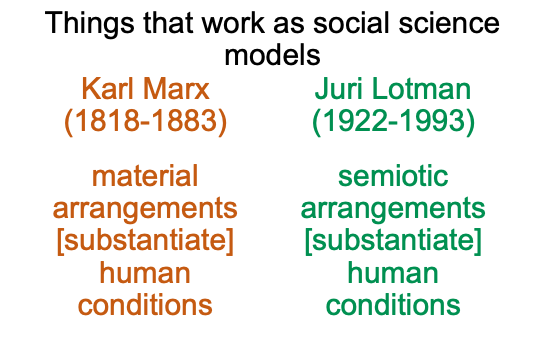
0250 Against this interpretation, which explains this social phenomenon in terms of a model where material arrangements after the Second World War and the start of the Cold War [substantiate] conditions ripe for scam-ideas about ancient civilizations, I place a Lotmanist suggestion that the social popularity of the ancient astronaut theories is accounted for by the inadequacies of Marxist-interpretations of archaeological research into the Neolithic period.

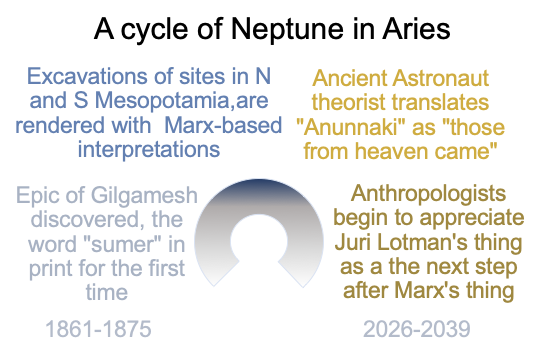
0251 Here is a picture of the framework of the latest cycle of Neptune in Aries.

Highly successful excavations by Western archaeologists offer the promise of coming to terms with the rise of ancient civilizations, based on Marxists formulations.

The Marxist thing does not quite do the job, so alternate theories are proposed by hucksters anticipating an explanatory breakthrough.  Basak’s exercise in debunking the very entertaining alternatives only replays the Marxist thing. Basak relies on the Marxist thing to debunk the alternatives that arose from the lack of explanatory power of the model that material arrangements [substantiate] human conditions.

Now, anthropologists are starting to realize that all those people who entertained the now-debunked “ancient astronaut theory” were not as stupid as the Marxist thing presumes.

0251 Once again, Razie Mah’s four part blog, Looking at Melinda A. Zeder’s Article (2025) “Unpacking the Neolithic”, offers insights.  The results of anthropological research into the so-called “Neolithic” does not… indeed, cannot… account for another trend hidden within the data.  That trend is towards unconstrained social complexity.  Basak’s AI program (my speculation, of course) trains only on results and discussions produced by researchers interested in looking for the material arrangements that substantiate neolithic conditions.  They cannot account for a change in semiotic practices.  They cannot account for what Razie Mah’s hypothesis of the first singularity suggests.

0252 Therefore, why not postulate ancient astronauts?

Surely, ancient monumental constructions, such as pyramids, stone circles, and tracks of figures that can only be seen from the sky indicate ways that civilizing humans communicate with these alien beings.

0253 If this is not a cry for a semiotic accounting for the emergence of unconstrained social complexity, I don’t know what is.

0254 Chapter 14 offers a standard summary of the achievements of ancient Sumeria.

0255 Chapter 15 returns to the topic of the Sumerian creation myths.  Once again, the text re-iterates established points.  On one hand, the Marxist thing can provide an explanation that cannot be challenged because… well… it is supposedly just like a mathematical or mechanical natural science model.  On the other hand, the Marxist thing cannot account for the emergence of unconstrained social complexity in southern Mesopotamia.

Lotman’s thing can.

0256 Here is a picture.

0257 Although this pair of options may appear stunningly simplistic, the ancient astronaut theory shows that stunningly simplistic can work.  It can offer an off-ramp to the current academic highway of a publication-based arms race, where young professional archaeologists struggle to pass through the substance called “tenure” only to realize that they have merely passed from antithesis to thesis (see points 0124-0128).

0258 Beck et al.’s manifesto, “Changing the Landscape of Archaeological Publishing” (Current Anthropology 67(1) (2026), https://doi.org/10.1086/739789), is well worth contemplating as a marker for the end of one Neptune in Aries spiral and the beginning of another.

04/30/26

Looking at John H. Walton’s Book (2025) “New Explorations in the Lost World of Genesis”  (Part 1 of 20)

0001 The book before me is published by Intervarsity Press.  The subtitle is “Advances in the Origins Debate”.  This work is the latest in the “Lost World Series” that delves into how Genesis should be regarded in light of the archaeological discoveries of the past three centuries.

Of course, “new explorations” implies “advances”.  Advances adjust previous positions.  The reader is advised to consult the conclusion immediately after the introduction, and before the section on methodology.

An examination of a prior work can be found in Looking at John Walton’s Book (2015) “The Lost World of Adam and Eve” appearing in Razie Mah’s blog in August 2022.  The review is updated and fashioned as the first and fifth chapters in Razie Mah’s 2024 e-book, Exercises In Artistic Concordism, available at smashwords and other e-book venues.

0002 The term, “literature of the ancient Near East” is somewhat awkward, because the writings of the ancient Near East were buried in the ruins of royal libraries throughout Egypt and the Levant.  The writings are in cuneiform, wedge impressions on clay tablets.  The clay fires into brick when the royal library burns, along with the rest of the royal city.  Then, the ruins get buried in vegetation, and later human settlements, and so on.  Then, the tells (or hills) are excavated by modern archaeologists.  Archaeologists discover thousands of cuneiform tablets and learn how to translate them.  These translations constitute “the literature of the ancient Near East”.

0003 Of course, this story sounds implausible.

However, God tends to manifest the implausible.

0004 In fact, if God only performs sensible… what is the correct term?… “interventions”, then no one would notice.  If anyone could turn water into wine, then the miracle at Cana would be ho-hum.

The Uruk culture invents writing by impressing tokens onto the surface of clay balls (which then contain the impressed tokens).  That seems sensible.  Centuries later, a Sumerians scribe uses a reed stylus to create impressions on a clay surface that is curved, like the surface of a ball.  That seems sensible, also.  Then, stylus impressions on a clay tablet become so routine that cuneiform is used for centuries to record transactions and inventories.  Eventually, the same writing is used to record the civilization’s origin myths.

0005 Okay, each of these steps is sensible, although unlikely.

How many unlikely, yet sensible, developments can be strung together before the results may be declared “miraculous”?

0006 So, what is miraculous with respect to Walton’s lost-world propositions?

God provides eighteen centuries of biblical interpretation by Christians before creating the conditions where a challenge to traditional reference and affirmation occurs.

The archaeology of the ancient Near East unearths literature that is (more or less) contemporaneous with the Old Testament.

That is the challenge.

0007 The Old and New Testaments are no longer subject to plain reading as the sole foundation of interpretation.

Why?

How can one conduct an honest reading of the Old and New Testaments and not accommodate the literature of the ancient Near East?

0008 Okay, replace the word, “honest”, with the word, “literal”.

It seems that figurative and allegorical readings are not challenged.

04/8/26

Looking at John H. Walton’s Book (2025) “New Explorations in the Lost World of Genesis”  (Part 20 of 20)

0218 Chapters seven and eight cover the Fall and God’s pronouncements in Genesis 3.

These are more results of Walton’s scientific explorations.

I leave the application of hylomorphe, entanglement, confounding and resolution to the reader.

0219 Recall, a scientific paper contains five elements: introduction, methodology, results, discussion and conclusion.

So does Walton’s book.

0220 Chapter nine offers a discussion on Genesis and science.

At no point in the discussion does Dr. Walton touch base with the following hylomorphes.

0221 In regards to the Creation Story, Razie Mah’s Looking at Hugh Ross’s Book (2023) “Rescuing Inerrancy” reviews what Walton is trying to avoid.  Walton imagines that the entanglement of a moderate or an artistic concordism will turn out to be… um… dangerous.

Didn’t I say that confoundings are dangerous?

Hugh Ross’s version of moderate concordism cannot rescue the doctrine of biblical inerrancy, because it offers only a miraculous coincidence between what the Genesis text for each day appears to be describing and a corresponding evolutionary epoch.

Razie Mah’s version of artistic concordism changes the character of the doctrine of biblical inerrancy, because it offers a method for showing that each Genesis day offers natural signs of a corresponding epoch.  There are three types of natural signs: icons, indexes and symbols.

0222 If the Bible is supposed to be plainly read, then why would an author write the Creation Story as a vision that depicts the evolution of the Earth on the basis of natural signs?  The author could not possibly had known the natural history of the Earth, unless having been presented with a series of visions.  The text breaks down into natural signsbundled for each day, as images, indicators and symbols.

0223 It is enough to make John H. Walton swoon.

There is no way that Genesis 1-11 can entangle the modern… now… postmodern age.

There is no way… except… for… that ever-churning Christian imagination.

See Razie Mah’s e-book, Exercises in Artistic Concordism.

0224 In regards to the Primeval History, all the written origin stories of the ANE (except for the Creation Story) depict a recent creation of humans, by newly differentiated gods, according to their designs and purposes.

The question is, “Why?”

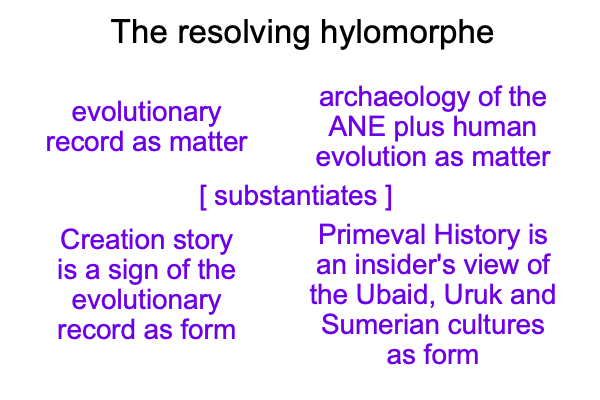
The civilizations of the ANE cannot see past a theoretical time point corresponding to the start of the Ubaid archaeological period in southern Mesopotamia.  They cannot see from our current Lebenswelt into the Lebenswelt that we evolved in.

0225 The first singularity is currently a hypothesis.

As further research is conducted with this hypothesis in mind, we may eventually feel confident that the Ubaid is the first culture in human evolution to practice speech-alone talk.  8800 years ago, all other cultures practice hand-speech talk, in continuity with the founding of our species 300,000 years ago.

Over a period of a few thousand years, these hand-speech talking cultures convert to speech-alone talk, after being exposed to speech-alone talking cultures.  Why do they adopt the new way of talking?  Hand-speech talk promotes constrained social complexity.  Speech-alone talk removes the constraints.  The semiotic qualities of hand-speech talk and speech-alone talk are hugely different.

0226 The above hylomorphes are resolutions in favor of the entanglement.

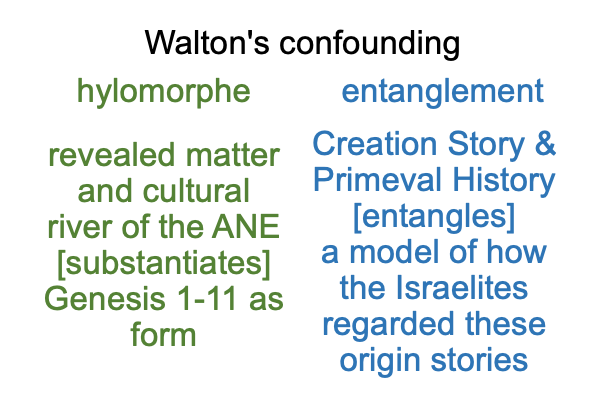
Against this prospect, Walton configures his own confounding.

0227 Will this be sufficient to stop the goofy, science-loving impulses of the Christian imagination?

I don’t think so, because even if Walton’s confounding resolves in favor of his entanglement, the form of the resulting hylomorphe will entangle the Christian imagination.

0228 The Tartu-Moscow School of Semiotics pulls up a fish from the depths of the Christian Slavic civilization.

They open the mouth of the fish.

What do they find?

The golden coin of entanglement.

0229 Welcome to the Fourth Age of Understanding, The Age of Triadic Relations.

0230 I thank John H. Walton for publishing this advance in the origins debate and I wish J. Harvey Walton the best.

10/4/25

Adam and Eve and Original Sin: The Subject Matters (Part 2 of 2)

AEOS 0011 Yes, there is more.

Here is another online course on the same subject matter.  All parts appear in Razie Mah’s blogs.  Click on the month, then scroll downwards.

0012 These are sample courses.  So, one may pick and choose points and reviews as one pleases.

Plus, there are lots of pictures.  Pictures can be interesting and informative.

How so?

For the most part, the pictures are diagrams of purely relational structures.

0013 What am I selling?

Three online courses that cover the topic of human evolution.  All are offered by Razie Mah.  All are available at smashwords and other e-book venues.  Merely purchase the e-books, print the pdf or read on a tablet.  Each point can be discussed.  The texts are designed to read and discuss.

A Course on the Human Niche contains the masterwork, plus four commentaries.  This course introduces the Lebenswelt that we evolved in.

A Course on An Archaeology of the Fall, contains the masterwork, plus outside reading (Paul’s letter to the Romans and Sura 5).  An instructor’s guide is available.  This course pertains to the hypothesis of the first singularity.

A Course in How To Define the Word “Religion” contains the masterwork, plus 10 primers.  This course concerns our current Lebenswelt, which is not the same as the Lebenswelt that we evolved in.  A “how-to” instruction appears in Razie Mah’s blog in December 2022.

0014 With that said, here is the second online course on this topic.

One: Looking at William Lane Craig’s Book (2021) “In Quest of the Historical Adam”

(September 31-1, 2022, 21 blogs, 120 points)

Two: Looking at John Walton’s Book (2015) “The Lost World of Adam and Eve”

(August 30-1, 2022, 22 blogs, 192 points)

Three: Looking at Andrew Kulokovsky’s Overview (2005) “The Bible and Hermeneutics”

(May 27-16, 2022, 10 blogs, 85 points)

Four: Looking at Carol Hill’s Article (2021) “Original Sin with Respect to Science”

(February 25-7, 2022, 15 blogs, 72 points)

Five: Looking at Roy Clouser’s Article (2021) “… Support of Carol Hill’s Reading…”

(March 8-1, 2022, 6 blogs, 34 points)

Six: Looking at Mark S. Smith’s Book (2019) “The Genesis of Good and Evil”

(January 31-13, 2022, 16 blogs, 100 points)

0015 Total: 90 blogs, 603 points, 10 hours at 1 minute per point.

Maybe, this online course lasts around 2 weeks.

Enjoy this sample and consider purchasing Razie Mah’s online courses.

07/31/25

Looking at Hugh Ross’s Book (2023) “Rescuing Inerrancy” (Part 1 of 25)

0001 The full title of the book before me is Rescuing Inerrancy: A Scientific Defense (2023, Reasons To Believe Press, Covina California).  The author, Hugh Ross, is an excellent writer and a Christian scientist.  The qualifier is crucial here, because biblical inerrancy is mysteriously conjunct the modern construct of scientific inerrancy.  “Conjunct” means “stuck with”.

0002 The book has both a greek and a semitic architecture.  As noted in The Instructor’s Guide to An Archaeology of the Fall (by Razie Mah, available at smashwords and other e-book venues), the two literary styles represent different types of recognition.

The greek argument presents a variety of opinions, weeds out the inadequate ones, then proclaims the one left standing, the winner.  One might call it “linear thinking”.  The greek style dominates the second half of the book (chapters 12 through 20), concluding with the proposal of a “model approach”.

The semitic style presents various rhetorical tricks, aiming to induce the reader to recognize a possibility.  Am I saying that the Bible is full of rhetorical tricks?  I suggest the reader look at the appendix of Ross’s book on that one.  Or, consider the Genesis use of the word, “day”, in the Creation Story.  The word leads to a flight of fancy, so to speak, asking the reader to recognize that the reported events are themselves, a flight of… what?… not of fancies, but of revelations… or significations… that become more and more esoteric (or hidden) even as they appear more and more exoteric (or obvious).

0003 What about Adam and Eve, fashioned from dust and rib, respectively?

Oh, they end up getting fooled by a talking snake.

0004 Christians are fine following the exoteric lessons and scratching their heads about some of the esoteric implications.

The problem is that Christians are stuck with the sciences.  Conjunct!  Science is all about truncated material and efficient causalities.  Truncated?  Scientific causalities are shorn of formal and final causation.  Formal and final causes are metaphysical (a step beyond physics) because they concern triadic relations.  It is like being able to account for all the motions (the truncated material and efficient causes) of a mechanical clock without acknowledging that the clock has a design (formal cause) and purpose (final cause)

And, the purpose has ‘something’ to do with us!

0005 The positivist intellect has a rule.  Metaphysics is not allowed.

So Christians are conjunct with a positivist intellect who has no idea that the purpose of the Genesis text may have something to do with us, right now, not as we once were at some time in the not-so-distant past.  The positivist intellect cannot consider that the first chapter of Genesis may be like a clock or whatever mechanical analogy one wants to use.  Is it a story designed to set the “time”?  The time of what?

Truncated material and efficient causalities cannot ideate what Christians observe (and sort of… measure, in the sense of “weighing”) in Scripture.  Christians struggle to discern what the early chapters of Genesis could possibly reveal.  Plus, those possibilities are not obvious at all.  Even a plain reading of these stories tells the inquirer, “A plain reading of this text is not enough.”

0006 The Chicago Statement on Biblical Hermeneutics, published in 1982, says as much.  Ross lists the relevant articles in chapter three.

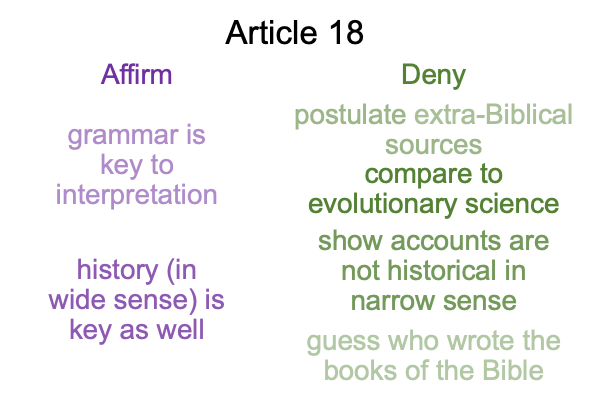
For example, in article eighteen, the convening theologians confirm that the text of Scripture is to be interpreted by grammatical and historical exegesis, so that Scripture is used to interpret Scripture.  Then, they reject the legitimacy of various modern quests, including postulating extra-Biblical civilizational sources, relativizing the text by comparing it to evolutionary science, demonstrating that the accounts are not “historical” in the modern sense of the word, and rejecting the Bible’s claims to authorship.

Here is a picture.

0007 I ask, “Are these theologians affirming that Genesis 1-11 confronts the reader with the possibility of ‘something’, and that ‘something’ is not obvious from a plain reading of the text?”

They say, “Look at the grammar.  Look at what the stories are saying in regards to history, in the widest sense of the term.”

0008 I ask, “Are these theologians denying that Genesis 1-11 can be assessed, compared to, and explained by scientific empirio-schematic inquiry?”

It sure looks that way.

And, that is a problem in a civilization where science appears triumphant.

07/1/25

Looking at Hugh Ross’s Book (2023) “Rescuing Inerrancy” (Part 25 of 25)

0211 This examination adds value to Ross’s project in five ways.

First, it introduces a history that encompasses the modern conundrum presented in this text.

Hugh Ross and the Reasons To Believe Team are actors in a theodrama that is at least 800 years old.

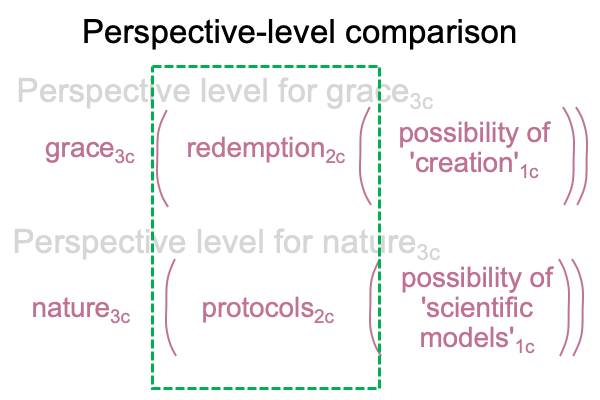
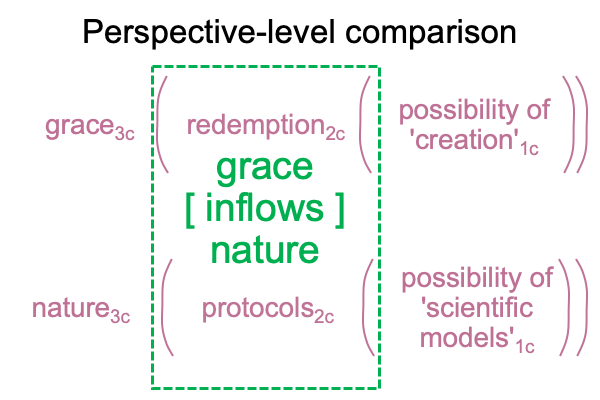
Plus, that theodrama is about to undergo a pivot that is captured in the following figure.

0212 Yes, the redemption2c offered by the party that exalts grace3c over nature3c and the protocols2c offered by the party that exalts nature3c over grace3c, are now entangled because, on the content level, the Creation Story is a sign of the evolutionary record and the Primeval History is an insider’s view of the start of our current Lebenswelt.

0212 Second, this examination offers a semiotic way to view what Ross is trying to articulate.  Theologians should be interested in sign-relations.  Scientists take sign-relations for granted.  Ross’s book is titled as if a scientific defense will rescue Biblical inerrancy.  This makes no sense unless its taken from a semiotic point of view.  Inerrancy draws the Bible, especially Genesis 1-11, into hitherto unimagined triadic relations with scientific inquiry.  The empirio-schematics of artistic concordism and the first singularity are variations of what ought to be for the Positivist’s judgment.

When, you think about it, signs tend to share certain characteristics with the term, “inerrancy”.  Every sign-vehicle stands for its sign-object in regards to its sign-interpretant.  Even if the interpretant is camouflage, the sign-relation purports to be flawless and honest in its own way.  Indeed, all signs are “inerrant” in the eyes of God.

0213 Third, this examination offers a way of appreciating how Ross’s efforts aesthetically derive from the Positivist’s and the empirio-schematic judgments.  Indeed, Ross’s project towers head and shoulder above other projects in the Venn diagram of science and religion because his aesthetics are one step away from the ways that scientists operate.

0214 Fourth, this examination offers a slightly different version of concordism than Ross.  Mah’s artistic version may assist Ross’s moderate version in future research.  In particular, I pray for a science book on the Earth’s evolutionary history to accompany Exercises in Artistic Concordism.  Wouldn’t that be fantastic?

Fifth, this examination offers a wonderful endpoint, in the form of a label for the single actuality implied by the intersection of redemption2c and protocols2c.  The early scholastics knew this label well.   And now, perhaps, the following dyad will be born again.

0215 My thanks to Hugh Ross and this team at Reasons To Believe for publishing a book worthy of examination.