09/30/26

Looking at Dr. D. Basak’s Book (2025) “Sumerian Mythology…”  (Part 1 of 20)

0001 The full title of the book before me is Sumerian Mythology, Ancient Civilizations, and the Epic Search For Humanity’s Origins.  That is a great title.  This publication is the 13th in a sequence of 37 books downloaded into the Amazon product line between the end of July, 2025, and the start of January, 2026.  This literary output is staggering.

0002 Plus, it raises a question in my mind.

How does one identify an artificial intelligence (AI) produced article or book?

0003 Every sentence is well constructed.  The text is highly segmented.

Are these clues?

0004 For example, the preface divides into A (5 subsections) and B (1 subsection).  Each subsection contains two paragraphs.  The preface also includes additional material, C, informing the reader what to expect, why this is essential reading, and how this qualifies for understanding.

Of course, this is standard textbook formatting.

However, the two clues, well-constructed sentences and high segmentation, still apply to the question at hand.

0005 Here are some other clue.

Flat statements contain no wordplay.  The entire book consists of (1) direct statements and (2) a negative followed by an affirmative.  No, I don’t mean to be negative, it is obviously better to be positive.

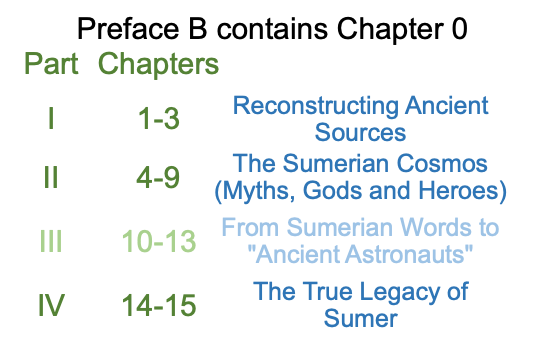
Fractal repetitions appear within the book’s organization.  For example, the preface’s B subsection constitutes (what may be called) “Chapter 0”, which recapitulates the topics of the subsequent 15 chapters.

0006 Here is a picture of the list of chapters.
0007 Even though the text itself does not state that it is AI generated, one may raise the question and ponder the clues. These clues do not prove an answer, one way or another.  But, they do raise another question.

If the work at hand is AI generated, then what does that imply?

0008 The postmodern scholastic will start with Aristotle’s hylomorphe, which is an exemplar of Peirce’s category of secondness.  These concepts may be derived from Razie Mah’s e-books A Primer on the Category-Based Nested Form and A Primer on Sensible and Social Construction.

The book that I have before me is a thing.  A thing is composed of two contiguous real elements.  For Aristotle, the real elements are matter and form.  The contiguity is placed in brackets for clear nomenclature.

0009 Here is a diagram.
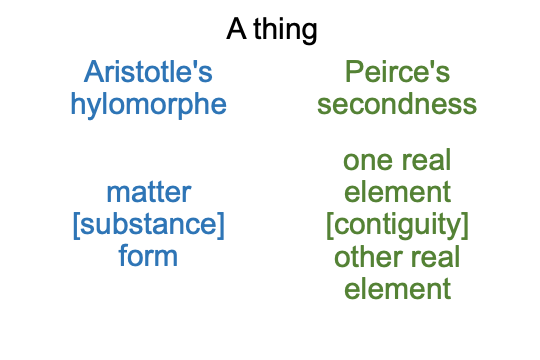
0010 My question as to whether the book is AI generated and what that implies is called “an entanglement”.  The following diagram is sort of confusing (something that an AI would avoid), because two expressions are linked in that they have the same form. 
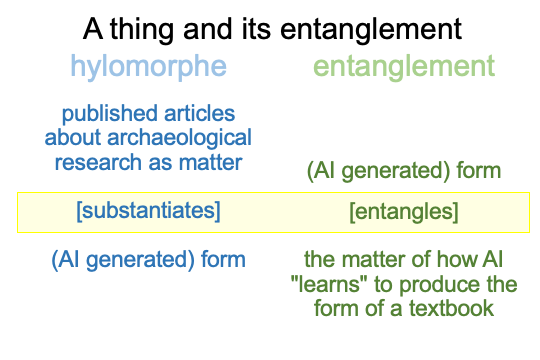
0011 In the hylomorphe, describing the book before me, the phrase, “AI generated”, is put into parenthesis because the question remains open.  The form is a book. 

In the second (upside down, so to speak) thing, the (AI generated) form entangles another matter.   That “other matter” is a question about how the AI learns what it is going to say.  Obviously, the answer will include the originating matter.  One may wonder, “What else?”

A thing and its entanglement consists in two matters (one originating and one entangled) and one form.  The technical name for this pair is “confounding”.

0012 With the above confounding in mind, I may consider Chapter 1.

Here is a list of the learning objectives.
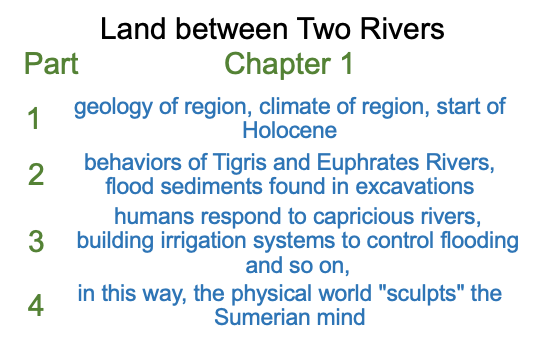
0013 This list suggests that the search for humanity’s origins, involving the Sumerian civilization and its mythology, arises in response to the precarious and fertile landscape between the Tigris and Euphrates Rivers.  Annual floods from both rivers deliver silt.  They can also deliver floods and destruction.

Excavations at locations in southern Mesopotamia find strata associated to floods during the Ubaid, Uruk, and Sumerian Dynastic archaeological periods.

0014 The irrigation systems control the rivers and redirect their water into productive agricultural uses.  These systems require large scale labor under central (yet local) authority.

0015 To me, these conclusions are precisely what an AI program would deliver, after processing the literature (web-pages) cited at the end of the chapter.  But, these are my suspicions.  I have no proof.

0016 However, I can construct a confounding.  There is one form, the land between the Tigris and Euphrates Rivers.  These rivers are subject to annual crests that deposit silt and may cause catastrophic flooding.  The originating matter is the geology and climate of southern Mesopotamia during the Ubaid, Uruk and Early Sumerian Dynastic archaeological periods.  The entangled matter is the mind of the Sumerian people, who celebrate the mythology that this book addresses.

0017 Here is a picture of the confounding.
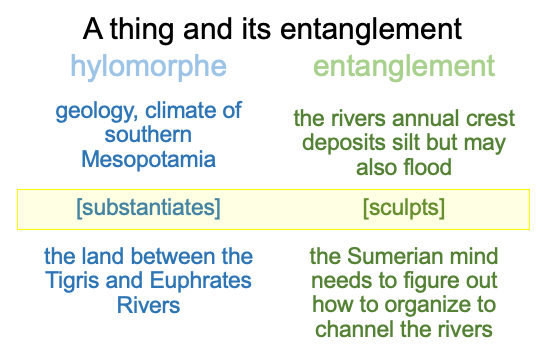
0018 The confounding leaves this reader with a hypothesis.  Sumerian mythology is an ideological component of an organizational imperative.  The Sumerians must figure out how to organize to channel the rivers in order to irrigate their fields and to avoid catastrophic flooding.

In the process, the organizational imperative captures the Sumerian imagination.
09/29/26

Looking at Jess Beck, et al.’s Article (2026) “Changing the Landscape of Archaeological Publishing”   (Part 2 of 20)

0019 Why am I concerned about AI?

0020 Well, I have another manuscript before me.  The article appears in Current Anthropology 67(1), pages 155-180 (https://doi.org/10.1086/739789).  The essay goes online in February, 2026, which is around the time when Dr. D. Basak finishes downloading his 37 books on various topics in human evolution, origins and archaeology.  Surely, none of the 23 authors of the proclamation in Current Anthropology know about Dr. Basak’s efforts.  Artificial intelligence is barely mentioned.

0021 If AI is not the future of publishing in Archaeology, then what is this lead essay about?

Young academics in the field of archaeology are getting crushed by their dual mandates of teaching and research.

0022 The article reminds me of when I heard about the beveled-rim bowl of Uruk.  This standardized hastily spun pottery found popularity as towns were becoming cities.  Some speculate that the bevel-rimmed bowl was used to measure rations of grains.

0023 The exploitation of labor by a religious and political system is not new.  Archaeologists, of all experts, should know that.  The irony of the contemporary complaints is startling.  Postmodern academics are caught in the same dilemma as the laborers who dredged canals or cast bricks of mud and clay, thousands of years ago.

0024 The first sentence of the article reads like a manifesto.  It is time to change academic publishing in archaeology.

If Dr. D. Basak has his way, it has already changed.

0025 The complaint is serious.  Twenty-three authors sign the manifesto.  These include Jess Beck (University of Ireland), Rowan Flad (Peabody Museum, Harvard University), Bridget Alex (Peabody Museum,), Ari Caramanic (Vanderbilt), Andre Costopoulis (University of Alberta), Nicholas Kawa (Ohio State University), Ben Marwick (University of Washington), Christina Warinner (Peabody Museum), Lewis Borck (University of Oklahoma), Kristina Douglas (Columbia Climate School), Alan Farahani (University of California, Los Angeles), Mackinley FitzPatrick (Peabody Museum), Lars Fogelin (University of Arizona), Laura F. Heath-Stout (Stanford), Scott R. Hutson (University of Kentucky), Matthew Magnani and Natalia Magnani (University of Maine), Ana Cecilia Mauricio (Pontificia Universidad Catolica de Peru), Lisa Overholtzer (McGill University), Mattaus Rest (University of Fribourg), Daniel Scott Souleles (Copenhagen Business School) and Renata Verdun de Silva Carmo (Universidade Federal do Rio de Janeiro).

I type each author’s name because each deserves a citation, adding to a number that… um… administrators might use in their promotion considerations.

0026 A citation is like a scoop of grain using a bevel-rimmed bowl.

Ironically, these academics are the winners in a “publications arms-race”.  They teach.  They write.  They review.  They work over forty hours per week.  Are they investigating what they love to study?  Do they feel that they are flourishing?  Or are they keeping the canals clear of sediments and the dikes capable of withstanding turbulent waters?

0027 What are these academics hoping for?

They hope that their activities further their academic careers.  Their rimmed-bowls of citations carry the promise of security.  Some call it “tenure”.  Some call it a false hope amidst economic turmoil.

0028 At the end of the introduction, the authors elevate three “tensions”.

First (1), the theory of publishing to communicate results to other scholars clashes with the practical incentives to please hiring, promotion and granting committees.

Second (2), on one hand, papers are supposed to be presentations of knowledge.  On the other hand, papers are products that publishing corporations leverage for profit.  There is a price that the author (or the author’s institution) must pay in order to establish open access.  Otherwise, the article goes behind a paywall.

Third (3), the academic must teach classes (and perform other pedagogical duties), which are not as valued (by the aforementioned committees) as productive (paper publishing) research.

0029 To me, by the end of the introduction, these young upcoming academics in archaeology articulate the same complaints as the corvee laborers during the Uruk period, saying (more or less), “We are compelled to labor in an exploitative system that extracts profits without compensation, restricts research results from the public and biases stories about the human past.”

0030 Biased stories?

Yeah, look at chapter 1 of Dr. D. Basak’s book, which could serve as a textbook for any classroom on the subject of Sumerian mythology, ancient civilizations, and the epic quest for the origins of humanity.

09/8/26

Looking at Dr. D. Basak’s Book (2025) “Sumerian Mythology…”  (Part 20 of 20)

0249 Chapters 11, 12 and 13 are devoted to debunking an agenda, called “the ancient astronaut theory”, proposed by various hucksters starting in the 1950s.  This theory is multifaceted, since there is more than one proponent.  Basak’s book says that the theory sweeps into public popularity because of the uncertainty following the second battle among the Enlightenment gods, the hot war among fraternal ideologies (1938-1945 AD) and leading into the third battle among the Enlightenment gods, the cold war among materialist ideologies (1945-1989).

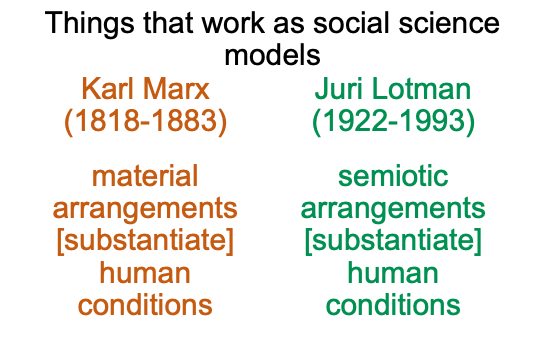
0250 Against this interpretation, which explains this social phenomenon in terms of a model where material arrangements after the Second World War and the start of the Cold War [substantiate] conditions ripe for scam-ideas about ancient civilizations, I place a Lotmanist suggestion that the social popularity of the ancient astronaut theories is accounted for by the inadequacies of Marxist-interpretations of archaeological research into the Neolithic period.

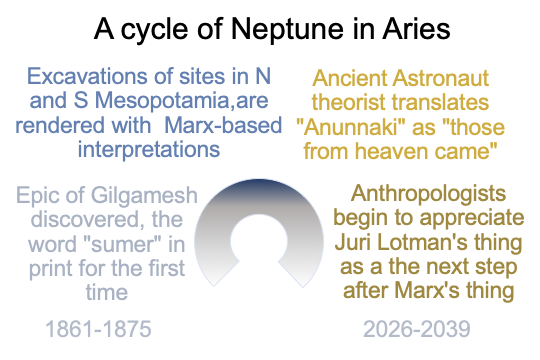
0251 Here is a picture of the framework of the latest cycle of Neptune in Aries.

Highly successful excavations by Western archaeologists offer the promise of coming to terms with the rise of ancient civilizations, based on Marxists formulations.

The Marxist thing does not quite do the job, so alternate theories are proposed by hucksters anticipating an explanatory breakthrough.  Basak’s exercise in debunking the very entertaining alternatives only replays the Marxist thing. Basak relies on the Marxist thing to debunk the alternatives that arose from the lack of explanatory power of the model that material arrangements [substantiate] human conditions.

Now, anthropologists are starting to realize that all those people who entertained the now-debunked “ancient astronaut theory” were not as stupid as the Marxist thing presumes.

0251 Once again, Razie Mah’s four part blog, Looking at Melinda A. Zeder’s Article (2025) “Unpacking the Neolithic”, offers insights.  The results of anthropological research into the so-called “Neolithic” does not… indeed, cannot… account for another trend hidden within the data.  That trend is towards unconstrained social complexity.  Basak’s AI program (my speculation, of course) trains only on results and discussions produced by researchers interested in looking for the material arrangements that substantiate neolithic conditions.  They cannot account for a change in semiotic practices.  They cannot account for what Razie Mah’s hypothesis of the first singularity suggests.

0252 Therefore, why not postulate ancient astronauts?

Surely, ancient monumental constructions, such as pyramids, stone circles, and tracks of figures that can only be seen from the sky indicate ways that civilizing humans communicate with these alien beings.

0253 If this is not a cry for a semiotic accounting for the emergence of unconstrained social complexity, I don’t know what is.

0254 Chapter 14 offers a standard summary of the achievements of ancient Sumeria.

0255 Chapter 15 returns to the topic of the Sumerian creation myths.  Once again, the text re-iterates established points.  On one hand, the Marxist thing can provide an explanation that cannot be challenged because… well… it is supposedly just like a mathematical or mechanical natural science model.  On the other hand, the Marxist thing cannot account for the emergence of unconstrained social complexity in southern Mesopotamia.

Lotman’s thing can.

0256 Here is a picture.

0257 Although this pair of options may appear stunningly simplistic, the ancient astronaut theory shows that stunningly simplistic can work.  It can offer an off-ramp to the current academic highway of a publication-based arms race, where young professional archaeologists struggle to pass through the substance called “tenure” only to realize that they have merely passed from antithesis to thesis (see points 0124-0128).

0258 Beck et al.’s manifesto, “Changing the Landscape of Archaeological Publishing” (Current Anthropology 67(1) (2026), https://doi.org/10.1086/739789), is well worth contemplating as a marker for the end of one Neptune in Aries spiral and the beginning of another.